The idea
There are not 36 minor scales to learn. There are 12 minor scales, each with two places near the top where a note can move.
Natural minor is the raw material. Harmonic minor raises the seventh, which manufactures a leading tone and, as a byproduct, the augmented second between the sixth and seventh that gives the scale its particular smell. Melodic minor raises the sixth as well, which smooths that gap out on the way up. Classical practice lowers both again coming down; jazz and modern practice usually does not, and keeps the raised form in both directions. Play it both ways and know which one you are doing.
The blues scale is a different kind of object and deserves saying plainly. It is six notes, it is not diatonic, and it is the one scale in this lesson that will make you sound worse if you learn it and then use it. Greg's warning is the right one to attach at the start, from the B flat blues video at [01:57]: "I would recommend avoiding just blues, it's always cheesy... you want to be expressing your ideas and your ideas are very rarely just a scale going from the top to the bottom, it's gonna be like utilizing the notes from that scale."
Learn the fingering so the scale is available. Then almost never play it end to end.
Watch

Fingering for Bb Blues Scale
- [00:33] The problem stated: blues scales "are particularly difficult when you're starting on the Black Keys." That is the whole reason this lesson needs its own chart.
- [00:42] His doctrine, verbatim: "I hate crossing my thumb under when it's from a black key to a black key and I try to structure my fingerings so that whenever possible going from of the black key to the white key is when you cross your thumb."
- At the top of the scale the thumb crosses over to continue upward, or the fourth finger ends the run.
- The musical caution at the end is not an aside. Take it as the assignment's constraint.
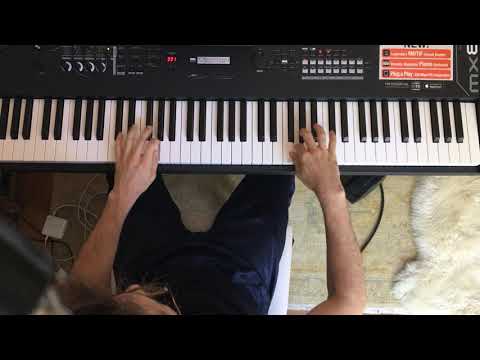
Piano Fingerings for Scales
- The organizing rule for everything below: "the mode of any given key has the fingering of its relative major." Natural minor is a mode of its relative major, so you derive its fingering instead of memorizing it.
- Crossings restated as efficiency: crossing down puts the thumb under, crossing up sends another finger over after the thumb.
- Tempo, again: start at 40 and work up, with a metronome. He plays faster in the video only to demonstrate, and says so.
- He is explicit about where these numbers come from: "these fingering aren't something that I know of in a specific book. But this is the most efficient fingering for any scale." That is the standard you hold the blues chart below to.
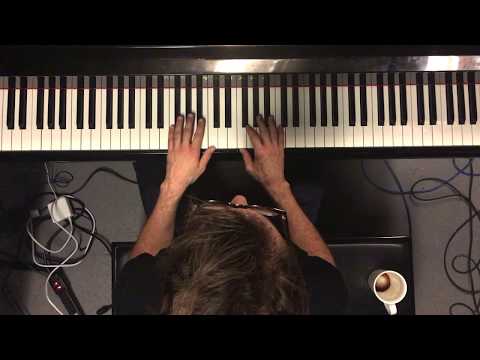
How to play all modes on the piano
- [01:27] Thumb-under mechanics. Move the hand as little as possible, keep the elbow still, because if you move the hand and then try to go faster you get stuck.
- [11:17] Posture, if A2 has not stuck yet: feet squarely on the floor, legs relaxed and slightly apart, and at [11:54] and [12:11] the shoulders directly over the hip bones with the weight resting on them.
- [16:34] The rule that produces half the fingerings below: "any time that you want to go upwards to a black note from a white note it makes sense to cross over." He adds that other techniques exist and this is the one that makes the most sense to him.
- [03:43] The dose that built his technique: at 18 he spent "at least two hours every day doing 40 beats per minute," and at [04:04] admits some nights ran to eight. You are doing 30 to 60 minutes total, so this will take longer, and that is fine.

Jazz Scales to play over a Blues
- Watch this now so you know what the blues scale is competing with. At [01:01] and [04:59] Greg's device over a dominant chord is a superimposition starting a half step above the root, a minor scale with a major sixth and seventh, because those are the tension notes that lead to the IV.
- [01:56] The phrasing rule that applies to every scale in this lesson: "make sure you're starting somewhere and ending somewhere, don't just play a bunch of random directions, have a goal for the end of your phrase."
- [06:28] He admits on camera that applying one device to every chord "sounds a little disjunct when I do it now." Note the honesty and copy the habit.

Practicing SLOW!!!
- the tempo law, still 40, still non-negotiable, now across 48 new scales
At the piano
Same rules as A1. Metronome at 40, one note per click, hands separate before hands together, four octaves, and stop the moment tension appears. Do not raise the tempo on the minors to catch up with your majors; you are adding 48 scales, and the tempo is what keeps the fingering correct while you do it.
The relative-major shortcut. Every natural minor scale contains exactly the notes of the major scale a minor third above it. A minor is the white keys, like C major. C minor has the notes of E flat major. F sharp minor has the notes of A major. That relationship is why the chart below has so few distinct shapes: once the thumb has to land on the white keys of a given seven-note collection, most of the decisions are already made.
Harmonic and melodic minor use the natural-minor fingering in every key, with two exceptions, both in the right hand and both for the same reason: the raised note lands under a thumb and turns black.
- F sharp minor, melodic, right hand. Natural fingering puts the thumb on D. Melodic minor raises D to D sharp, so use
2 3 1 2 3 4 1 2, which moves the thumbs to A and E sharp (the key F), both white. - C sharp minor, melodic, right hand. Natural fingering puts the thumb on A. Melodic minor raises A to A sharp, so use
3 4 1 2 3 4 1 2, which moves the thumbs to E and B sharp (the key C), both white.
Everywhere else, check the raised sixth and seventh against your thumb positions and you will find they land under fingers 2, 3 or 4, and nothing has to change. G sharp minor looks like a third exception and is not: its raised seventh is F double sharp, which is the white key G, and its raised sixth is E sharp, which is the white key F. Both make the thumb's life easier, not harder.
The fingerings, all 12 minor scales
Ascending, one octave, thumb is 1, descending is the same numbers backward. These match the published natural-minor charts on pianoscales.org key for key in both hands, and with the two exceptions noted above they serve harmonic and melodic minor as well.
KEY        RIGHT HAND            LEFT HAND
A  min     1 2 3 1 2 3 4 5       5 4 3 2 1 3 2 1
E  min     1 2 3 1 2 3 4 5       5 4 3 2 1 3 2 1
B  min     1 2 3 1 2 3 4 5       4 3 2 1 4 3 2 1
F# min     2 3 1 2 3 1 2 3       4 3 2 1 3 2 1 4
C# min     3 4 1 2 3 1 2 3       3 2 1 4 3 2 1 3
G# min     3 4 1 2 3 1 2 3       3 2 1 3 2 1 4 3   (natural)
G# min     3 4 1 2 3 1 2 3       3 2 1 4 3 2 1 3   (harmonic/melodic)
Eb min     3 1 2 3 4 1 2 3       2 1 4 3 2 1 3 2
Bb min     2 1 2 3 1 2 3 4       2 1 3 2 1 4 3 2
F  min     1 2 3 4 1 2 3 4       5 4 3 2 1 3 2 1
C  min     1 2 3 1 2 3 4 5       5 4 3 2 1 3 2 1
G  min     1 2 3 1 2 3 4 5       5 4 3 2 1 3 2 1
D  min     1 2 3 1 2 3 4 5       5 4 3 2 1 3 2 1

Melodic-minor right-hand exceptions:
F# min melodic RH   2 3 1 2 3 4 1 2
C# min melodic RH   3 4 1 2 3 4 1 2
Five of the twelve, A, E, C, G and D, take the plain shape in both hands, which means a third of this chart is already in your fingers from A1. F minor takes the plain left hand and F major's right hand, 1 2 3 4 1 2 3 4, for the same reason F major does. B minor keeps the plain right hand and takes B major's left hand. The five black-key minors, F sharp, C sharp, G sharp, E flat and B flat, are where the work is.
G sharp minor is the one key where the natural and harmonic left hands genuinely differ, because raising the seventh turns F sharp into the white key G, and the thumb moves to take it.
The fingerings, all 12 blues scales
The blues scale is 1, ♭3, 4, ♭5, 5, ♭7. Six notes plus the octave is seven notes to a hand with five fingers, so there are two hand positions per octave and one crossing in each direction, every time.
There is no authoritative published chart for this, and Greg says as much about his scale fingerings generally: "these fingering aren't something that I know of in a specific book. But this is the most efficient fingering for any scale." What follows is derived from his stated rule, thumb crosses under going from a black key to a white key, checked at every crossing.
KEY   NOTES (ascending)        RIGHT HAND       LEFT HAND
C     C  Eb F  Gb G  Bb C      1 2 3 4 1 2 1    5 4 3 2 1 3 2
Db    Db E  Gb G  Ab B  Db     3 1 2 3 4 1 2    4 3 2 1 4 3 2
D     D  F  G  Ab A  C  D      1 2 3 4 1 2 1    5 4 3 2 1 3 2
Eb    Eb Gb Ab A  Bb Db Eb     2 3 4 1 2 3 1    4 3 2 1 4 3 2
E     E  G  A  Bb B  D  E      1 2 3 4 1 2 1    5 4 3 2 1 3 2
F     F  Ab Bb B  C  Eb F      1 2 3 4 1 2 1    5 4 3 2 1 3 2
Gb    Gb A  B  C  Db E  Gb     2 3 1 2 3 1 2    4 3 2 1 4 3 2
G     G  Bb C  Db D  F  G      1 2 3 4 1 2 1    5 4 3 2 1 3 2
Ab    Ab B  Db D  Eb Gb Ab     2 1 2 3 4 1 2    4 3 2 1 4 3 2
A     A  C  D  Eb E  G  A      1 2 3 4 1 2 1    5 4 3 2 1 3 2
Bb    Bb Db Eb E  F  Ab Bb     2 3 4 1 2 3 1    5 4 3 2 1 3 2
B     B  D  E  F  F# A  B      1 2 3 1 2 3 1    4 3 2 1 3 2 1
Check these yourself rather than trusting them, because checking them is the exercise. The test is one line: name every note your thumb plays and confirm it is white. In this chart it is, in every key in both hands, except in three right hands where the scale makes it impossible: E flat, whose only white note is A; A flat, where the two white notes sit two scale steps apart; and B flat, whose two white notes, E and F, are next to each other in the scale and so cannot hold two separate hand positions apart. In those three the thumb takes one black key per octave. That is exactly the difficulty Greg names in the video, and there is no fingering that avoids it.
Two of these are worth a second look. B blues has five white notes out of six and takes the plainest fingering of all twelve. G flat blues has the thumb on B and E, which is the same solution G flat major uses, for the same reason.
Exercises
1. Natural minor, the six plain keys
Do. A, E, C, G, D and F natural minor, four octaves, hands separate then together, at 40. Say the relative major out loud before each one.
Done when: all six hands together at 40 with no hesitation, and you can name the relative major of any minor key in under a second.
2. The five black-key minors
Do. F sharp, C sharp, G sharp and E flat minor, plus B flat minor, one key every two days, hands separate for the first day and together on the second. Write the fingering out before you play it.
Done when: your written fingerings match the chart, and each scale is clean hands together, four octaves, at 40.
3. The three forms, one key at a time
Do. In one key, play natural, then harmonic, then melodic, back to back without stopping, four octaves each. Then the same key with melodic descending as natural, the classical form, and again with the raised form both directions, the modern form. Listen to the difference at the top of the scale.
Done when: you can play all three forms in all twelve keys, and you can hear which one is being played without looking.
4. Thumb audit
Do. For every scale in this lesson, play it once at half speed and say out loud the name of each note the thumb plays. Log any thumb that lands on a black key.
Done when: the log contains exactly three entries, all right-hand blues scales, in E flat, A flat and B flat.
5. Blues fingering, derived before it is read
Do. Pick five keys you have not played yet. Write out the six notes, mark the white ones, decide where the thumbs go, then write the fingering. Only then compare to the chart above.
Done when: your five agree with the chart, or you can say in one sentence why yours is better.
6. The anti-run exercise
Do. Over a B flat blues backing track, play eight bars using the blues scale but never more than four consecutive scale notes in a row. Then the same in F, then in C.
Done when: nothing in the chorus reads as a straight run from top to bottom, and every phrase has an audible ending.
Checkpoint
Before A4, demonstrate:
- All 36 minor scales, four octaves, hands together, at 40, no hesitation.
- All 12 blues scales, four octaves, hands together, at 40.
- The two melodic-minor right-hand exceptions, played and explained.
- Your thumb audit log, with exactly three black-key entries.
- Eight bars of blues in three keys with no scale run in any of them.
Read
- Source course, Lesson 2, on the interval as expressive force. Read it against the raised sixth and seventh: the same seven-note collection changes character because two intervals moved, which is the smallest version of the argument the whole course is built on.
- Sándor, On Piano Playing, chapter 5. Second pass, now for the thumb specifically. His framing of the crossing as a lateral shift of the arm is the fix for the black-key crossings in E flat and A flat blues. Archive
- Sakai 2006, the slow-down protocol. Twenty professional pianists with focal dystonia were treated by reducing tempo until the faulty movement disappeared, holding it thirty minutes a day for two weeks, then raising speed 10 to 20% every two weeks. All twenty improved. That is the clinical version of what Greg means by 40 BPM, and it is worth knowing that the treatment for a serious neurological problem and the method for learning a scale are the same method. DOI
- The Weekly Piano fingering chart from the A1 reading list, for cross-checking your written minors.