The idea
In a Classical movement, harmony carries the form. Sections sit where they do because a key was established, dissolved, replaced and restored. The source course states it flatly. The form is not a container music is poured into, the form is the music (Source course, Lesson 12).
In much of the music you want to write, harmony cannot carry the form, because it is a four-chord loop that resolves nothing. Something else does the work, usually rhythm, texture and register.
Two bodies of theory grew up around this. Drew Nobile's book argues that form in rock is still harmony, looked at correctly. Nicole Biamonte's article argues that metric dissonance does formal work in its own right. They look at different loads on the same cable, and once you see both you stop writing sections that begin because the last one stopped.
Watch

Good Time and Feel: The Time Stack
- [01:43] "feel is really time." The four layers at [09:14] are consistency, precision, flexibility, subtlety.
- [06:18] flexibility against a DAW grid, quarter notes deliberately late, the lateness the same distance every time. Precision and lateness are not opposites.

Good Time and Feel: Swing Demystified
- [03:33] a Bach passage on the grid as straight eighths, then the grid switched to triplets, jazz eighths landing on the third of each triplet. One recording, two rulers.
- [07:55] the finding that matters here. When his eighths are straighter he lays the line back behind the beat, and on the grid the notes almost even out to straight while sitting behind the bar line. What you hear and what you measure disagree, and neither is wrong.
Chord progressions with 7th chords
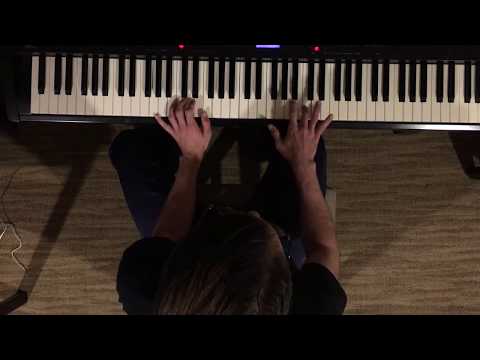
- [16:51] the "Closer" progression Greg played on the VMAs, flat six to flat seven to minor one to flat six in F minor, in tenths with an ostinato on top. Hold it for the argument below.
Listen
Pink Floyd, "Money." Pass one: tap the bass riff and feel for where the bar begins. Pass two: 2:50 to 3:15 with a hand on your knee, feeling what changes at 3:00. Pass five: read the two accounts below, then listen again with each in mind.
Jones's dissertation gives the analytical spine. Across Dark Side the harmony is a functional dominant-tonic axis globally while individual songs are often modal, and that juxtaposition is the album's driving conflict. On "Money," the cash-register loop's cycle of strong and weak beats repeats every seven pulses, the song is tonal and centred on B in a minor framework, and a real F-sharp dominant truly tonicises a single note for the first time on the album. Each A section is tonal but metrically dissonant. Then at 3:00 the metric dissonance resolves and the meter becomes a regular quadruple, and at that same moment the harmony stops being truly tonal and turns modal, with a Phrygian-coloured C to B bass descent.
Read that again, because it is the lesson. The two parameters are traded against each other. When the rhythm settles, the harmony leaves. The piece never lets both be stable at once, and that keeps it moving.
Gustar adds a mechanical point. The anticipated eighth beat of each bar of the bass line is actually the first note of the next bar, so the seven comes from elision rather than counting. His wider finding is that septuple time might occur in no more than around 0.01 per cent of Western music.
Queen, "We Are the Champions." Nobile's worked example. A C minor verse functions as a secondary area resolving to the global F major tonic at the chorus. Hear the chorus arrival as a resolution rather than a change of section.
Rush, "Freewill." Bowman has the verse as voice, guitar and bass in unison outlining F Lydian, shifting among groupings of 3/4 and 4/4. Biamonte reads the same verse as eighth-note grouping dissonances. Listen for both. You will hear one more easily, and which one says something about you.
The Who, "I Can't Explain," and the Beatles, "The Night Before." Two songs Everett dates precisely in the arrival of flat-seven to four to one. Listen, then decide, before reading below, whether it sounds like a mode or a chain of falling fifths.
Mozart, K. 550, recapitulation only. Your control sample. Harmony does all the formal work, meter none.
The comparison
Two theories of what makes a section a section.
Nobile: form is harmony. His scope is small-r rock from 1960 to 1991, and his slogan, after Hepokoski and Darcy and Schmalfeldt, is that form is something a song does rather than something it is. His keystone is the functional circuit, T to PD to D to T, spanning a formal unit, and following Caplin he requires a cadence to coincide with a circuit's completion. He distinguishes sectional verses from initiating verses, and sectional, continuation and telos choruses. Tonic prolongation happens three ways, a sustained chord, a chord shuttle, or a chord loop. His verse-prechorus-chorus layout spreads one circuit across three sections, the cadential tonic arriving at the chorus, the telos principle.
Biamonte: meter does formal work. Her apparatus comes from Krebs, separating displacement dissonance from grouping dissonance, adding Waters's measure-preserving against tactus-preserving distinction and London's non-isochronous meters. Memorise her six formal functions. Initiating dissonance, cadential hemiola, fragmentary link, sectional demarcation, dissonant frame, dissonant middle section. Sectional demarcation is the crucial one, naming a boundary the harmony did not mark.
The exact parallel. Both are Classical theories in modern clothes. Nobile's functional circuit is Lesson 15's tonic-dominant-tonic dramatisation shrunk to a verse. Biamonte's apparatus descends from Krebs's Fantasy Pieces on Schumann, and she says so. The cadential hemiola is the Classical device, unchanged in function.
Where Nobile breaks. What makes T to PD to D to T binding in common practice is the leading tone and its cadential obligation. Much rock has neither. Nobile has to stipulate the cadence rule rather than derive it, and the apparatus rests on a Schenkerian prolongation model. Barna's review criticises that dependency, plus the sidelining of rhythm, text and timbre. With no functional dominant, Nobile gives you a vocabulary and not a mechanism.
Where Biamonte breaks. In Schumann a metric dissonance resolves inside a notated hierarchy the composer controls. In rock the consonant layer is a groove held in real time by a rhythm section, so resolution is performative rather than notational. No page to appeal to, which is why competent analysts hear one passage two ways.
Argument one: what is flat-seven to four to one? Everett says chromatic, a descending-fourths sequence parallel to an applied-dominant chain, establishing neither scale nor tonal centre, and he dates its arrival precisely. The Four Tops' "Baby I Need Your Loving" in late summer 1964, then in the first three months of 1965 Martha and the Vandellas' "Nowhere to Run," the Who's "I Can't Explain," the Rolling Stones' "The Last Time," and the Beatles' "The Night Before." Biamonte says modal, the double-plagal pattern, alongside the Aeolian flat-six to flat-seven to one. The disagreement is about what a chord succession fundamentally is, a scale coloured or a sequence run. Play Greg's "Closer" loop and you are playing the Aeolian version of the argument.
Argument two: "Freewill." Bowman hears bar-level alternation of 3/4 and 4/4. Biamonte hears eighth-note grouping dissonance. Neither is a transcription error. They describe different metric levels of the same passage, which is the mature version of every argument about time signatures you will ever have.
What you steal from each. From Nobile, asking what a section's harmonic function is, and the telos principle, putting the arrival at the start of the section it belongs to. From Biamonte, the six functions and permission to build a boundary out of meter. From both, naming which parameter is load-bearing before you write a bar.
At the piano
Make a boundary four ways over one loop. Set up the "Closer" loop in F minor, flat six to flat seven to minor one, in tenths, one bar each. Play sixteen bars, then mark a section boundary at bar 17 using each of these in turn and nothing else:
- Harmony. A cadence, C7 to F minor.
- Meter. Two bars of 3/4 before the new section, Biamonte's cadential hemiola doing the job alone.
- Displacement. Move the left-hand pattern one eighth earlier and keep it there eight bars, an initiating dissonance that settles.
- Register and texture. Change only the octave and the number of voices.
Play all four for a listener who cannot see your hands and ask which read as new sections.
The Money trade. Build a riff in seven that is harmonically clear, a minor tonality with a real dominant, and play it sixteen bars. Then move to plain 4/4 whose harmony is modal with no dominant. Cross the two parameters at the same instant. That is the 3:00 move in "Money."
Elision, practised. Play a bass line of eight eighth notes, then delete the eighth and let the next bar's first note fall where it would have been. Slowly enough to feel the seven appear without counting.
Left hand. Root and tenth, or root and fifth, kept simple so the right hand can be wrong on purpose.
Exercises
1. Load-bearing audit
Do. Take ten pieces you love, at least four instrumental. For each, name in one sentence which parameter creates the section boundaries, harmony, meter, texture, register or dynamics.
Done when: the list holds at least three different answers and one entry you had to hear three times to decide.
2. Four boundaries, one loop
Do. The four-boundary exercise above, recorded.
Done when: a listener who cannot see you identifies all four and ranks them strongest to weakest.
3. Biamonte's six, found in the wild
Do. Find a recorded example of each of her six functions, with artist, track and timestamp.
Done when: you have six timestamps and can play each and name the function.
4. The parameter trade
Do. Write two minutes in which rhythm and harmony are never both stable. When the meter settles the harmony leaves, when the harmony settles the meter destabilises. At least three crossings.
Done when: all three crossings are marked on the score and a listener points at two unprompted.
5. The disagreement, refereed
Do. Transcribe eight bars of the "Freewill" verse twice, once as bar-level alternation of 3/4 and 4/4, once as eighth-note grouping dissonance over a fixed meter. Play both from your own notation.
Done when: both produce the same sound and you can say in two sentences why neither is wrong.
6. The circuit, transposed
Do. Take one verse-prechorus-chorus song you know well and map it as Nobile would, marking where tonic function ends, where predominant and dominant occur, and where the cadential tonic arrives. Then say whether the telos principle holds.
Done when: the map is on paper with a one-sentence verdict, including the honest verdict that the model does not fit.
Compose
Write four to five minutes in two halves that argue with each other.
The first half is governed by harmony. Sections begin because a harmonic function completes. Use a real cadence twice and mark both on the score. Meter stays regular and does no formal work.
The second half uses the same material and is governed by meter. The harmony is one loop or shuttle that never resolves. Every boundary comes from one of Biamonte's six functions, at least three different ones, each labelled on the score.
The join happens once, in one bar, and must be audible.
Then write half a page. Which half is better, and why? If it is the second, say what that tells you about the music you want to write.
Checkpoint
- Play the four-boundary exercise and have a listener rank them.
- Hand over the ten-piece audit.
- Play the "Money" parameter trade and name what changes in each hand.
- State Everett's and Biamonte's positions on flat-seven to four to one, and the dates Everett attaches to its arrival.
- Explain the Bowman and Biamonte disagreement about "Freewill" without accusing either of an error.
- Hand over the two-half composition with labelled boundaries and the written verdict.
Read
- Drew Nobile, Form as Harmony in Rock Music (Oxford University Press, 2020). The introduction and the "We Are the Champions" chapter. Then Alyssa Barna's review, https://doi.org/10.30535/mto.28.1.10, so you meet the criticism alongside the theory.
- Nicole Biamonte, "Formal Functions of Metric Dissonance in Rock Music" (Music Theory Online 20/2, 2014), https://www.mtosmt.org/issues/mto.14.20.2/mto.14.20.2.biamonte.html. All of it. Take the six functions into your notebook.
- Walter Everett, "Making Sense of Rock's Tonal Systems" (Music Theory Online 10/4, 2004), https://www.mtosmt.org/issues/mto.04.10.4/mto.04.10.4.w_everett.html. The systems and the flat-seven argument. His Type 2 could not be verified from the prose, because that table is an image, so do not cite a Type 2 description to him.
- Christopher Everett Jones, "Tear Down the Wall" (DMA diss., West Virginia University, 2017), https://researchrepository.wvu.edu/etd/7098/. The "Money" section, with the recording playing.
- Andrew Gustar, "The Closest Thing to Crazy" (Journal of the Royal Musical Association 137/2, 2012), https://doi.org/10.1080/02690403.2012.717472. The elision reading of "Money" and the septuple-time rarity claim.
- Durrell Bowman, "Permanent Change" (PhD diss., UCLA, 2003), https://durrellbowman.com/wp-content/uploads/2013/02/dbowman_dissertation.pdf. Notated, and the Rush source to use rather than the trade book. Examples 4.3 to 4.5 cover "Freewill."
- A caution on Rush sources. No scholarly metric analysis of "Jacob's Ladder" exists. Bowman calls it metrically complex and does not analyse it. Every meter claim about it is transcription-based and to verify.