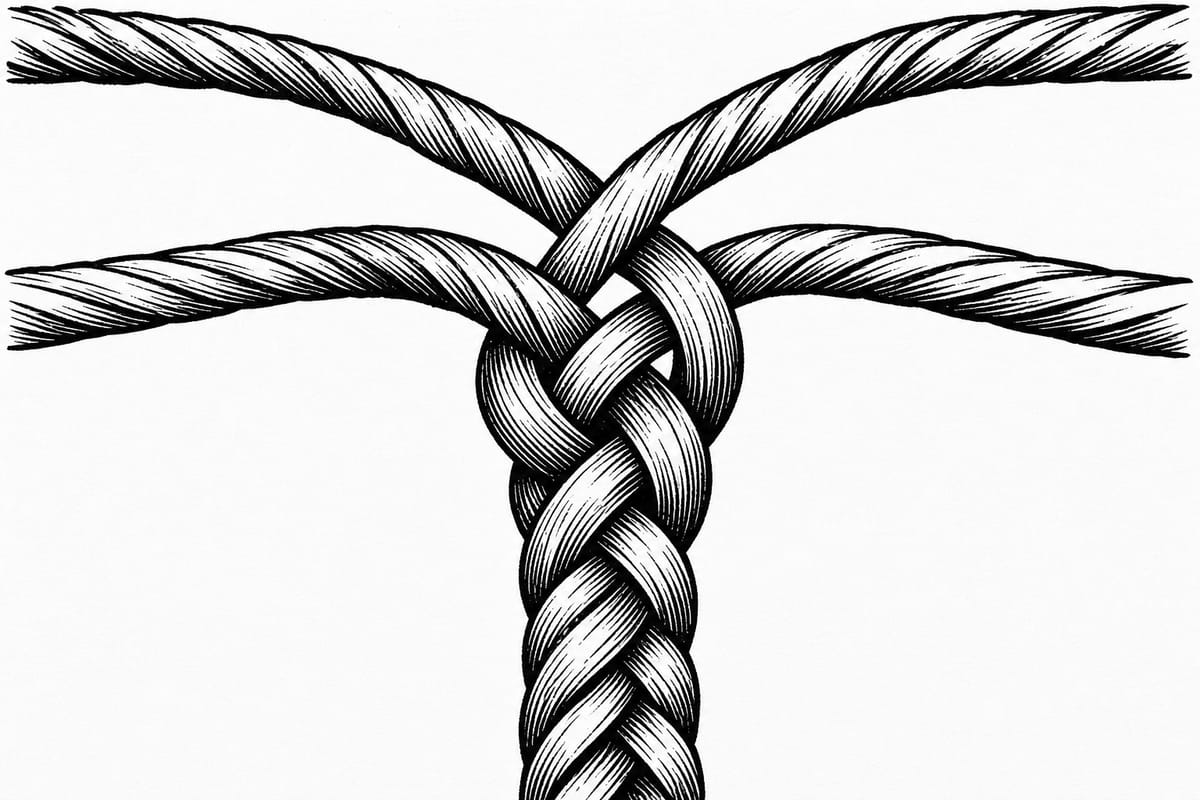
The idea
Fifty-five lessons ago you could riff with your right hand and nothing underneath it. What has changed is not your vocabulary. It is that you can now hear a local event and the large structure it sits inside at the same time.
The source course calls that structural hearing and says plainly that it is the single most important skill it tried to develop (Lesson 28). It names three companions running beside it across four centuries: combinatorial thinking, voice-leading, and transformational logic. Four habits of mind, not four techniques. Bach's invertible triple fugue and a Meshuggah riff family are both the first. A chorale and a Bill Evans left hand are both the second.
The deepest of the four is one sentence, and your capstone is built on it: richness comes from the thorough exploration of constrained materials, not from the accumulation of diverse materials.
That is also Greg's diagnosis of your EP. Consistency and no movement, sections built by repeating a thing until it became a section. The capstone is where you prove that is over.
Watch
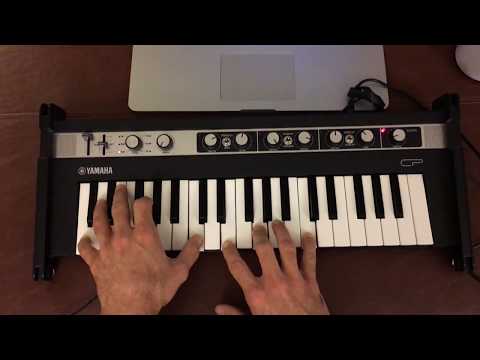
Theory and composition lesson (44 minutes, a private lesson with a student who says he is "just pressing notes and hoping")
- Composition as storytelling, at [10:35]. "That story has steps and it has questions and answers, it has diversions and conclusions." Keep that sentence in front of you while you write.
- The accident protocol at [25:04]: an accident you dislike, find out why; an accident you like, find out in that moment why you like it. Your capstone log is that protocol written down.
- The closing point at [41:45]. Composition "is more in your brain than your fingers." The scales from A1 and A2 do not stop during the capstone.
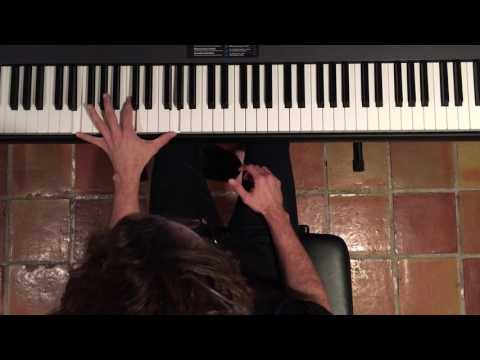
How to create a melody and chord progression on piano
- The rule underneath everything, at [10:59]: "build an expectation, satisfy that expectation, and expand." Your form has to do all three verbs.
- Melody and harmony chosen together chord by chord, at [05:34]. He is honest that it takes much longer than the demo suggests.
- Question and answer between the hands, at [09:22]. The right hand asks with three ascending notes, the left answers and continues to the note that says where the music goes next.
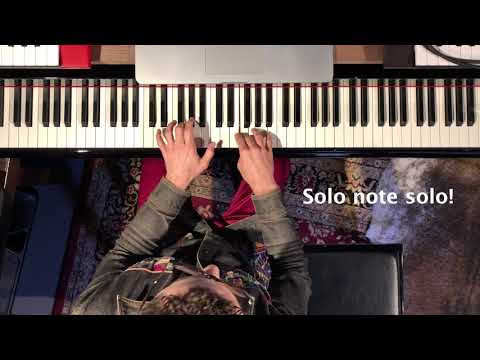
12 Steps to Musicality overview
- The diagnosis at [00:31] is the one you got on 9/6 in different words: the vocabulary is there, "what do you do with all the vocabulary when you have it."
- Item 1 at [01:31] names what a bebop line is made of: enclosures, goal notes, and contour. Items 2 and 3 are goal notes and feel. You have had whole lessons on the first two (A12, A13). Feel is where the capstone will expose you.

How to make yourself practice
- The sizing rule at [01:11]: much better a schedule you hold for a year than one you do for two weeks before burning out. The plan below is deliberately small per day.
- The grid at [01:50], and the late-night rule at [04:22]. Exercises down the left, dates across the top, filled in ahead so the empty cells accuse you, and you do the block even at midnight when you do not want to.
Listen
Five passes, and only the fifth one is about your own music.
Pass 1, surface. "Bleed" from 1:15 to 2:10, then "Song for Melan and Rafik" from 3:44. Do not count anything. Note only where you felt lost and where you felt planted.
Pass 2, structure. Same two excerpts. In "Bleed," Lucas documents the 4/4 layer changing hands: cymbals state it clearly until roughly 1:25, the drums move to eighths with a popping kick, the cymbals join that pattern around 1:40 leaving the vocals to carry the 4/4, and from about 1:58 the lead guitar marks the downbeats. Tap 4/4 throughout and feel who is holding it for you at each moment. In the Hamasyan, Schumann's transcription has Layer 1 as an eight-bar unit of seven 5/8 bars plus one 7/8 bar on a C center, against a 12/8 backbeat entering at 3:44, Layer 1 repeating twice while Layer 2 repeats seven times before they realign. Tap the 12/8 and let the other layer be wrong.
Pass 3, one line. Sing the top voice of each excerpt. Where you cannot sing it, that is a limit of your hearing, not of the music.
Pass 4, the long shape. "St. Thomas" and "My Favorite Things," complete, once each, listening only for where the argument turns. Lesson 29 claims the Coltrane arc from simple melody through rising density to a climax and back to a transformed melody has the structural logic of a Beethoven development section. Decide whether you agree, in writing, with a reason.
Pass 5, your own record. The Cloud Speak track you and Greg played on 9/6, five times with a pen. What is the material. How many sections, and what starts each one. Sing the top line and mark every goal note in the A13 sense. Mark every section that begins because something repeated rather than because the music built to it. Then write one paragraph on what you would do instead. That paragraph is the seed of the capstone.
The comparison
The caveat discipline is the thing you are supposed to leave with.
The parallel. Meshuggah's cyclic riffs against a steady 4/4 and Stravinsky's irregular meter both put the listener's sense of the bar under attack, and both come from composers thinking in cells rather than phrases. Almost every popular account calls them the same technique two generations apart.
Where it breaks, in four places. First, the background pulse never changes in Meshuggah and always changes in Stravinsky. Lucas documents Meshuggah building songs in segments of eight, sixteen, or thirty-two bars of 4/4, with riffs falling in and out of alignment with that background but rarely overcoming it. The Rite of Spring renotates the meter bar by bar, so the bar itself is the composed object. Second, the drummer's job is opposite. Tomas Haake has said in interviews that everything sits on a 4/4 platform and that he plays eighths on the hi-hat so the audience can headbang. A Stravinsky percussionist has no such standing layer. Third, in Stravinsky your tactus is genuinely displaced with nothing to count against, while in Meshuggah you can always count, which is why Lucas can describe one audience counting in the balcony while another moshes in the pit. Fourth, the consequence: the right classical comparisons for Meshuggah are Krebs's grouping dissonance, Reich's phase process, and Babbitt's modular time points, all of which hold a grid fixed and vary the pattern against it. Stravinsky varies the grid.
Why this is the last comparison. Lesson 28 offers four threads and warns in the same breath that it is not making "a vague appeal to universals." A thread is useful only if you can say where it stops. Every comparison in your written analysis carries its breaking point in this shape: the exact parallel, then the exact break. A comparison without one is a slogan, and a slogan is how a composer stops learning.
At the piano
The capstone is played before it is scored, so these ten weeks hold what you have while you write.
The daily floor, twenty minutes, never skipped. Scales at 40 bpm in quarter notes, one octave, one key per day around the circle in the A1 order, hands together, wrist moving slightly between notes, thumb tucking under with no arm lift. Greg still does this himself, at [30:18] of the composition lesson. Then the two-finger alternation and pinky drop from A2 if tension shows up.
The capstone block, twenty minutes. Play your own piece slowly, from the top, at half tempo, both hands, stopping only to fix a note you cannot yet reach. Not fragments. This is where the left hand gets built, and the left hand is what carries a six-minute form.
Voicing decisions, ten minutes. Voice one chord from the piece four ways using A11 (drop-2, block, superimposition over a thinned 1-5-9 bass), in the tempo and register of the actual passage. Choose one, write down why, do not revisit it.
Cap the writing to what your hands can carry. You said it on 9/6: you will only write as well as you can play. True this quarter, less true later. If a passage cannot be played at 80 percent tempo by week six, simplify it or move it to another instrument.
Exercises
1. The four-threads essay
Do. Choose one thread from Lesson 28, combinatorial thinking, voice-leading, structural hearing, or transformational logic, and trace it through four works: one Bach (fugue, invention, or chorale), one Classical-period movement, one twentieth-century concert work from Modules 6 and 7, and one recording from the repertoire you write in. Name pitches, bars, voicings, or transformations. One page, at Rosen's precision rather than a textbook's generality.
Done when: each of the four paragraphs contains a claim checkable against a score or a timestamp, and the essay never says that all music is the same.
2. The transformation audit
Do. Take sixteen bars you have written since L27 and label every relationship in them with a transformation: transposition by interval, inversion, retrograde, rhythmic augmentation or diminution, reorchestration. Lewin's point is that an interval is an operation taking you from one object to another. Write them as an ordered list.
Done when: the list has at least eight entries and you can point to two places where nothing is happening, which is where the music is padding.
3. The technique inventory
Do. Build a two-column table. Left column, every technique in this curriculum you can deploy, one row each with its lesson id: motivic inversion and sequence (A12), goal-note skeletons (A13), voice-leading as continuity (A13b), phrase shape (A14), metric superimposition and odd meter (A15, L6, L10), fugal thinking (L12–L14), modal and Lydian color (L17, L18), symmetric scales (L19), chromatic mediants (L20), inversional thinking (L21), surprise and concealed symmetry (L22, L23), terminally climactic form (L24), real development (L25), row and hexachord as riff generator (L27, L28), rotation (L29, L30), gesture, process, and timbre (L32–L34), structural virtuosity (L35). Right column, one bar you wrote that demonstrates it.
Done when: at least twelve rows carry a real musical example, and every empty row is a choice you can defend rather than a gap you forgot.
4. The analysis of one modern piece
Do. Pick one piece from the modern repertoire this course documents and write 900 to 1,200 words on it in the source course's vocabulary. Cite the verified literature: Pieslak or Lucas for Meshuggah, Schumann for Hamasyan, Biamonte for metric dissonance doing formal work, Osborn for terminally climactic form. Every classical comparison states the parallel and then the break. Where a claim rests on an interview rather than an analysis, say so in the sentence.
Done when: every factual claim has a source you can name, every comparison has a breaking point, and one passage says the literature does not settle the question.
5. The grid and the accident log
Do. Build the paper grid from the practice video, four rows (daily floor, capstone block, voicing block, writing), dates for the full ten weeks filled in before you start. Beside it keep the accident log: every time something surprises you, write it down with one sentence on why it worked or did not.
Done when: every grid cell holds an X or an N/A, the log holds fifteen entries by week ten, and three of them made it into the piece.
Compose
The capstone
A six-to-ten-minute instrumental work for piano plus a named ensemble, recorded, engraved in Sibelius, and produced. Ten weeks. One piece, not a suite, and not three good ideas placed end to end.
The constraints, all binding.
- One germ. Every pitch idea derives from a single cell of three or four notes. Transpose, invert, rotate, augment, fragment, reharmonize, reorchestrate. No second unrelated theme. Lesson 28's central claim, tested on your own material.
- One rhythmic identity. One device from Module 2 as the piece's other constant: metric superimposition over a fixed grid, an additive process, a cycle in Schumann's sense, or mixed meter as melody. Name it before you write.
- A form that builds. At least one section arrives because the music built to it. Mark that bar. If you cannot mark it, the piece is not finished.
- Length. Six minutes minimum, ten maximum. Under six and you have not solved the long-form problem, the one you never have.
- Playable by you at tempo by week nine, both hands, without tension.
- Instrumentation named in week one. Piano plus at least three other parts. Guitars, bass, and drums is the obvious choice given your background, and a good one.
- No vocals.
Deliverables, all four.
- The recording. A produced mix in Logic, piano performed by you, other parts performed or programmed. Not a release master, but finished audio with intentional balance and a real ending.
- The score. Full score plus parts in Sibelius, following Behind Bars on spacing, beaming, rests, and part layout, with tempo, dynamics, and articulation marked. The A17 ladder at full size.
- The technique inventory. Exercise 3's table, pointing at bar numbers in the finished score.
- The written analysis. Exercise 4, on a piece that is not yours.
The ten weeks
Week 1, the germ. Choose the cell. Play it in every mode you know on one root and write its eight transformations from A12. Name the rhythmic device and the instrumentation. Write nothing else. End the week with one page holding the cell in notation, its transformations, and two sentences on what the piece is about.
Week 2, the goal-note skeleton. Write the skeleton of the whole piece as goal notes only, in the A13 sense, before writing a single line. Their own progression matters more than any one of them, so keep successive goals within a step or two.
Week 3, harmony under the skeleton. Harmonize it at the piano using A14's method, melody and harmony chosen together chord by chord, with A11's voicings. Record a rough piano pass of the whole span, placeholder or not. Having the shape in audio by the end of week three is the most important thing in this plan.
Week 4, the rhythmic layer. Apply the named device. For metric superimposition, write the riff cycle and the grid it runs against and calculate where they realign. For a cycle, decide whether it is phrasal, structural, or developmental in Schumann's terms, and where you cut it short to protect the hypermeter. Play it against a metronome until it is countable.
Week 5, counterpoint. Give at least one section two voices that are independent in the L12 to L15 sense. This is where the piece stops sounding like a keyboard sketch with parts added.
Week 6, the form audit. Play it at half tempo and mark every section start as arrived or pasted. Cut or rebuild every pasted one. Expect to lose a minute of music, and expect this to be the best week.
Week 7, the virtuosic passage. Write it under the L35 test: what is it a development of, and what happens to the form if you delete it. If deleting it costs nothing, do not write it.
Week 8, engraving. Enter the piece in Sibelius, step-time from the MIDI keyboard, score first and parts second. Print the parts and read them at the piano, because errors are invisible on screen and obvious on paper.
Week 9, recording. Track the piano to a click or the programmed drums using Greg's protocol: record, stop on the error, drill the spot ten to twenty times, restart, keep only a flawless take. Then track or program the rest.
Week 10, production. Mix for balance, register separation, and the ending. Finish the inventory against final bar numbers and the analysis, then send Greg the score PDF, the mix, and the inventory in one message.
The self-review rubric
Score yourself before Greg sees it. Every row is a checkpoint you already passed in this curriculum, applied to the finished piece. Pass or fail.
| # | Criterion | Passes when | From |
|---|---|---|---|
| 1 | Single germ | Every pitch idea traces to the cell in the inventory | L28, A12 |
| 2 | Goal notes | The skeleton exists on paper and every structural downbeat lands on it | A13 |
| 3 | Movement | One section arrives because the music built to it, and the bar is marked | A14, 9/6 |
| 4 | Consistency | No section exists solely because a thing repeated | 9/6 |
| 5 | Rhythmic identity | The named device is audible to a listener who was not told about it | A15, Module 2 |
| 6 | Counterpoint | One passage has two independently interesting voices | L12–L15 |
| 7 | Harmonic reach | One color from Module 4 used deliberately, and you can name it | L17–L21 |
| 8 | Structural virtuosity | The hard passage cannot be deleted without collapsing the form | L35 |
| 9 | Playable | You perform it at tempo, both hands, no tension, no arm lift on crossings | A1, A2 |
| 10 | Engraving | Clean enough to hand a player who has never heard the piece | A17, Gould |
| 11 | Reading | You sight-read your own parts slowly, rhythms correct on the first pass | A18 |
| 12 | Analysis | Every comparison carries its break, every claim carries a source | L0, L28 |
Ten of twelve is a finished piece. Under eight, name the failing rows for Greg and say what you would do with four more weeks.
Checkpoint
- The four-threads essay, one page.
- The analysis of one modern piece, 900 to 1,200 words, sourced and caveated.
- The technique inventory, twelve populated rows pointing at bar numbers in your own score.
- The score and parts as a Sibelius PDF, and the piece performed at the piano at tempo.
- The produced mix, six to ten minutes, one piece.
- The completed rubric, with one sentence on every failed row.
Read
- Source course, Lesson 28 (garnett-course.pdf). The four threads, and why the course refuses to call them universals. Read it before choosing your germ, because the combinatorial claim is what makes the one-germ constraint reasonable rather than arbitrary.
- Source course, Lessons 29 and 30. Lesson 29 is the course turned into practice: chorale harmonization of a standard, one motive per chorus, one trichord over familiar changes. Lesson 30 carries the consolidated bibliography and the Bach instruction to keep permanently, a prelude and fugue per week or per month, slowly, playing through the voices. "This is not a task to complete but a discipline to maintain."
- Lewin, Generalized Musical Intervals and Transformations. The opening chapters, for interval as operation. The theory behind exercise 2, and behind why tritone substitution and Babbitt's hexachord pairing are one move.
- Rosen, The Classical Style. End to end during the capstone weeks. Reread it in two years and it will be a different book.
- Lucas, MTO 24/3 (2018). The rotated riff, and the clearest demonstration in the modern literature of form generated by a metric device.
- Schumann, MTO 27/2 (2021). The three formal functions of a cycle, phrasal, structural, developmental. A menu for week four.
- Biamonte, MTO 20/2 (2014). Metric dissonance as initiating gesture, cadential hemiola, link, and sectional boundary. Four ways to start a section without a chord change.
- Gould, Behind Bars, and the Sibelius Reference Guide 2023.11 (plus Learn and Support). Looked up in week eight rather than read. Gould answers every notation question the score raises. Reference Guide sections 1.9, 1.10, and 1.19 cover MusicXML in and out, which keeps the Logic session and the Sibelius file in sync.