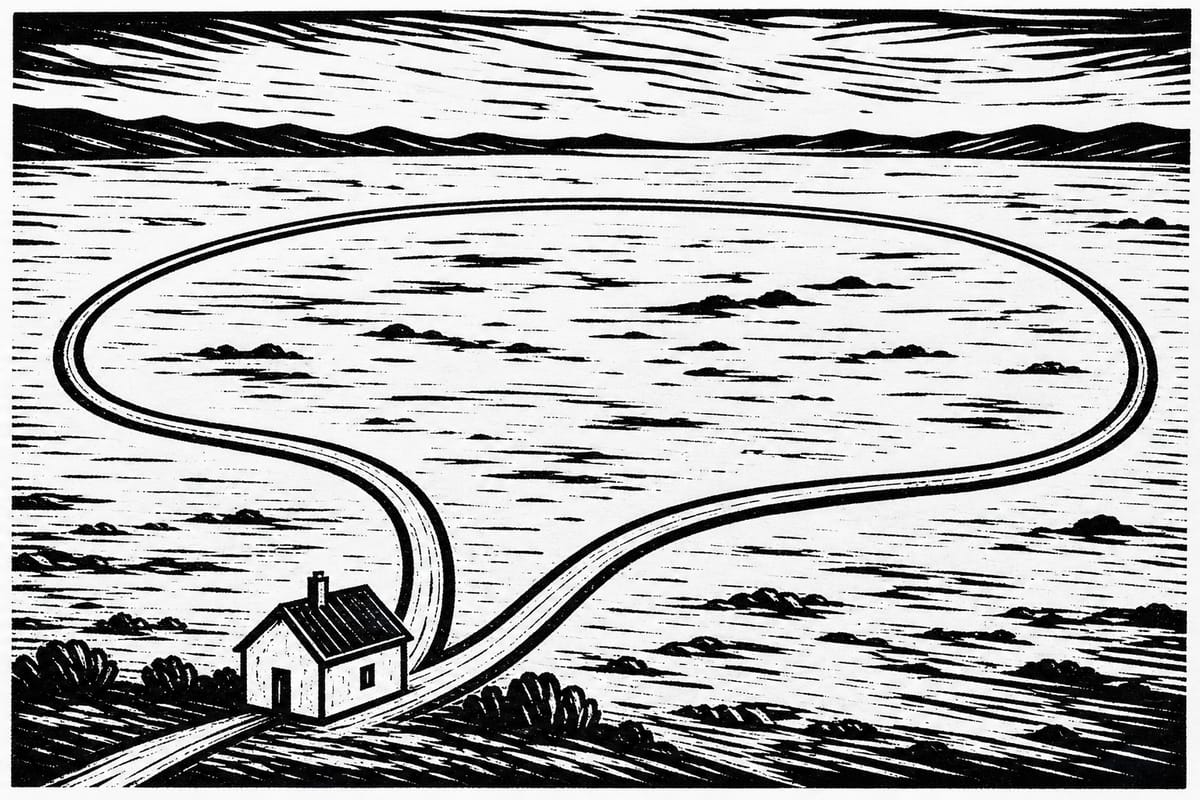
The idea
The textbook sonata form is a container. Exposition, development, recapitulation, first theme in the tonic, second in the dominant. Rosen's correction, which the source course builds on, is that this describes an average rather than a rule anybody followed. Sonata form is a way of writing, a feeling for proportion, direction and texture rather than a pattern (Source course, Lesson 15).
The consequence is practical. The form is not the themes, it is the tonal trajectory. Home is established, dissolves, somewhere else is reached and confirmed, and home returns changed. Haydn frequently has no contrasting second theme at all. What makes a movement a sonata form is tonal opposition, not thematic contrast.
Rosen's other line is the one to keep. Sonata form could not be defined until it was dead. Carl Czerny claimed around 1840 to be its first codifier, by then the style was history.
So stop asking what the parts are called. Ask where the tonic ends, where the new key begins, and what happens between.
Watch
Theory and composition lesson
- [10:35] composition as storytelling. "That story has steps and it has questions and answers, it has diversions and conclusions." Exposition, development and recapitulation without the vocabulary.
- [23:04] the half-step modulation chain out of C and back through a ii-V-I. Greg: "you've created a story that uses a technique that tells the ear exactly where it's going and makes no mistakes... any ear will have taken that journey with you."
- [37:41] the assignment, a sonata exposition drill in disguise. Leave home by a dominant chain around the circle and return, from any chromatic starting point, tracking one melody note and naming its function at every chord.
Chord progressions with 7th chords
- [06:17] why running the circle of fifths is unmusical, and what to do instead, "pick a progression and then do that in all the keys."
How To Improvise
- [02:25] what the great players do. "They have themes that they develop, they go away from the themes, they come back to the themes." Sonata thinking, defined by a jazz pianist.
- [04:19] why it works, pattern recognition. "If you give people a thread to follow in your solo they'll intuitively follow it, and if you don't have that thread, they'll intuitively zone out."
- [11:24] the hard permutation, new material first, the original rhythm held in mind and returned to.
Listen
Yes, "Close to the Edge," whole, three times. This is the assignment. Covach's Figure 1.1 is a complete timed formal diagram. Build your own before reading his. His reads:
- Intro, 0:00 to 3:54. A three-octave ascending bass scale at 0:56. A bass ostinato repeated nine times to a fermata at 1:21. The title theme at 2:58, in D major and D minor.
- A, 3:54 to 6:03.
- A prime, 6:03 to 8:28, with a fugato from 8:00 to 8:28.
- B, 8:28 to 14:59. Church organ interlude at 12:10. Organ and fanfare at 13:04. Theme reset at 14:11.
- A double prime, 14:59 to 18:38. Wakeman's Hammond solo enters at 14:59 and again at 15:30. Extended bridge and chorus at 16:33. Fade to bird and stream at 17:36.
Covach labels the verse harmony A Dorian, hears the intro bass as the second mode of D harmonic minor, and tracks a motivic half step, E to F, transposed to E to D-sharp in the organ interlude. The polymeter deserves its own pass: 12/8 in vocal and sitar against 3/2 in bass and drums at 3:54, and against 4/2 at 6:03, realigning only after eight bars of 12/8 and six of 4/2, with Squire trimming the 4/2 back to 3/2 at 15:53.
Pass one: no notes. Pass two: write every timestamp where the piece changes gear, before looking at the list above. Pass five: the four verses, which Covach describes as establishing, dissonating, returning and reconciling.
Mozart, K. 550, first movement. Pass one: the exposition, and where B-flat major arrives. Pass five: the recapitulation, the second theme now in G minor. Same notes, different key, different meaning.
Beethoven, Waldstein, exposition. C major to E major. No textbook rule predicts it, and the labels tell you almost nothing.
Shorter, "Footprints." A twelve-bar minor blues whose expectations are tested in performance. Tony Williams disrupts the metre, Herbie Hancock reharmonises the turnaround, Shorter stretches the melody's intervals. Each chorus disappoints the head in Rosen's exact sense.
Yes, "I've Seen All Good People," and Alan Parsons Project, "I Robot." Spicer's verified accumulative-form analyses. In "I Robot" an eight-bar C minor progression moves by chromatic third to the mediant, the dominant is avoided, and an ostinato synth riff is transposed under each chord. Form built by layers arriving rather than keys changing.
Dream Theater, "The Dance of Eternity." Six minutes thirteen, instrumental. Listen once for pleasure, once with a stopwatch, noting how often a section returns.
The comparison
The exact parallel. Sonata thinking and a long prog instrumental solve the same problem, making a ten-to-twenty-minute span cohere without a text. The source course states the Classical solution as dramatising tonic and dominant polarity at the largest structural level. Covach's analysis shows Yes solving it with the same three functions, statement, departure, return.
Where it breaks, and this is a live argument you should be able to referee. Three published scholars read the piece three ways.
- Dirk von der Horst reads it as expanded sonata form, two themes introduced in the first section, developed, then repeated in the following three.
- Covach reads it as compound AABA plus an overarching two-part design, and the "Form in Rock" primer calls it a version of compound AABA. His conclusion is anti-triumphalist. The piece pushes at the stylistic boundary and does not cross over, and the art-music reference sits at the level of large-scale strategy rather than form-type.
- Brett Clement says the resolution is scalar. The large-scale motion happens between key-signature collections, formalised with Hook's signature transformations, so the return is scalar rather than tonal.
Three peer-reviewed readings of one eighteen minutes, none careless. The disagreement is not about the notes, it is about what counts as the mechanism of return.
Where the classical parallel breaks for you. Sonata form's engine is a functional dominant, and much of the repertoire you want to write in has none. Everett's survey of rock's tonal systems includes progressive structures with true modulation that need never return to the tonic, and a pentatonic type where every degree carries a major triad and the five chords are not functionally related. There, departure and return still work as formal functions and stop working as harmonic mechanisms. You cannot rely on the dominant to make the coming back feel obligatory.
The other option, which is not a lesser one. Spicer's accumulative form builds a groove gradually from its parts. Memorise his definitions. A riff is a distinctive melodic or rhythmic idea, longer than a motive but not a full phrase, and a groove is the tapestry of riffs creating the backdrop that identifies a song. He argues these forms are enabled by multitrack recording, and traces the ancestry through Burkholder on Ives, whose prototype is the finale of Beethoven's Ninth, where fragments of the Ode to Joy appear long before the theme does. Sonata form dramatises a tonal opposition. Cumulative form withholds a theme and assembles it. Choose one per piece.
And a third, from your own genre. McCandless's ABAC Additive Metrical Process in Dream Theater builds a phrase-like unit from four subphrases ordered a-b-a-c, with growing metric cardinalities, B greater than A, C greater than A, C greater than B. A static head and a variable tail. Hannan later argued this is a subset of the general ABAC phrase schema, the Classical parallel period with an expanded consequent in different clothes. In Haydn the variable tail changes harmonic goal, half cadence to authentic cadence, and phrase length follows harmonic rhythm. In Dream Theater it changes metric cardinality, the second ending literally longer in beats, no cadence implied.
At the piano
Harmonic-trajectory analysis, played. Take the K. 545 or K. 550 exposition. Play only the bass line and chord roots and mark every cadence. Find the last firm tonic cadence and the first firm cadence in the new key. Between them is the drama, usually what you were taught to call a bridge.
The circle assignment. Starting on E: E, E7, A, A7, D, D7, G, G7, C. Then from every chromatic degree. Then track one melody note through the chain, naming its function on each chord, as Greg does at [37:41]. The minor-thirds cycle makes twelve keys three passes.
Departure without a dominant. Play an eight-bar loop in A Dorian. Leave it by moving the whole collection one position around the circle so one note changes, not by a V-I, and stay there eight bars. Then come back. Clement's signature-transformation idea reduced to something your hands can do this week.
Left hand, tenths. A root and a tenth, one attack per bar, so you can hold a harmonic area for thirty seconds. Greg voices "Closer" this way at [16:51] of the seventh-chords video.
Exercises
1. Build the diagram before you read it
Do. Listen to "Close to the Edge" with a stopwatch and write your own timed diagram. Only then compare it with Covach's.
Done when: both diagrams sit side by side, every disagreement circled, one sentence on each.
2. Trajectory, not labels
Do. Take one Classical exposition and mark every cadence. Identify the last firm tonic cadence and the first firm cadence in the new key, then describe what happens between them in three sentences, no theme labels.
Done when: your description contains no phrase like "second theme."
3. Same analysis on a solo
Do. Run the same procedure on a recorded jazz solo, using character, register and rhythmic profile in place of key. Where does departure begin, intensification peak, the return arrive?
Done when: you can point at the three moments in real time while it plays.
4. The circle assignment, all twelve
Do. Greg's dominant chain home, from every chromatic starting point, one melody note tracked and named aloud before each chord.
Done when: every starting note reaches home without hunting, and you name the note's function one chord ahead.
5. Departure by collection
Do. Write four eight-bar modal loops. For each, a departure that changes the collection by one note and a return that changes it back. No functional dominants.
Done when: a listener hears each return as a return, and you say which note moved.
6. Two engines, same material
Do. Take one riff. Build ninety seconds of accumulative form from it, one layer at a time. Then ninety seconds of departure and return from the same riff.
Done when: both exist as recordings, and you can say in one sentence what each would need in order to end.
Compose
Write a six-minute instrumental with a real development.
Structure. An exposition of about ninety seconds establishing a home area, dissolving it, then reaching and confirming a second area. The transition between them is the most active passage there, and you will be asked to point at it.
A development of at least two minutes, the longest section, using only material already heard. It visits at least three areas and settles in none. One passage has a fragment in augmentation underneath its own faster form, and one runs at least twenty seconds over a single sustained or repeated bass note immediately before the return.
A recapitulation bringing the second area's material back home. Something must differ from the exposition beyond transposition, named in one sentence.
Write it at the piano, then arrange for a small band. With no functional dominant available, use the collection-shift departure from Exercise 5 and say so on the score.
Deliver a Sibelius score, a piano recording, and a one-page timed diagram in Covach's style.
Checkpoint
Hand over your "Close to the Edge" diagram beside Covach's, disagreements marked.
Describe one Classical exposition using only harmonic events, no theme labels.
Play the dominant chain home from three chromatic starting points, tracking a melody note.
Play a modal departure and return with no functional dominant, and name the note that moved.
State the three published readings of "Close to the Edge," who holds each, and the difference between sonata and accumulative form in terms of what each withholds.
Hand over the six-minute piece and its diagram.
Read
- Source course, Lesson 15 (/library/garnett-course.pdf). The three misconceptions, the harmonic-trajectory method, the exposition as process rather than list.
- John Covach, "Progressive Rock, 'Close to the Edge,' and the Boundaries of Style" (1997), at https://forgotten-yesterdays.com/_graphics/memorabilia/_understanding_rock_essays_in_musical_analysis_chapter_1_progressive_rock_close_to_the_edge_and_the_boundaries_of_style_1997_36083.pdf. Figure 1.1 first, then the argument. It is the single most useful piece of writing you will read about this song.
- John Covach, "Form in Rock Music: A Primer" (2005), https://www.personal.kent.edu/~sbirch/Theory/21341%20CMT/Form%20in%20Rock%20Music.pdf. Twelve pages, for compound AABA, needed again in L26.
- Brett Clement, "Scale Systems and Large-Scale Form in the Music of Yes" (Music Theory Online 21/1, 2015), https://www.mtosmt.org/issues/mto.15.21.1/mto.15.21.1.clement.html. Hard. Read it after Covach, so you feel the disagreement rather than being told about it.
- Mark Spicer, "(Ac)cumulative Form in Pop-Rock Music" (twentieth-century music 1/1, 2004). For the riff and groove definitions and the "I Robot" analysis. Spicer's Genesis material could not be verified in full from the copies available, so treat any Genesis-specific claim from it as to verify.
- Charles Rosen, The Classical Style. The sonata-form chapter. Both quoted sentences are there, and the surrounding pages are the best writing on the subject in English.