The idea
Cut a row in half. The first six notes and the last six notes are complementary. Between them they account for all twelve pitch classes, which means each half is defined as much by what it excludes as by what it holds. Babbitt's move was to ask which hexachords can be paired with hexachords from a transformation of the same row and still produce a complete aggregate. When they can, the row is combinatorial.
The reason this matters to a composer with two guitars is that combinatoriality is a rule about what happens between voices, not inside one. It guarantees that when riff A and riff B sound together, no pitch class is doubled and nothing accidental becomes a tonic. The source course puts the danger exactly: an unintended duplication creates "a kind of involuntary 'tonic'" (Lesson 19). If you have ever written two parts that fought each other for a home note you did not choose, that is the problem this solves.
Hexachord choice is a structural decision on the level of choosing a key.
Watch
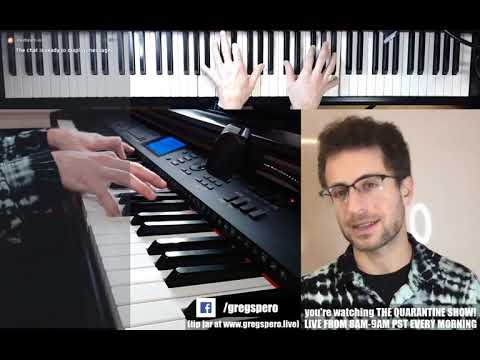
The most dissonant chord in the world (1:10)
- [00:10] The spelling, bottom to top: 3 and 7 at the bottom, then the ♯9, then the ♯5, then the ♭9, and the tritone on top. Every available alteration on a dominant, present at once.
- [00:33] His preferred resolution, to a minor chord with a major 7, which is the melodic minor sound used in both directions.
- [01:00] The assignment, one line: "try learning that in all keys." Do it. You will need to hear maximum vertical density as a color before you can use partitions.
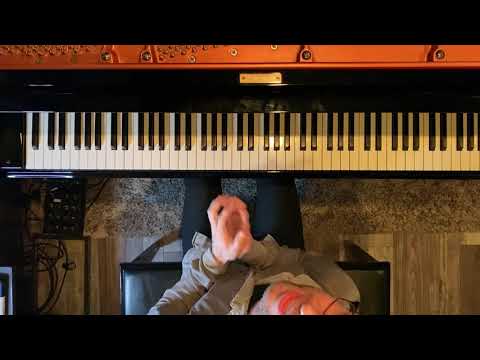
The Most Beautiful Chord in the World (4:03)
- [00:03] Credited to the pianist Ruslan Sirota. [00:49] The alterations named one by one: ♯5, ♭9, ♯11, a doubled 5 and 7 in the middle of the voicing, and the ♯9 on top.
- [01:09] The instruction that outranks the notes: "make sure you understand and hear every bit of it when you are playing it." He says it three times in four minutes.
- [01:54] He learned it in A♭ minor and moves it up a half step at a time through all twelve keys. That is the practice discipline for every hexachord in this lesson.
- Compare the two chords. Similar density, different distribution between the hands. That difference is what Babbitt calls a partition.
Listen
Pass 1, surface. Semi-Simple Variations, solo piano, about six minutes. The source course recommends it as the compact and vivid Babbitt. Write down three adjectives for the sound. Not the technique, the sound.
Pass 2, structure. Same piece. Try to hear where the texture thins to one voice and where it thickens. Every one of those changes is a partition changing.
Pass 5, relationships. Philomel, opening. Listen to the soprano against her own electronic double. Then go back to Semi-Simple Variations and notice that the rhythmic surface of both dances. Alex Ross described Babbitt's music as music that "shuffles and shimmies like jazz from another planet." Decide whether you agree.
Sing. Sing the hexachord {C, D, E, F, G, A}, which is Babbitt's Type C, the diatonic hexachord. Then sing its complement, {C♯, D♯, F♯, G♯, A♯, B}. Two very different-sounding collections that together are the chromatic scale.
Tap. "Tempting Time," mm. 31–40. Tap the underlying pulse while the meter shifts. Patrick Nolan Sallings shows in his UNT dissertation that these shifts are best represented cyclically. You will use that cycle in Module 2 work; here just notice that the pitch material stays small while the meter does the work.
The comparison
The parallel. Babbitt classified six all-combinatorial hexachords. Learn them by their correct labels, because you will see them mislabeled:
| Label | Pitch classes | Order | Name |
|---|---|---|---|
| A | {0,1,2,3,4,5} | first | chromatic hexachord |
| B | {0,2,3,4,5,7} | first | |
| C | {0,2,4,5,7,9} | first | diatonic hexachord |
| D | {0,1,2,6,7,8} | second | |
| E | {0,1,4,5,8,9} | third | three interlocking minor thirds |
| F | {0,2,4,6,8,10} | sixth | whole-tone hexachord |
"Order" counts how many transposition levels produce the complement. Type A maps onto its complement at T6 only. Type D does it at T3 and T9. Type E does it at T2, T6 and T10. Type F, the whole-tone hexachord, does it at every odd transposition, T1 through T11.
The bridge to your music runs through Forte's set classes. Eric Smialek frames death metal riffs as largely atonal constructions built on transpositionally similar pitch collections, which is the same operation as building a surface from a small unordered set transposed and reordered rather than from a scale with functional degrees. A djent cell is a set class. You can look it up in Forte's catalogue, transpose it, invert it, and ask what its complement is.
Where it breaks, precisely. Smialek's transpositions in death metal are largely fret-shape transpositions on the guitar neck. The invariance is ergonomic before it is intervallic. Nobody chose those pitch classes for their combinatorial properties. Babbitt chose his hexachords deliberately and tracked the consequences across an entire piece. So the honest statement is that set-class analysis describes metal riffs well, and combinatoriality describes nothing that any metal band has been documented doing. Combinatoriality enters your practice as a writing constraint you impose, and the reason to impose it is the one the source course gives, which is that it prevents an involuntary tonic.
Two corrections to the source course. Lesson 19 contains two internal inconsistencies, and you should know about both. Its exercise calls {0,1,4,5,8,9} "Type A, the Schoenberg hexachord," while its own classification section correctly assigns {0,1,4,5,8,9} to Type E and {0,1,2,3,4,5} to Type A. Use the table above. Separately, the lesson's prose says the whole-tone hexachord maps onto its complement at every even transposition, while its exercise says every odd transposition. The exercise is right. T1 of {0,2,4,6,8,10} is {1,3,5,7,9,11}, which is the complement. Even transpositions map the whole-tone hexachord onto itself.
At the piano
Take Type E, {0,1,4,5,8,9}. On C that is C, D♭, E, F, A♭, A. Play it as a scale up and down, then play it as a chord in two hands. It is built of three interlocking minor thirds, and it sounds like it.
Now play its T6, which is F♯, G, B♭, B, D, E♭. That is the complement. Alternate the two collections in two-bar blocks over a static low C. You are hearing combinatoriality directly, one hexachord answering the other, no note repeated across the boundary.
Then the partition work. Take C13(♯11), which holds C, E, G, B♭, D, F♯, A. Voice it four different ways: third and seventh in the left hand with extensions in the right; a spread voicing across two octaves; close position in the right hand alone; and the Sirota voicing from the second video. Same seven pitch classes, four partitions, four pieces of music. This is the jazz version of what Babbitt's array does, and the source course makes the connection explicitly in Lesson 19.
For your left hand, hold two notes only, the third and the seventh, and let the right hand carry the rest. That is a real partition and it is playable this week.
Exercises
1. Verify complementation by hand
Do. Write out Type C, {0,2,4,5,7,9}. List the six pitch classes not in it. Now transpose the original by T6 and compare. Then repeat the whole procedure for Type A, Type D at T3, and Type E at T2 and T6.
Done when: You have four verified pairs written on paper and can produce any hexachord's complement in under ten seconds.
2. Find the whole-tone transposition levels yourself
Do. Take {0,2,4,6,8,10}. Transpose it by T1, T2, T3, T4, T5 and T6 in turn and write out each result. Mark which transpositions give the complement and which give the original collection back.
Done when: You have written the rule in your own words and it matches the odd-transposition answer, and you can explain why the even ones fail.
3. Hexachordal complements as call and response
Do. Write riff A using only the six pitch classes of one hexachord, in a rhythm and register you would actually record. Write riff B, its answer, using only the complementary six. Same rhythm, or a rhythmic answer to it. Record them alternating, four bars each, over a drum loop.
Done when: The two riffs sound like a question and an answer rather than two unrelated ideas, and no pitch class appears in both.
4. Look up your own riff as a set class
Do. Take a riff from your 2016 EP, or one you wrote last week. Reduce it to its unordered pitch-class content. Find it in Forte's catalogue. Write down its prime form and its interval-vector. Then find its complement and write a second riff from that.
Done when: You can name the set class of your own riff, and you have a companion riff built from its complement.
5. Voicing as partition
Do. Take C13(♯11) and produce eight different partitions of its seven pitch classes between the two hands. Write each one down in Sibelius. Play all eight in sequence, slowly, and record it.
Done when: All eight are notated, all eight are playable without hesitation, and you can say which one you would use behind a guitar solo and why.
6. Chromatic saturation, then removal
Do. Over one static low C, play all twelve pitch classes in the right hand as slowly as you like. Now remove one pitch class and play the remaining eleven. Repeat, removing a different one each time.
Done when: You can hear which single omission changes the color most, and you can name it.
Compose
Write a two-minute instrumental in which the pitch material is exactly one hexachord and its complement, and nothing else. Constraints: pick your hexachord from the table above and say which one and why before you write a note. Section 1 uses only hexachord 1. Section 2 uses only its complement. Section 3 uses both, sounding together, in two voices. The one technique that must be audible is the arrival of section 3, where the whole chromatic total is present for the first time.
Arrange it for the ensemble you actually want, guitars and bass and drums or piano trio, and record it. Then write one paragraph on whether a listener could hear the constraint. Be honest in that paragraph. The source course is honest about it: "A listener does not hear combinatorial hexachords or all-partition arrays, just as a listener to Bach does not hear retrograde inversions of fugue subjects in analytical terms."
Checkpoint
- The six all-combinatorial hexachords written from memory with correct labels and correct orders.
- Four complementation pairs verified by hand, plus the whole-tone transposition rule derived independently.
- Riff A and riff B recorded, complementary, no shared pitch class.
- One riff of your own identified by its Forte set class, with a companion riff from its complement.
- Eight partitions of C13(♯11) notated in Sibelius and played.
- The two-minute piece exists, and your honest paragraph about audibility exists with it.
Read
- Source course, Lesson 19, complete, including its two internal inconsistencies, which you have already corrected. Hexachordal complementation, the six all-combinatorial hexachords, the time-point system, the lyne, the aggregate, the partition, the four conditions of the all-partition array. /library/garnett-course.pdf
- Forte, The Structure of Atonal Music (Yale, 1973). Use it as a reference. Learn the prime-form algorithm and the interval-vector, and nothing more for now.
- Babbitt, "The Composer as Specialist" (1958), in The Collected Essays of Milton Babbitt (Princeton, 2003). Read the essay he actually wrote, not the title an editor put on it.
- Smialek, "Recent dissertations in the analysis of metal genres", Metal Music Studies, https://intellectdiscover.com/content/journals/10.1386/mms_00158_7. The best single bibliographic entry point to the whole field, and the source for the transpositionally-similar-pitch-collections framing.
- Sallings, Change, Longing, and Frustration in Djent-Style Progressive Metal (UNT, 2021), pages 132 to 393. Full transcriptions of four djent songs. Read a transcription the way you would read a score, and notice how small the pitch inventory is.