The idea
You already listen well. What you do not yet do reliably is listen four times on purpose, each time for one thing, then compare what the four passes gave you.
Source course, Lesson 1 splits listening into four dimensions. Linear: what happens next. Vertical: what is sounding at the same time. Proximity: how one event connects to the one beside it. Distance: how an event relates to something three minutes earlier. The course is blunt that distance is the hardest, "because it requires memory," and it is the one that reveals form.
This matters to you specifically because of the diagnosis Greg gave you: you are more a composer than a player. A composer's problem is rarely finding ideas. The hard part is knowing what an idea is doing to the listener over four minutes. That is the distance dimension, and it is trainable.
One line to keep: the surface is what you hear on the first listening, and the structure is the set of relationships that generate the surface.
Watch
How To Transcribe a Piano Solo
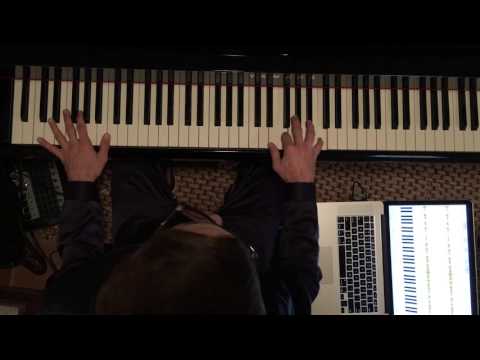
- The tool matters here. Greg names the app Transcribe ("it's like 25 bucks, well worth the purchase") and downloads audio to load into it. Set it up this week, before you need it.
- The waveform is a listening aid before it is a transcription aid. "The sound wave bubbles up there when it's louder," so you can see where a section starts. Space bar starts and stops, and restarting resumes from wherever you clicked.
- The speed ladder: 50 percent, then 60, 71, then plus ten at a time to 100. Back up a bar before each attempt "so that you can have some time to ramp up to it."
- The chunking rule: work in phrase lengths of four or eight bars, learn the end of the chunk first, then extend backward toward the beginning.
5 solos every pianist should transcribe
- The premise: "transcribing music will teach you more than any professor can ever teach you."
- Bill Evans on "Autumn Leaves" is his first pick, and the reason is exactly this module. Greg chooses Evans "not because he was super technically proficient, which he was, but more so because he was musical and focused on motivic development, focused on goal notes, and listening." Start about two minutes in, at the end of the bass solo.
- Miles Davis on "So What" is on the list as a trumpet solo on purpose. "Miles is just the king of musicality." He took "the basics of telling a story using a limited amount of vocabulary."
- Note what these picks have in common: every one was chosen for a listening quality, not a technical one.
Improv on Everything In It's Right Place
- No transcript exists for this video, so nothing verbal in it can be reported here. Watch it as listening practice, not as instruction.
- What to track: the harmony under Greg is static, so every bit of forward motion has to come from what he does with a small amount of material. Time yourself. At what point do you first hear him developing something rather than decorating?
Listen
Four passes, then a fifth. Do not skip to the fifth.
Meshuggah, "Bleed" (obZen, 2008), 0:00 to 2:15.
Pass 1, linear. Follow the guitar figure only. Where does it change? Where does it stop? Do not count anything.
Pass 2, vertical. Ignore the guitar. Listen to the cymbals and the snare, and nothing else. Write down what meter they are in.
Pass 3, proximity. Listen to the seam between guitar attack and kick drum. Are they locked together, or does one of them move against the other?
Pass 4, distance. Listen to the whole span and ask what changed between 0:30 and 2:00 that you can name.
Pass 5, integrated. Lucas gives a timestamped account of which instrument carries the 4/4 as the track proceeds, and it is the most useful listening map published on this band. The cymbals state 4/4 clearly until roughly 1:25. Around 1:25 the drums move to eighths with a popping kick. By about 1:40 the cymbals join the new pattern and the vocals carry the 4/4. From about 1:58 the lead guitar marks the downbeats. On your fifth pass, say out loud in real time which instrument currently holds the grid. That is a distance-dimension observation that you can hear without a score.
Then sing it. Sing the guitar cycle on one pitch while your foot keeps quarters. If you cannot sing it, you have not heard it, whatever you think you have heard.
Radiohead, "Everything in Its Right Place" (Kid A, 2000). Same four passes. The vertical pass is the interesting one here and the vertical pass on "Bleed" was nearly empty, which is the point of pairing them.
One verified fact to anchor the listening: Steve Reich took the harmonic frame of this song, and its "everything" melodic turn, as the material for movements 2 and 4 of Radio Rewrite, and has said in interviews that the figure is the tonic-dominant-tonic root of Western harmony. A minimalist composer heard a chord loop in a rock record and treated it as raw material. That is compositional hearing performed in public.
To verify. The frequently repeated claim that the track sits in a 10/4 cycle has no source in this curriculum's dossiers, and the one scholar who has catalogued Radiohead's odd-cardinality meters, Brad Osborn, names "2+2=5" and "15 Step" rather than this track. Count it yourself and write down what you count. Do not repeat the number as fact until you have.
Beethoven, "Pathétique," first movement, slow introduction. Source course, Lesson 1 uses this as its worked example. The casual listener hears a loud chord and a soft answer. The compositional ear hears that the diminished seventh is built from stacked minor thirds, that this symmetry makes it tonally ambiguous, and that the pleading figures which follow are built from the same intervals now spread out as melody. The course's own claim about this is the one that should stay with you: all of it is audible, and none of it requires a score.
The comparison
The parallel. The four dimensions are style-independent. You can run linear, vertical, proximity, and distance on the Beethoven introduction and on "Bleed," and in both cases the four passes give you four different pieces of information about the same sixty seconds. Source course, Lesson 1 makes the strong version of this claim: the trained ear does not consciously hold all four, it has internalized enough patterns that it processes them automatically and notices deviation.
Where it breaks, precisely. The four dimensions are not equally loaded in the two repertoires.
In Beethoven the vertical pass is dense and the distance pass is carried by harmony. The introduction's C minor is contradicted by a move to E flat major in the exposition, and the movement has to resolve that. You hear the return because you hear the key.
In "Bleed" the vertical pass returns almost nothing. Pieslak's analysis of Meshuggah is entirely about attack points and metric layers, and the pitch content is deliberately close to static. The distance dimension is still there, but it is carried by rhythm and texture. The thing that "returns" is the alignment of the riff cycle with the 4/4 grid, and Lucas shows that the arrival is arithmetic rather than cadential.
So the honest statement is this. The same four dimensions apply. The weight assigned to each one is a property of the repertoire, and a composer who imports Beethoven's weighting into a metal track will write vertical events that nobody in that idiom is listening for.
One caution about Radiohead. Osborn's book-length analysis of the band names five rhythmic techniques in chapter 3: odd-cardinality meter, changing meter, Euclidean and maximally even rhythms, grouping dissonance, and polytempo. His grouping-dissonance examples are "Weird Fishes" and "Lotus Flower." That much is documented and you can teach it. Everything else you say about this band this month should come from your own counting.
At the piano
The keyboard is your reference tool for the vertical dimension, which is the one your ear is weakest at, because you came from guitar and bass and you think in shapes.
Reduce, then play. Take "Everything in Its Right Place" and find its chord loop by ear at the piano. Two hands, block chords, no rhythm, no groove. Play the loop slowly enough to hear every voice inside it.
Then move one voice at a time. Hold the loop and ask which single note changes between chord one and chord two. This is the same question Greg asks in "Three Secrets to Hearing Chord Changes" about F7 going to B flat 7, where "the difference in those is this one note." Do it here.
Then the Evans. Play the first eight bars of the melody of "Autumn Leaves" with the left hand doing nothing but roots. Your left hand is weak and you know it, so let this be one note per bar, placed exactly on beat one, with the arm weight coming through the finger rather than the finger pressing on its own.
Tempo for everything above: slow enough that you never miss a note. Greg's rule, from your lesson: do it slow enough that you can think about exactly what you are doing.
Exercises
1. The five-pass log
Do. Choose one piece you already know well. Run the five passes from Source course, Exercise 1.1: linear, vertical, proximity, distance, integrated. After each pass write one paragraph on what you heard that you had not noticed before.
Done when: You have five paragraphs, and the vertical paragraph is as long as the linear one.
2. Custody of the grid
Do. Play "Bleed" 0:00 to 2:15 five times. Each time, call out in real time which instrument is holding the 4/4.
Done when: Your calls match Lucas's account at 1:25, 1:40, and 1:58 on three consecutive passes without looking at the article.
3. Sing the cycle
Do. Foot on quarters. Sing the "Bleed" guitar cycle on a single pitch, in the riff's own grouping, for eight bars of 4/4.
Done when: You can start the sing on any bar and still land your foot and your voice together where the cycle re-aligns.
4. One-note-changes
Do. At the piano, find the chord loop of "Everything in Its Right Place" by ear. Write out the loop. Then mark, between each pair of chords, every note that moves and every note that stays.
Done when: Your written loop plays back against the record without a wrong bass note, and you can name the common tones in every pair.
5. Set up the transcription rig
Do. Install Transcribe (or an equivalent slow-down app). Load Bill Evans's "Autumn Leaves." Mark the start of the piano solo, about two minutes in, at the end of the bass solo. Set the app to 50 percent.
Done when: You can start playback from your marked point with one click, at 50 percent, without hunting.
Compose
No composing yet. Source course keeps its first five lessons on listening, and this module keeps that rule. The output is a transcription.
The assignment. Transcribe the first four bars of Bill Evans's piano solo on "Autumn Leaves," starting at the end of the bass solo.
Constraints:
- Work at 50 percent. Learn the last figure of the four bars first, then extend backward, which is Greg's method in the transcription video.
- Right hand only. Ignore the left hand entirely this week.
- Write it down by hand on staff paper before you enter anything into software. You do not read notation fluently yet, and writing four bars by hand is how that starts.
- Mark accents. Greg's instruction when transcribing a line is to pay attention to "the notes, but then also the accents and the velocity, because that will come into play in our analysis later."
Deliverable: four bars, handwritten, plus a one-sentence answer to this question: which of the four listening dimensions did you actually use while transcribing?
Checkpoint
Before L2:
- Five-pass log complete on one piece, with a vertical paragraph of real length.
- "Bleed" custody calls correct at all three timestamps, three passes running.
- The "Everything in Its Right Place" loop played at the piano from your own ear, written out, with common tones marked.
- Four bars of the Evans solo transcribed by hand at 50 percent, accents marked.
- Transcribe app installed and working, with one solo loaded and a marked start point.
Read
- Source course, Lesson 1. The four dimensions and the surface-and-structure distinction. Read the Beethoven walkthrough with the recording playing.
- Lucas 2018, Music Theory Online 24/3. Read the timestamped passage on "Bleed" only, after you have done your five passes, not before. https://mtosmt.org/issues/mto.18.24.3/mto.18.24.3.lucas.html
- Pieslak 2007, Music Theory Spectrum 29/2, pp. 219–245. Skim now for the concept of metric superimposition; you will read it properly in L6. https://doi.org/10.1525/mts.2007.29.2.219
- Osborn, Everything in its Right Place: Analyzing Radiohead (2016), https://doi.org/10.1093/acprof:oso/9780190629229.001.0001. Get the book and start with chapter 3, on rhythm and meter. Brett Clement's review in Music Theory Online 23/2 (2017), https://mtosmt.org/issues/mto.17.23.2/mto.17.23.2.clement.html, is free and is the best page-numbered window into the book's interior. Clement also catches a real contradiction: Osborn claims Radiohead has "none of the surface level traits from progressive rock bands of the 1970s," and Clement shows most of the techniques discussed are commonplace in progressive rock.