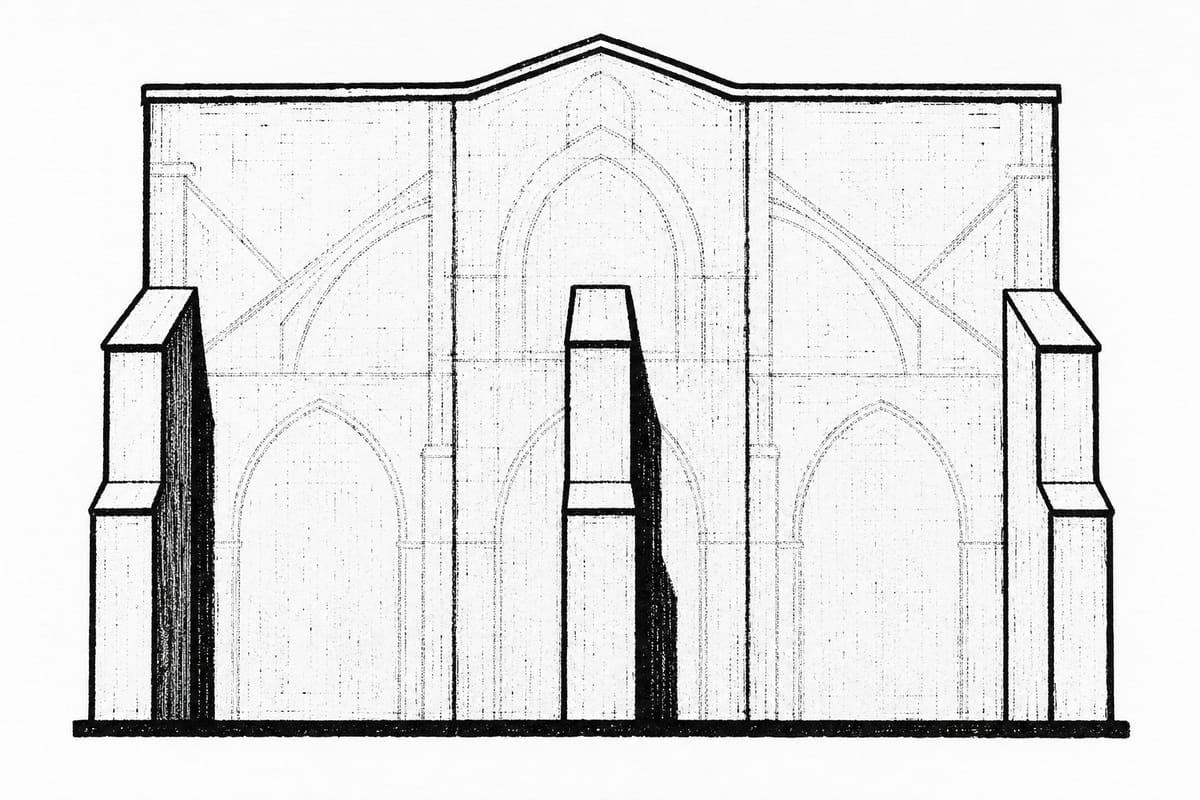
The idea
Two things get called symmetry and they are not the same job.
One you hear. A phrase leaves a note and comes back. A line climbs four steps and falls four. You feel the balance without arithmetic, and you feel it when the composer got it slightly wrong.
The other you count. Section lengths in a ratio, syllables in a numerical series, proportions you can only find with a stopwatch. Sometimes a composer put it there. Sometimes an analyst measured until a number appeared.
Mozart is the master of the first. Rosen's word for it, quoted in the source course, is concealed, a continuous game of symmetry and asymmetry hiding beneath the innocent surface (Source course, Lesson 13). Build the kind you can hear. Be suspicious of the kind you can only count, including in your own work.
Watch

The Most Important Thing for Intermediate Piano Players
- [01:04] finding a goal note without a score. It is the note the line climbs to, held longer, with space around it.
- [02:08] the finding that makes this a Mozart lesson. Greg maps the goal notes of Autumn Leaves and each is one diatonic step below the last. "That's why this is a brilliant melody."
- [02:56] the goals then reverse and rise by the same number of steps they fell, "a long-term layer that your brain then senses." Nobody counts that on first hearing. Everybody feels it.
How to create a melody and chord progression on piano
- [09:22] counter-melody as question and answer between the hands. Three notes up in the right, three up in the left, which then keeps going to a note that says where the harmony is heading.
- [10:59] the rule underneath the video, "build an expectation, satisfy that expectation, and expand." Rosen in Greg's words.

The Biggest Pitfall for Piano Players
- [01:24] the exercise. Choose the note the phrase begins on, end on that same note, stop.
- [02:03] the caveat that keeps it from sounding mechanical. The ending note can sit a step above or below, "so that you're diverging from it and coming back to it."
- [02:52] "It's not just about starting and stopping, it's about phrasing." A closed phrase is a symmetry registered without counting.
Listen
Mozart, K. 545, first movement. Pass one: the first four bars. A rising C major arpeggio, then a falling scale, two gestures in four bars. Pass two: the eight-bar first theme as two four-bar phrases, and where the harmony lands at the end of the first. Pass five: the second theme in G major, in the left hand, almost entirely stepwise. What is it made of? The falling scale from bar 2, freed from the arpeggio and allowed to sing.
Then check the recapitulation against the score. The music does not return in C major. It returns in F major, the subdominant, and rights itself later so the second theme can arrive in C. That is a score fact, not a course fact, and it shows a composer breaking the rule the textbook says he invented. Verify the exact bar on your own copy before you quote it.
Mozart, K. 332, exposition. Count the distinct ideas before the second key is confirmed. It is more than you expect. Then take two adjacent ideas and say what the second does that the first left undone.
Mozart, K. 466, opening. The orchestra plays a long exposition and never modulates. Every theme is in D minor. Then the piano enters with material the orchestra never played. The source course frames the orchestra as stability and the soloist as tonal motion.
Shorter, "Nefertiti." The melody repeats without variation while the rhythm section improvises underneath. The source course notes the intervallic economy, mostly minor seconds and thirds, and asymmetrical phrase lengths. Tap the phrase lengths. They do not match, and the melody survives anyway.
Hancock, "Maiden Voyage." Four suspended dominants. The source course describes ascending fourths and descending half steps, tracing a symmetrical key scheme. Hear it, check the roots against a lead sheet, then decide whether that symmetry is one you heard or one you found.
Radiohead, "2+2=5." Osborn analyses the piece as through-composed with two section groups split at 1:54. He insists it is in F minor rather than F Aeolian, because the leading tone is consistently raised over the dominant. Check that by ear.
Tool, "Lateralus," first vocal verse. Count the syllables of the sung phrases, then read the caution below before concluding anything.
The comparison
The exact parallel. Mozart's expositions and Radiohead's rhythmic surfaces both hide regularity under a free-sounding surface. The source course calls Mozart's construction responsive rather than additive, each new idea fulfilling something the previous one left open while creating new openings (Source course, Lesson 13). Osborn's "Kid Algebra" formalises the same instinct. He analyses Radiohead's irregular-sounding patterns as Euclidean rhythms, written E(k,n), where k attacks are spread as evenly as possible across n pulses. E(3,8) is the clave pattern you know. E(5,8) and E(7,16) feel lopsided and are maximally even, as symmetrical as an odd number of attacks in an even number of slots can be. Osborn's "Goldilocks principle" puts these between the fully predictable and the arbitrary. That is the Mozart trade, regular enough that the ear commits and irregular enough that it stays awake.
Where it breaks, first break. Mozart's symmetries are tonal and Osborn's are durational. An antecedent and consequent balance because one ends away from home and the other at home, which is harmonic function doing the work. A Euclidean rhythm balances because of how integers divide, and nothing in E(5,8) knows what key it is in. Take Mozart's apparatus to a one-chord vamp and it does not transfer, because you removed what was balancing.
Where it breaks, second break, and this is the important one. Mozart's concealment is verifiable. Point at the score, name the cadence, show the second theme deriving from the first theme's descent. Numerical proportion claims in modern music often are not verifiable, and the most famous one in this repertoire shows how they fail.
What is documented about Tool's "Lateralus": in the verse the vocal phrases are grouped in syllable counts following a Fibonacci-like series, widely circulated as 1-1-2-3-5-8-5-3, countable from the recording. The instrumental parts move between 9/8, 8/8 and 7/8, which is where the band's nickname and the claim that the meters spell 987 come from.
What is not documented. No spiral, golden-section, or whole-form Fibonacci architecture has been demonstrated. The band has published no account confirming systematic Fibonacci construction. Reading three time-signature numerators as decimal digits is an interpretation performed afterwards, not a compositional operation. The most-cited scholarly source for the strong version is fabricated and does not exist. Label any use of this as fan analysis.
The paired case is Bartók. Ernő Lendvai's golden-section analyses have been substantially challenged for cherry-picked measurement and post-hoc fitting, the same failure of measuring until the number appears. Bartók at least left sketches and a documented interest in proportion to argue over. For Tool there is no sketch evidence at all, so the Tool case is weaker.
What you take from this. Write the symmetry you can hear. If you want a proportional scheme too, use it as a private constraint that generates material, and never present it as the reason the piece is good. A listener cannot hear a ratio. A listener can hear a phrase come home.
At the piano
The responsive pair. In G major, write a two-bar idea that rises and ends unresolved, high in the right hand. Then a two-bar answer that descends, sits lower, and closes, built only from the first idea's material. Invert its contour and let it sing where the first asserted. That is K. 545 in miniature, the second theme being what the first theme's descent becomes once freed from the arpeggio.
Registral tension as the generator. Play a phrase that climbs a tenth in two bars and comes down only a fourth. You have claimed the top of the range and not accounted for it. Now write four bars whose only job is to use that register and land in the dominant. That is the source course's Mozart transition, two jobs at once, both implied by the first theme.
The modulation checklist, played. Play four bars going from C to G and make each of these audible in turn, more chromatic notes, faster harmonic rhythm, a bass moving by step instead of by leap, more energy. Then play the same four bars with all four signals and with none. The difference is what "the transition is where the form lives" means.
Left hand. A root and a fifth, or the 1-5-3 shape from Greg's melody-writing video, moved as a shape rather than rebuilt under each note.
Exercises
1. Goal-note map of a melody you did not write
Do. Take the Autumn Leaves melody. Mark every note longer than its neighbours with space around it, and write the sequence on one line. Then do the same with the K. 545 first theme.
Done when: you can sing each tune as goal notes alone and it stays recognisable, and say what each goal-note line does.
2. The closed phrase, twelve keys
Do. Run Greg's space exercise over a tune you know, inside one octave. Every phrase begins and ends on the same note, or within a step of it, and is followed by silence. Then move the window up chromatically.
Done when: every phrase in a chorus is audibly closed, in all twelve keys.
3. Answer without copying
Do. Write eight two-bar ideas. Answer each with two bars using only the inverted contour of the original, in a different register, ending closed.
Done when: a listener hears each pair as related and cannot say which notes were repeated, because none were.
4. Euclidean rhythms at the keyboard
Do. On one pitch, play E(3,8), E(5,8), E(5,16) and E(7,16), spacing the attacks as evenly as the integers allow. Loop each for eight bars over a foot-tap and write down where the attacks fell.
Done when: you can play all four from memory, and say which you feel as a groove and which you can only count.
5. The proportion audit
Do. Count the syllable groupings in the first verse of "Lateralus" from the recording three times, writing them down before comparing.
Done when: you have three counts on paper and a written statement of where they disagree, plus one sentence on what the disagreement tells you about proportion claims.
6. Exposition as argument
Do. Take the exposition of K. 545 or K. 332 and list every idea in order. Next to each, write one sentence saying what the previous idea left open and what this one leaves open.
Done when: no entry has the honest answer "nothing," and you have found at least one idea whose only job is to answer.
Compose
Write a sixty-four-bar piano piece whose halves are symmetrical in a way a listener hears and asymmetrical in a way a listener feels.
Constraints. Bars 1 to 32 present three ideas in order, the second and third each answering something the previous idea left open, stated in one written sentence per idea. The piece leaves the home key between bars 9 and 20, and the transition shows all four modulation signals from the At the piano section.
Bars 33 to 64 return the three ideas in the same order, in the home key, with exactly one of them changed in length rather than in notes, shortened or extended by exactly four bars.
You may use one numerical constraint anywhere, and you must write it down. Play the piece to a listener who has not seen your notes and ask what they heard. If they cannot hear the constraint, keep it and stop mentioning it.
Checkpoint
- Sing the goal-note line of Autumn Leaves and of the K. 545 first theme from memory.
- Play a chorus of closed phrases inside one octave, with real silence between them, in three keys.
- Play four responsive pairs where the answer inverts the question's contour and repeats no notes.
- Play E(5,8) and E(7,16) as loops, and say which is a groove for you and which is arithmetic.
- State what is documented about the "Lateralus" syllable counts, what is not, and why Bartók is the right comparison.
- Say where the K. 545 recapitulation begins, and how you know.
Read
- Source course, Lesson 13 (/library/garnett-course.pdf). Concealed symmetry, the exposition as argument, registral tension, and the double exposition in the concerto. The Rosen sentence quoted there is worth memorising.
- Brad Osborn, "Kid Algebra: Radiohead's Euclidean and Maximally Even Rhythms" (Perspectives of New Music 52/1, 2014, 81–105), https://doi.org/10.1353/pnm.2014.0002. For E(k,n), maximal evenness and the Goldilocks principle. Take both the method and the repertoire from him; his own attributions are given above and are no longer in question.
- Score of Mozart K. 545, first movement. Any free edition. Read the recapitulation with the recording playing. This is the lesson's one required piece of score work.
- On the Bartók side of the comparison, read any account of the objections to Ernő Lendvai's golden-section analyses. That literature is the model for how a proportion claim gets tested and where it usually fails. There is no equivalent literature on "Lateralus" to read, which is the point.
- Charles Rosen, The Classical Style. Not cover to cover yet. Find the passage the source course quotes and read the pages around it.