The idea
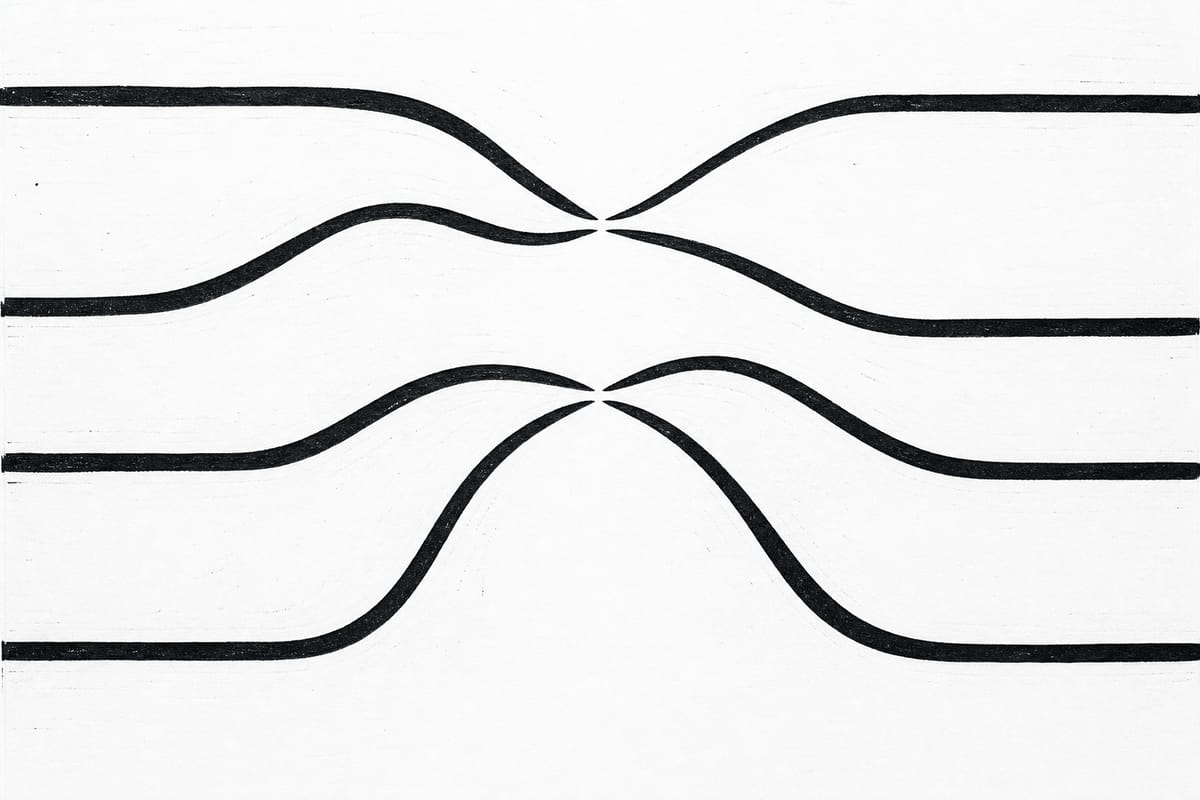
Harmony is a by-product. You move a small number of lines by the smallest distance available, and chords are what happens where those lines line up vertically. The source course states it flatly: "Voice-leading is the skeleton of harmony" (Source course, Lesson 16).
That is one claim with three consequences you will use. First, the notes that matter are the ones that move, which is why guide tones (the third and the seventh) carry a ii-V-I and the roots do not. Second, if you keep the lines smooth you can go almost anywhere harmonically, including places a Roman numeral cannot name. Third, the reverse is available: pick a distant chord, then find the voice-leading that makes it inevitable.
Bill Evans built a style on the first two. Chromatic-mediant writing in art rock lives on the third. Both are the same skill, applied at different distances.
Watch
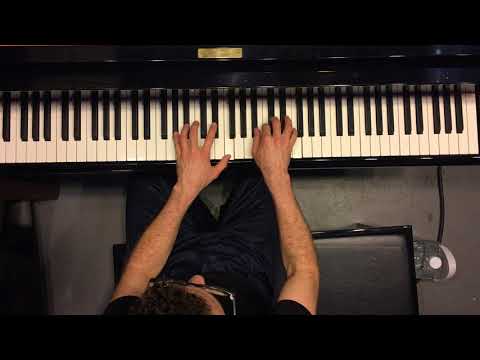
Voiceleading exercise (https://www.youtube.com/watch?v=rg-EP4rRTEs)
- The exercise is a chain Greg learned from Russell Ferrante, played through all twelve keys ascending by half step at [02:15]. Learn the chain first and worry about what it means second.
- At [02:46], the same chain flipped, which he calls reverse harmony. This is the connection to L21, and here you only need it as a voice-leading move.
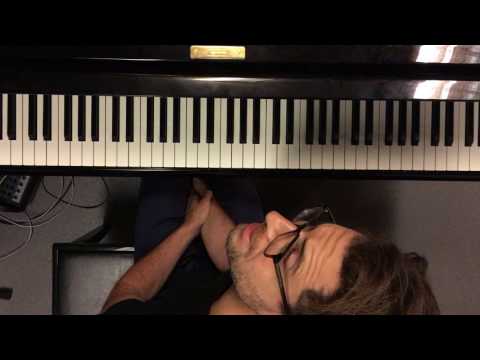
- At [05:20], the load-bearing observation: the tension points survive the mirror. The lines change identity and the shape of the tension does not. If you understand why, you understand what voice-leading actually is. Reverse Harmony, first three minutes only (https://www.youtube.com/watch?v=JfzN9e9OcKc)
- At [00:53], the axis, "in between an E and an E flat." Note the pitch and move on.
- At [02:21], the mirrored dominant lands on "your minor four with a major 6." A dominant becomes a plagal chord, and the reason is entirely in the voice-leading. Stop the video there. L21 handles the rest and the argument about it.
Voiceleading exercise
- one chain, all twelve keys, then the same chain inverted, with the tension points held constant
Reverse Harmony
- watch the first three minutes only, for the mirror as a voice-leading device; the full argument is L21
Listen
Evans, "'Round Midnight," the 30 May 1963 live trio version. Larson transcribes five complete Evans performances of this tune. Pass one: the melody only. Pass three: the top note of each left-hand voicing. Pass five: whether the melody's expected resolution arrives when you think it will. Larson's reading is that Evans's premise is the closing motive and the delay of its resolution, and that in measures 3 and 4 a descending fourth progression with delayed tones produces the ninths and thirteenths on the surface. The extensions are a consequence of the delay.
Evans, "'Round Midnight" from Conversations with Myself. Three pianos, all Evans, recorded February 1963, and Larson isolated the individual tracks from the original multitrack tapes. Pass one: pick one piano and follow it. Pass five: hear where two of them converge and what the third does at that moment.
Evans, "Autumn Leaves." The source course uses this tune in G minor for its worked voice-leading example. Pass one: the bass. Pass three: sing the seventh of each chord and hear it fall by step to the third of the next. That single motion is the ii-V-I engine.
Genesis, "The Lamb Lies Down on Broadway," introduction. Holm-Hudson analyses this as balanced harmonic progression: at every chord change the signed semitone displacements of the voices sum to zero. One voice up two, another down two. Pass one: hear it as a wash. Pass five: track two voices and check the arithmetic. Of everything in the Genesis literature this is the most transferable device to a piano.
Radiohead, a track you already know. Listen for a chord change where the root moves by a third and one or two notes stay put. That is a chromatic mediant, and hearing one in music you already have in your ears is worth more than a new track.
The comparison
The exact parallel. Schenker's claim is that a tonal piece is a large-scale prolongation of one structural progression, and that the surface is an elaboration of a few structural lines. Larson's claim is that jazz improvisation works the same way, and he argues it with full Schenkerian graphs of Evans, Coltrane and Bill Evans's contemporaries. His definition of improvisation is worth memorizing: "the real-time yet pre-heard, and even practiced, choice among possible paths that elaborate a pre-existing structure" (Larson 2005). Reading the sentence closely tells you what to practise. Pre-heard. Practised. Choice among paths. Elaborating a structure that exists before you play.
Larson's analytic apparatus makes this concrete with linking motives (a figure that connects one structural point to the next) and closing motives (the figure that ends a unit). Evans's "'Round Midnight" is built on the second of those, with resolution consistently postponed, and Larson notes Evans's avoidance of scale-degree 1 and his use of a C flat upper neighbour as recurring markers.
Where it breaks, first break. Schenkerian analysis assumes that dissonance is prolongational, meaning it must eventually resolve into consonance. Jazz contains tensions that never resolve at all. McFarland's argument is that the added sixth and the augmented ninth in Evans's playing are stable sonorities, not dissonances awaiting treatment, so a strict Schenkerian graph has to either mis-hear them as consonant or invent a resolution that no listener hears. Carry this forward: the technique of smooth lines transfers cleanly; the theory of structural levels transfers with a hole in it.
The citation is now settled: Mark McFarland, "Bill Evans and the Limits of Schenkerian Analysis," Journal of Schenkerian Studies 6 (2012): 33–66. Note what he actually analyses, because it narrows the claim usefully. He works from three early recordings, "Who Can I Turn To?" and "My Foolish Heart" from Bill Evans at Town Hall (1966) and "Goodbye" from Empathy (1962), and he restricts himself to Evans's opening statement of each tune. That deliberately sets the improviser aside and examines Evans the interpreter, which is where his harmonic thinking is most exposed.
Where it breaks, second break, and this is the one that matters for composing. Schenker's system requires a structural dominant. Much of the harmony you actually want to write does not have one. Capuzzo's argument in Music Theory Spectrum is that neo-Riemannian operations are well suited to exactly those progressions, and he names the conditions: progressions "that lack structural dominant harmonies, and that lack leading tones," typically featuring modal mixture and root motion by third. That is a precise description of chromatic-mediant writing.
The operations are three, and they are inversions that hold two notes and move one:
- P (parallel) turns C major into C minor. One voice moves a semitone.
- L (leading-tone exchange) turns C major into E minor. One voice moves a semitone.
- R (relative) turns C major into A minor. One voice moves a whole tone.
Compose them and you travel a long way with tiny motion. C major to A flat major is P then L then P, three moves, and it sounds inevitable at the keyboard while looking absurd on paper.
Capuzzo also draws a distinction you should keep. Pitch-class parsimony is what the operations describe, meaning the smallest motion between abstract pitch classes. Pitch parsimony is what your hands do, meaning the actual registral distance between the notes you play. They come apart constantly, and the second one is what a listener hears. When you voice these progressions, optimize the second.
Where it breaks, third break, and it is a sourcing break, narrower now than it was. Brad Osborn's Everything in its Right Place: Analyzing Radiohead (Oxford, 2016) is verified for this course, with Brett Clement's page-numbered review as the way into its interior. What Osborn documents is form, rhythm and what he calls salience, the sweet spot between expectation and surprise (Osborn 2016, p. 11). He supplies no analysis of chromatic mediants or mode mixture, and nothing verified for this course says anything about the harmony of "Pyramid Song," so that claim stays to verify and you cite nobody for it. The harmonic argument here is Capuzzo's and holds on its own. He analyses Radiohead inside his pop-rock repertoire and states the condition quoted above. Apply his mechanism to a Radiohead track by ear and attribute nothing to Osborn that he did not write.
One line of Osborn's bears on this lesson sideways. He claims Radiohead's music has "none of the surface level traits from progressive rock bands of the 1970s" (p. 10), and Clement's review answers that most of the techniques Osborn discusses are commonplace in experimental rock, progressive rock chief among them. If you want documented chromatic-third writing in this tradition, it sits in the prog literature, which is why the Genesis page below is in this lesson and no Radiohead chapter is.
A correction to the received story. Chromatic mediants are routinely taught as a colour effect, a splash of the unexpected. Capuzzo's framing is the opposite and the better one: they are what harmony does when the dominant is unavailable. If the leading tone is gone, root motion by third with common tones held is the strongest available connection between two chords. It is structural, not decorative.
At the piano
Guide tones alone. Play a ii-V-I in every key using only the third and seventh of each chord, two notes per hand position, right hand alone. In C: F and B, then F and B flat, then E and B. Hear the whole progression in two voices before you add anything.
Evans rootless voicings. The source course's A-form set, left hand:
- Dm7 as F A C E
- G7 as F A flat B E
- Cmaj7 as E G B D
Note what happens between the first two. Two notes hold, one moves a semitone, one moves a semitone. That is the whole design. Play the three in sequence until the hand stops thinking about which chord it is on.
Drop 2. Take a four-note close voicing, drop the second voice from the top by an octave, and you have the standard opening-out move the source course works through. Do it to all three voicings above.
The Ferrante chain. Learn Greg's chain in one key, hands as he plays it, then take it up by half step through all twelve. Do not move to a new key until the current one is fluent. The point is the hand learning the motion, not the mind learning the sequence.
The mediant walk. From C major, play P, L, R and their inverses one at a time, holding the two common tones each time and moving only the third voice. Say the destination chord out loud before you play it.
Balanced progression. Pick any four-voice chord. Move one voice up two semitones and another down two. Play the result. Repeat four times. This is Holm-Hudson's Genesis device, and it generates progressions you would never find by ear.
Exercises
1. Two-voice reduction
Do. Take an eight-bar progression of your own. Reduce it to guide tones only, two voices, and play it.
Done when: the reduction is playable at 80 bpm and you can name every chord from the two voices alone.
2. Rootless voicings, twelve keys
Do. Play the Dm7, G7, Cmaj7 A-form set in all twelve keys, left hand only, four beats each.
Done when: you can do it at 70 bpm without stopping and with the semitone motions audible.
3. The Ferrante chain
Do. Learn Greg's chain and take it through all twelve keys ascending by half step, as in the video at [02:15].
Done when: three consecutive error-free passes at whatever tempo is honest for you, which may well be 50 bpm.
4. Mirror the chain
Do. Invert the chain around the axis between E and E flat, as at [02:46], and play it. Then identify the two moments Greg calls tension points at [05:20] and confirm they are still there.
Done when: you can play both versions back to back and say what the mirror preserved and what it changed.
5. Chromatic mediant with common tones
Do. Write a sixteen-bar progression in which every chord change is a root motion by third with at least one common tone held in the same octave. No dominant sevenths, no leading tones.
Done when: it is playable, no change requires a jump larger than a whole tone in any voice, and you can name the P, L and R composition for each move.
6. Balanced displacement
Do. Build an eight-chord progression in which the signed semitone displacements sum to zero at every change, then voice it for two hands.
Done when: the arithmetic checks at all eight changes and you can play it.
Compose
Write a three-minute piece in two halves.
The first half is voice-led tonal writing. Four voices, no voice moving more than a whole tone at any change unless the melody demands it, guide tones carrying the harmony, at least one full ii-V-I in Evans's rootless voicings.
The second half is the same material with the dominant removed. No leading tones, no dominant sevenths. Every connection is a chromatic mediant or a balanced displacement. It must arrive somewhere convincing without a cadence.
The hinge between the halves is a single chord that belongs to both.
Then produce a two-voice guide-tone reduction of the whole piece on one stave and check that it stands up alone. If the reduction is dull, the piece is decorated rather than composed, and you go back to the reduction first.
Checkpoint
- Play a ii-V-I in guide tones only, any key, on request.
- Play the Evans rootless set in six keys at 70 bpm.
- Play the Ferrante chain in all twelve keys and its mirror in at least one.
- Execute P, L and R from any major or minor triad, naming the destination in advance.
- State Capuzzo's condition for when neo-Riemannian operations apply, in his terms.
- State the McFarland objection to Schenkerian analysis of Evans, and name the three recordings he builds it on.
- Say what Osborn's Radiohead book covers and what it does not, and name who carries the chromatic-mediant claim instead.
- Hand over the piece and its two-voice reduction.
Read
- Source course, Lesson 16 (/library/garnett-course.pdf). The whole lesson. The worked ii-V-I, the rootless voicings and the drop-2 example are the technical spine of this lesson, and the "Autumn Leaves" example is the listening.
- Larson, Analyzing Jazz: A Schenkerian Approach (Pendragon Press, 2009, ISBN 9781576471869; the publisher's own site does not currently serve over a working connection, so order it by ISBN). Read the "'Round Midnight" chapter, which is the reason to own the book. The graphs will be hard at first. Read them as five lines on a page, not as notation.
- Larson, "Composition versus Improvisation?" (DOI 10.1215/00222909-008). Read for the definition of improvisation quoted above and nothing else. Which specific Evans performance sits on which page is unconfirmed, so cite the definition and attribute no tune to it.
- Capuzzo, "Neo-Riemannian Theory and the Analysis of Pop-Rock Music" (DOI 10.1525/mts.2004.26.2.177). Twenty-four pages. Read the introduction for the conditions, the middle for the operations, and skim the analyses. His pitch-class versus pitch parsimony distinction is the practical takeaway.
- Holm-Hudson, Genesis and The Lamb Lies Down on Broadway, p. 59. One page for the balanced progression device.
- Osborn, Everything in its Right Place: Analyzing Radiohead (https://doi.org/10.1093/acprof:oso/9780190629229.001.0001), pp. 10–11, with Clement's review (https://mtosmt.org/issues/mto.17.23.2/mto.17.23.2.clement.html). The salience thesis and the argument about how much prog is in this music. Neither gives you a chromatic-mediant analysis, which is why you read them here.
- Mark McFarland, "Bill Evans and the Limits of Schenkerian Analysis" (Journal of Schenkerian Studies 6, 2012, 33–66), https://digital.library.unt.edu/ark:/67531/metadc330546/. Read it against Larson, because it is the strongest published objection to Larson's method applied to Evans. Note that McFarland works from three early recordings, "Who Can I Turn To?", "My Foolish Heart" and "Goodbye," and limits himself to Evans's opening statement of each tune rather than to his improvising.