The idea
Source course, Lesson 5 is built on one sentence of Rosen's, which the course calls perhaps the most important sentence written about music in the last century of scholarship: expression is always concentrated in the dissonance.
The course then gives a definition that survives crossing between styles, which the acoustic and historical ones do not. A consonance is a sound that can rest. A dissonance is a sound that implies motion. Nothing in it mentions intervals, so it works on a Bach suspension, on a 3/4 superimposed inside a 4/4, and on a section in the wrong key.
Rosen's structural dissonance says the opposition of keys functions as a dissonance at the level of the whole form. Babbitt extends that to rhythm, dynamics, register, and timbre: an irregular rhythm following a regular one is a dissonance, and it wants to resolve.
That is your missing movement, stated as a mechanism. Your writing has consistency without progression, and your sections behave like boxes. A section is a box when nothing in it is unresolved. Tension makes the next section necessary.
Watch

Three Secrets to Hearing Chord Changes
- At [02:55], the whole lesson in one note. Between F7 and B flat 7, "the difference in those is this one note," A against A flat. On the C7 that same note is the 13, "just an upper extension that doesn't really pull in one direction or another, it's just a color."
- At [04:03] he separates three things that sound similar and behave differently: chord tone, directional extension, and pure color. That is the dissonance continuum in his own words.
- Exercise 2 at [09:26]: only the third and seventh of every chord that goes by, with rhythmic continuity and a question-and-answer shape. The rationale at [10:48]: "the three and the seven are the two most important defining notes of every chord change."
- Exercise 3 at [11:01], improvising strictly between the 5 and the 5, and the prerequisite at [11:18]: only after the three-and-seven exercise, because you need the harmony in the ear first.
- The benchmark at [08:36]: the blues in all twelve keys at 120.
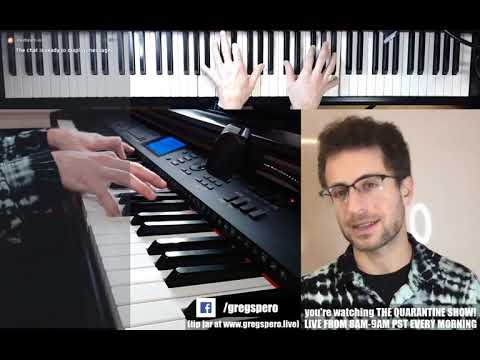
The most dissonant chord in the world
- Seventy seconds. The voicing spelled at [00:10]: 3 and 7 at the bottom, then sharp 9, sharp 5, flat 9, tritone on top. Every available alteration at once.
- The resolution at [00:33] is a minor chord with a major 7, the melodic minor sound used both directions.
- The assignment at [01:00]: learn it in all keys.
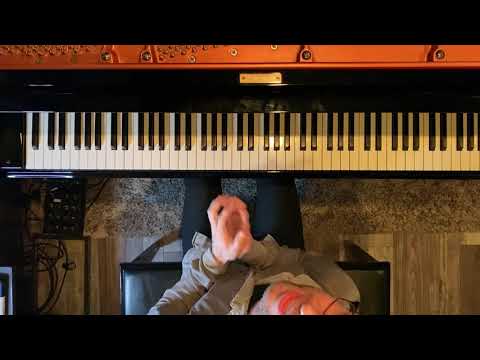
The Most Beautiful Chord in the World
- Credited at [00:03] to Ruslan Sirota. Another altered dominant with nearly every alteration, the darker end of the color.
- The instruction that matters more than the notes, repeated at [01:09], [02:08], and [03:31]: hear and understand every bit of it, feel every bit of it while you internalize it.
- Watch these two back to back on purpose. Two chords stuffed with alterations, one presented as maximum tension and the other as beauty. The difference is context and voicing, not dissonance content.
Listen
Mozart, Piano Sonata in C major, K. 545, first movement. The course calls it the famous easy sonata and notes that it is not easy to hear.
Pass 1: just listen. Pass 2: find where the exposition arrives in G major, the structural dissonance. Pass 3: follow the development's wandering. Pass 5: hear the recapitulation, where the second theme appears in C rather than G. That is the resolution: material that was in the wrong key is now home. You need the arrival in G, the wandering, and the return, not every chord.
Miles Davis, "So What." The course's account of the solo's shape: almost entirely consonant note choices at the start, gradually more chromatic material, maximum dissonance in the climactic chorus, then a pull back at the close. That arc mirrors what a Classical sonata does with keys. The course adds the honest line: Miles almost certainly did not think in those terms, "but the ear knows what it knows." Describing a shape is not claiming an intention.
Meshuggah, "Bleed," 0:00 to 2:15. A third pass, now with parametric dissonance as the frame. Nothing in the pitch domain generates tension. The dissonance is entirely metric: a riff cycle that will not sit still against a grid that will not move. Ask on each pass which parameter carries the tension.
A Bach chorale, for suspensions. The course's example is precise. The soprano holds a D while the bass moves from G down to C. Against G the D was a consonant fifth, at rest. Against C the same D is a dissonant ninth, resolving down by step to C. Preparation, suspension, resolution. The expressive peak is the middle stage. The note was at rest, and then the ground moved under it.
Metric dissonance with a formal job. Biamonte argues that metric dissonance in rock does formal work rather than decoration, and names four functions: initiating dissonance, where a passage begins displaced and settles; the cadential hemiola, a quadruple-to-triple shift acting as a cadence; truncated links between sections; and sectional demarcation, where the dissonance marks a boundary the harmony does not.
Her song examples were not captured in this curriculum's research, so do not attribute tracks to her from memory. Find one instance of each function in music you already listen to, write the track and timestamp, and label it your own identification.
The comparison
The parallel. Tension and resolution is one mechanism operating at every scale and in every parameter. In Mozart it is a key. In the chorale it is one note held while the bass moves. In "Bleed" it is a cycle against a grid. Source course, Lesson 5 makes the extension explicit through Babbitt: an irregular rhythm after a regular one is a dissonance, and so is a sudden fortissimo inside a quiet passage, and so is a note in an unexpected octave.
Meyer supplies the general account: musical affect arises when a tendency to respond is inhibited, and meaning is a function of learned stylistic probability rather than acoustics. Huron adds the five-system ITPRA model of reaction, tension, prediction, imagination, and appraisal.
Where it breaks, in three places.
Learned probability against reflex. Meyer's expectations are culturally learned all the way down; Huron grounds reaction and tension in pre-cultural reflexes, and that joint is where his critics push. If tension is learned, an audience unfamiliar with your idiom will not feel your resolutions. You write for listeners who know prog and metal, so design accordingly.
Resolution against arrival. In Mozart the structural dissonance resolves through harmonic syntax, and the second theme's return in the tonic is a syntactic event. In the metal case the alignment point is arithmetic; the cycles come due. Both are heard as arrival, and only one is a resolution in the classical sense.
Cadential hemiola in Corelli against cadential hemiola in rock. Biamonte names the Baroque and Classical hemiola as the direct ancestor, and the device is identical. In Corelli it coincides with a specific harmonic progression, so it is predictable. In rock it is often the entire cadential signal, so it has to be stronger and more literal. Import the device and you increase the dose.
One further tool for later. Cone defines a structural downbeat as a simultaneous harmonic and rhythmic arrival so powerful that it retrospectively turns everything before it into its own upbeat, so a whole composition could be one rhythmic impulse completed at the final cadence. It is the cleanest statement of what your sections should do to each other, and it returns in Module 5.
At the piano
The chord-level experiment. Source course, Exercise 5.1, slowly. C major triad in a middle register, let it ring, notice it can rest. Add B flat above the G and feel the change, which comes from the tritone between E and B flat. Resolve to F major.
The key-level experiment, immediately after, so you feel both in one sitting. Play C major. Then G, C/G, D, G to establish G as a key. Now play G7 and feel the tritone pull toward C. Resolve. The first was dissonance at chord level, the second at key level. Same feeling, different scale.
The suspension by hand. C major triad in the right hand, C in the bass. Move the bass down to B while holding the right hand. The E, a consonant third above C, is now a dissonant fourth above B. Sit in it, then resolve. Stay in the middle stage one beat longer than is comfortable.
The three-and-seven exercise. On an F blues, thirds and sevenths only, with rhythmic continuity and a question-and-answer shape, over a metronome. Then "Autumn Leaves."
The altered stack. Build Greg's maximum-alteration dominant on C: 3 and 7 low, then sharp 9, sharp 5, flat 9, tritone on top. Resolve to C minor with a major 7, then find three other resolutions. The left hand takes the 3 and 7.
Exercises
1. Chord level, then key level
Do. Both halves of Exercise 5.1 above, slowly, in one sitting.
Done when: You can say in a sentence what the two experiments share and what changed.
2. Suspension ladder
Do. Play a 4-3, a 7-6, and a 9-8 suspension in C, then in three other keys. Name the three stages out loud: preparation, suspension, resolution.
Done when: You can produce any of the three on request, in four keys, holding the suspension two full beats without rushing the resolution.
3. The three-and-seven
Do. On an F blues, thirds and sevenths only, with rhythmic continuity, over a walked bass or a metronome. Then the same on "Autumn Leaves."
Done when: You play a full chorus of "Autumn Leaves" without missing a change.
4. The dissonance arc
Do. Improvise a blues chorus where the first four bars use chord tones only, the middle four add diatonic extensions, the next two use chromatic approach tones, and the last two return to chord tones. Record it.
Done when: Listening back, you hear the arc without knowing in advance where the sections were.
5. Parameter audit
Do. Take three tracks you love, one from each of three genres. For each, find the moment of maximum tension and write which parameter carries it: pitch, rhythm, dynamics, register, or timbre.
Done when: Your three answers are not all the same parameter, and you can defend each with a timestamp.
6. Biamonte's four functions, in your own listening
Do. Find one instance each of initiating dissonance, cadential hemiola, truncated link, and sectional demarcation in music you know. Write track and timestamp for each, labeled as your identification rather than hers.
Done when: You have four timestamps and can play each and say what the metric dissonance is doing formally.
Compose
No composing. This is the module's last transcription, and the analytical one.
The assignment. Transcribe the first chorus of Miles Davis's trumpet solo on "So What."
Constraints:
- One line, single notes, by hand. It is the most transcribable thing in this module, which is why Greg puts it on his list of five.
- Mark every phrase's tension on a scale of one to five, where one is chord tones on strong beats and five is fully outside.
- Plot those numbers as a shape and compare it to the course's description of the whole solo: consonant beginning, gradual chromatic increase, maximum dissonance at the climactic chorus, pull back at the close.
- Write two sentences on where your first chorus sits inside that arc.
Then a short pass on your own music. Take one section of your 2016 EP and mark its tension bar by bar on the same scale. If the numbers do not move, that is the finding, and it is the diagnosis you and Greg already reached, in a form you can see.
Checkpoint
This is the checkpoint for the whole module. Before L6:
- Both halves of the chord-level and key-level experiment, explained in a sentence, and three suspension types in four keys held two beats.
- A full "Autumn Leaves" chorus on thirds and sevenths, no missed changes.
- One recorded blues chorus with an audible tension arc.
- Parameter audit complete, three genres, three different answers.
- Four Biamonte functions identified in your own listening, with timestamps.
- The first chorus of the "So What" solo transcribed by hand, with its tension plot, plus the tension plot of one section of your own EP, honestly marked.
Module gate: five transcriptions exist on paper, L1 through L5, every one annotated. Module 2 begins the week that is true.
Read
- Source course, Lesson 5. Read the structural-dissonance section twice. It is the concept the rest of Part B keeps using.
- Meyer, Emotion and Meaning in Music (1956). The chapters on expectation and on pattern perception: the Law of Good Continuation, completion and closure, and the weakening of shape.
- Huron, Sweet Anticipation (2006). Read the ITPRA chapter. This curriculum did not verify page-level claims about his account of syncopation, so read it yourself before quoting it. https://doi.org/10.7551/mitpress/6575.001.0001
- Biamonte 2014, Music Theory Online 20/2, https://mtosmt.org/issues/mto.14.20.2/mto.14.20.2.biamonte.html. Short and free. Read it for the four formal functions and take her song examples from the article, not from anywhere else.
- Cone, Musical Form and Musical Performance (1968), 24–25 and 38. Two pages on the structural downbeat, seed of Module 5.