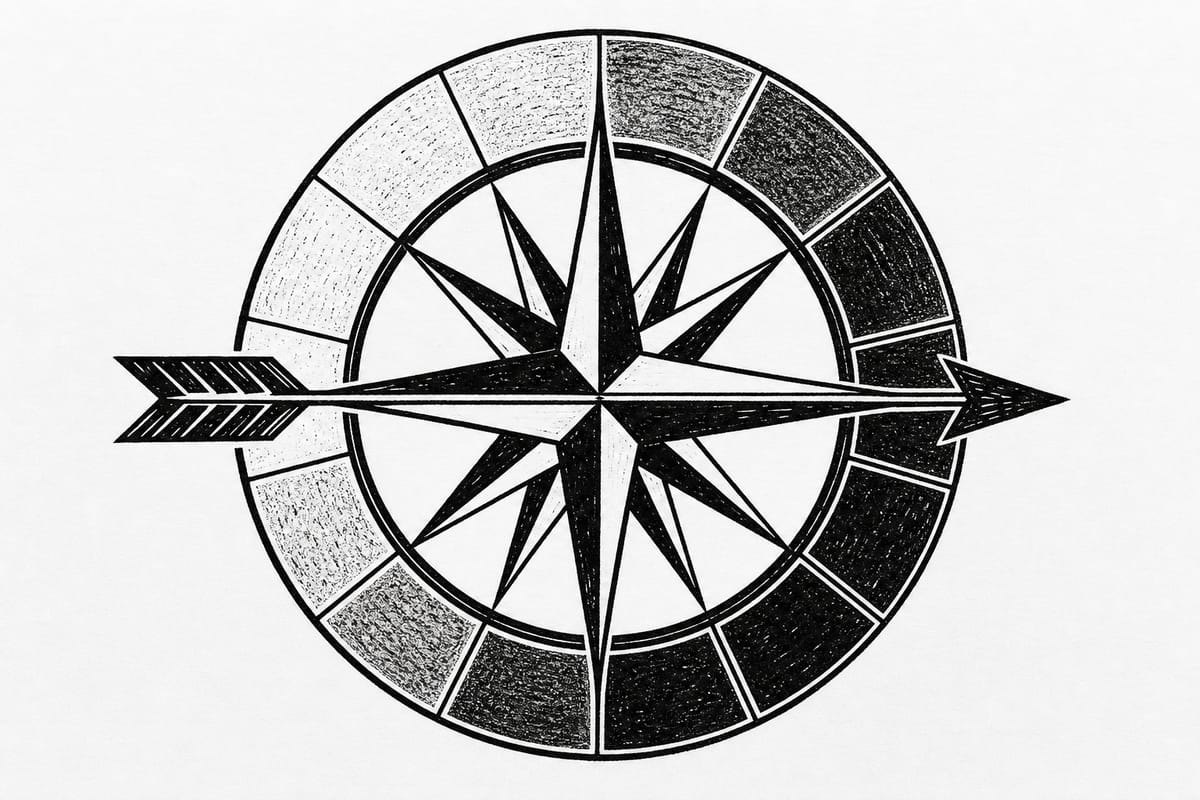
The idea
The circle of fifths is three things at once, and teaching it as one of them is why most people find it useless.
It is a map of the keys, a lookup table for the fifteen key signatures.
It is the engine of harmonic motion. Root movement down a fifth is the strongest move in tonal music, and the circle is that move repeated until it comes home.
It is a practice order, and the one to be careful with. Every scale, chord quality, voicing, and lick in this curriculum gets run around it in both directions until the twelve keys stop being twelve separate problems, but Greg has explicitly rejected a rote key-by-key march around the circle for an ear-first student. The circle tells you which key comes next. Your ear tells you when the last one is finished.
You asked Greg what a secondary dominant is. It is a detour on this circle, and by the end of this lesson it will be obvious rather than a term.
Watch
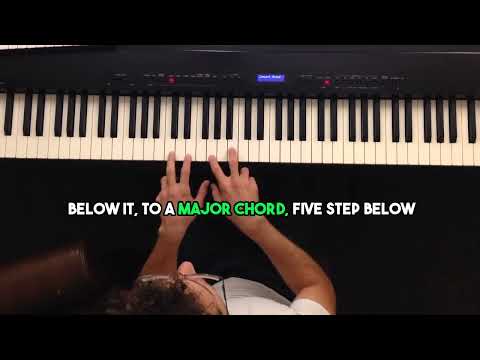
Jazz Piano: The Circle of Fifths (Greg Spero, Weekly Piano)
- Forty seconds and one idea: D minor, to the dominant a fifth below, to the major a fifth below that. "Going around the circle of fifths from minor to dominant to major, that's the foundation of well music in general but especially jazz."
- He keeps it moving by adding the six. That is back-cycling, and it is how the fragment becomes a loop.
Basics of Music Theory, at [21:27]
- The travel rule: turn any chord dominant and it becomes the five of the next one, which is how he walks C to F to B♭ to E♭ to A♭ to D♭ and back. At [21:59] he states it flat: "Any chord that you want to get to, you can get to from the five of that chord."
Chord progressions with 7th chords, at [06:17] and [12:08]
- The correction that keeps this lesson honest. Running the raw circle "is not so musical," so instead "pick a progression and then do that in all the keys." The circle is the route, not the material.
- The minor-thirds cycle at [12:08] covers all twelve keys in three passes: C, E♭, F♯, A, then D♭, E, G, B♭, then D, F, A♭, B. Use it once circle order has stopped teaching you anything.
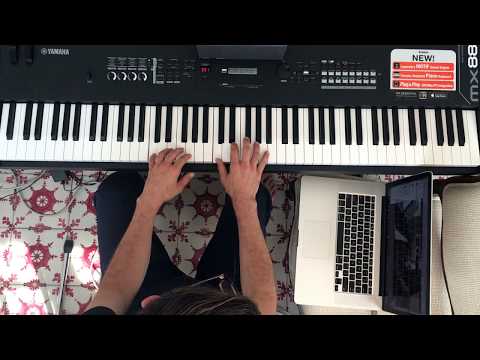
Basic Piano Lesson #1: Major scales and triads
- the all-keys practice standard the circle organizes, and the voice-leading chain at [48:28]
Listen
Two tracks, three passes each. Pass 1, follow the bass note only and hum it. Pass 2, name the root motion between each pair of chords by interval. Pass 5, decide whether the circle explains the motion or has nothing to say about it.
Circle motion is a claim about root movement by descending fifth, the mechanism the source course calls the tonic-dominant polarity (Lesson 11). Plenty of modern music keeps it intact, apparatus and all. Plenty of it replaces fifth motion with motion by major third, which the circle cannot describe at all. Both tracks below come from the same study, and they sit at opposite ends of it.
Boddington Jordan and Herbst analyzed one hundred metal tracks released since 2000, twenty each from five subgenres, and their findings split cleanly. Power metal stays closest to common-practice tonality, using secondary dominants and diminished sevenths as modulation devices exactly as the Baroque repertoire does. Their worked example is Heavenly's "Keepers of the Earth" at 0:49: three rising secondary dominants into a perfect cadence in C, then a B♭ diminished seventh at bar 12 acting as a secondary leading-tone chord into B major. Their own caution matters as much as the finding. In that idiom the devices carry rhetorical rather than structural weight, coloring a progression and signaling genre rather than organizing the song's long-range plan.
Black metal is the other pole. All twenty-four possible triads appear, and the progressions are better analyzed through Weitzmann regions than through function. Their example is Leviathan at 0:42: E♭m, C♭m, Gm, B♭, one chord every two bars, all inside one Weitzmann region, with the three non-diatonically related chords descending by major third. That is chromatic-mediant motion, and the circle has nothing to say about it. The one functional gesture in the passage is the last chord, B♭, which they read as a dominant returning to E♭ minor, so the only pull the circle could have predicted arrives at the very end.
Biamonte's rock study lands in between. Her flat-side patterns still map onto the cycle of fifths, so the circle remains the coordinate system, but those triads have no leading tone and no cadential drive. A8b takes that up in detail.
Carry this into Part B. The circle explains dominant motion completely and third motion not at all. When a progression stops behaving, check whether the roots are moving by third. They usually are.
At the piano
The circle. Outer ring is the major key, inner ring is its relative minor, and the number is its signature. Clockwise adds sharps. Counter-clockwise adds flats.
                              C
                             Am
                        0 sharps, 0 flats

            F                                     G
            Dm                                   Em
          1 flat                                1 sharp

      B♭                                              D
      Gm                                              Bm
     2 flats                                        2 sharps

    E♭                                                  A
    Cm                                                 F♯m
   3 flats                                           3 sharps

     A♭                                                E
     Fm                                               C♯m
    4 flats                                         4 sharps

        D♭                                        B
        B♭m                                      G♯m
       5 flats                                 5 sharps

                    G♭    =====    F♯
                   E♭m              D♯m
                  6 flats          6 sharps

     counter-clockwise = flats        clockwise = sharps
     outer ring = major               inner ring = relative minor
The fifteen key signatures. Sharps arrive in the order F C G D A E B, flats in the order B E A D G C F, the same list backwards. Two shortcuts: the last sharp is the seventh degree, so raise it a half step for the tonic; the second-to-last flat is the tonic itself.
| Major | Relative minor | Signature | Accidentals in order |
|---|---|---|---|
| C | A minor | none | |
| G | E minor | 1♯ | F♯ |
| D | B minor | 2♯ | F♯ C♯ |
| A | F♯ minor | 3♯ | F♯ C♯ G♯ |
| E | C♯ minor | 4♯ | F♯ C♯ G♯ D♯ |
| B | G♯ minor | 5♯ | F♯ C♯ G♯ D♯ A♯ |
| F♯ | D♯ minor | 6♯ | F♯ C♯ G♯ D♯ A♯ E♯ |
| C♯ | A♯ minor | 7♯ | F♯ C♯ G♯ D♯ A♯ E♯ B♯ |
| F | D minor | 1♭ | B♭ |
| B♭ | G minor | 2♭ | B♭ E♭ |
| E♭ | C minor | 3♭ | B♭ E♭ A♭ |
| A♭ | F minor | 4♭ | B♭ E♭ A♭ D♭ |
| D♭ | B♭ minor | 5♭ | B♭ E♭ A♭ D♭ G♭ |
| G♭ | E♭ minor | 6♭ | B♭ E♭ A♭ D♭ G♭ C♭ |
| C♭ | A♭ minor | 7♭ | B♭ E♭ A♭ D♭ G♭ C♭ F♭ |
Three pairs are the same keys on the piano and different on paper: B and C♭, F♯ and G♭, C♯ and D♭. Which one a composer writes is a readability choice, and you will make it yourself in A17.
The circle of fourths is the same circle read the other way. A fifth up and a fourth down land on the same pitch class, so counter-clockwise by fifths is clockwise by fourths. Jazz musicians say "around the fourths" because that is the direction harmony travels: each chord resolves down a fifth, which is up a fourth. It is also the order Greg ran your scales in: C, F, B♭, E♭, A♭, D♭, F♯, B, E, A, D, G, back to C. Practice both directions. Clockwise is harder and that is the point.
The circle is also the mode ladder. This is the piece Greg spent the longest on in your lesson, and his live walk around it compressed a step. Here is the clean version. Hold C as the root and change the parent key one position at a time:
| Parent key | Mode on C | New alteration |
|---|---|---|
| G | C Lydian | ♯4 |
| C | C Ionian | none |
| F | C Mixolydian | ♭7 |
| B♭ | C Dorian | ♭3 |
| E♭ | C Aeolian (natural minor) | ♭6 |
| A♭ | C Phrygian | ♭2 |
| D♭ | C Locrian | ♭5 |
Each step counter-clockwise flats exactly one more note, and the notes arrive in circle order: ♭7, ♭3, ♭6, ♭2, ♭5. Two ends, two walls. You cannot go brighter than Lydian, because the next sharp would raise the root itself. You cannot go darker than Locrian, because the next flat would lower the root itself. In Greg's words from the Poseidon lesson notes, "flatting the C itself removes the root, that's the wall on the far side of the circle."
A9 is the whole lesson on this. What belongs here is the geometry: a mode is a position on the circle relative to your root, not a degree of some other scale.
The ii-V-I is three consecutive stops on the circle. In C: D, then G, then C. Every ii-V-I you will ever play is a three-chord slice of this wheel, which is why learning it in one key teaches you almost nothing.
Secondary dominants are one-step detours. Any chord in a key can be preceded by the dominant seventh a fifth above it, borrowed from outside the key. In C the ii chord is Dm7; the fifth above D is A; so A7 pulls into Dm7 the way G7 pulls into C. You write it V7/ii, read "five of two." Greg's own way of putting it in the Poseidon lesson notes is "the one could be the five of another key," worked out as D7 to G7 to C, "five of five, to five, to one." Play C, A7, Dm7, G7, C and listen to the C♯ inside the A7. A note from outside the key makes the next chord feel inevitable. That is the whole device. The common ones in a major key are V7/ii, V7/iii, V7/IV, V7/V, and V7/vi.
Exercises
1. Key signatures, cold
Do. Have a partner name a key. Say the number of accidentals and list them in order, then play the scale. Both directions around the circle. Twenty calls per session.
Done when: Twenty out of twenty, under two seconds each, including the enharmonic pairs.
2. One quality, all twelve, ear-led
Do. Pick one chord quality from A7 and take it counter-clockwise along the path from the Poseidon lesson notes: C, F, B♭, E♭, A♭, D♭, F♯, B, E, A, D, G, back to C. Metronome at 40, one chord per click. Sing the root before you play each chord and do not move to the next key until the current one arrives with no hesitation. Then run it clockwise. Change quality each day.
Done when: Every quality from the A7 list runs both directions with no hesitation and no hunting on black-key roots. Greg's standard, from the Poseidon lesson notes: "You've got it when your brain doesn't hesitate at all and it's completely natural."
Adjacent keys on the circle share all but one note, which is why this order is easier than chromatic order and why it is worth singing. You are not learning twelve keys. You are learning one key and moving one note at a time.
3. The dominant chain
Do. C7 to F, F7 to B♭, B♭7 to E♭, all the way home, using the shell voicing of 3 and 7 in the right hand and the root in the left. Then do it with the 3 and 7 inverting each time, so one of them moves a half step and the other stays.
Done when: The full twelve-chord cycle is fluent and the two guide tones swap roles at every chord without you thinking about it.
4. Secondary dominants, built in
Do. Take the progression C, Am7, Dm7, G7, C. Insert V7/vi before the Am7, then V7/ii before the Dm7, then V7/V before the G7. Play the plain version and the detoured version back to back. Then transpose the whole thing around the circle.
Done when: You can insert any secondary dominant on request in four keys and name it correctly out loud before you play it.
5. A progression, not the circle
Do. Follow Greg's own correction. Pick one progression, either the ii-V-I or the "Closer" progression he shows at [16:51] of Chord progressions with 7th chords, and run that through all twelve keys rather than running the bare circle.
Done when: One real progression is fluent in all twelve keys from memory, at tempo.
6. The sixteen-bar cycle
Do. Improvise sixteen bars over a cycle progression, left hand walking roots down in fifths, right hand playing 3 and 7. Start on any chord and land on the tonic on bar 16. Model it on the "I Got Rhythm" bridge, which the source course describes as "leaving B♭ major for the cycle of dominants (D7, G7, C7, F7) that leads back to the top."
Done when: You can start on any of the twelve roots and arrive home on bar 16 without counting, and the line has a shape rather than running scales.
7. Where it breaks
Do. Listen to "Keepers of the Earth" from 0:49 and to Leviathan's "Fucking Your Ghost in Chains of Ice" from 0:42. Write half a page on which one still uses circle motion and which one has abandoned it.
Done when: You can state the difference in one sentence, without using the word interesting.
Checkpoint
- All fifteen key signatures spelled cold, in order, in under two seconds each.
- One chord quality played around the full circle in both directions at 40 with no stop.
- Any of the five common secondary dominants inserted into a progression on request, named before played, in four keys.
- One real progression fluent in all twelve keys from memory.
- Sixteen bars of improvised cycle progression starting from any root and landing home.
- One written paragraph distinguishing circle motion from chromatic-mediant motion, with an example of each.
Read
- Source course, Lesson 11, "Harmony as a Living System." The tonic-dominant polarity is the circle stated as physics: the dominant is "the point of maximum tension," and every secondary dominant, borrowed chord, and tritone substitution is "an elaboration of this gravitational relationship." Its "I Got Rhythm" analysis models Exercise 6.
- Boddington Jordan and Herbst (2023), section 5, power metal and black metal only. It is the strongest available evidence that progressive metal has no harmonic common practice.
- Biamonte (2010), the opening pages defining the double-plagal and Aeolian progressions. Both return in A8b.