The idea
Everything in this course except this lesson is available for free on a screen. Greg said so out loud on 9/6, and then said what the exception is: "There are a bunch of videos on everything that you could imagine wanting to learn. The thing that you can't get from video is an understanding of where you're at." Content is free and everywhere. Diagnosis and sequencing are what a teacher gives you, and a schedule is the thing that carries a diagnosis forward on the days nobody is watching.
You told Greg you can give this 30 to 60 minutes a day. Take him at his word when he says that is enough, and take him at his word again when he says the danger is doing more.
In How NOT to practice!! he says he has "practiced for 10 hours a day for several weeks straight" and burns himself out every time he does it [00:22]. His conclusion is not a comfort [00:48]: "the greatest musicians that I've talked to do the least technical exercises. The exercises they do are musical exercises. And that's because to make great music you don't need great technicality." The published evidence agrees for a different reason. Furuya's survey of 203 Japanese pianists found 77% reported playing-related musculoskeletal disorders in at least one body region, with daily practice over four hours among the contributing factors.
So build the schedule as a promise you can keep for a year, rather than as a container for as much work as you can stand. Greg's sizing rule is the one sentence to build everything else around. Do not give yourself too much, because it is "much much better to write a practice schedule that you'll be able to maintain every day for a year than write one that you'll do for two weeks and then burn out and then not practice anymore."
Stop while you still want more.
Watch
How to make yourself practice
- [00:13] The failure mode without a schedule: you spin in circles, do something and then something else, do not remember what you did before, and lose motivation because you are not moving forward.
- [00:33] The tool is physical. Greg recommends a fountain pen and a Moleskine, kept at the piano. Be ceremonial about it.
- [01:11] The sizing rule, quoted above. Target one hour as a core.
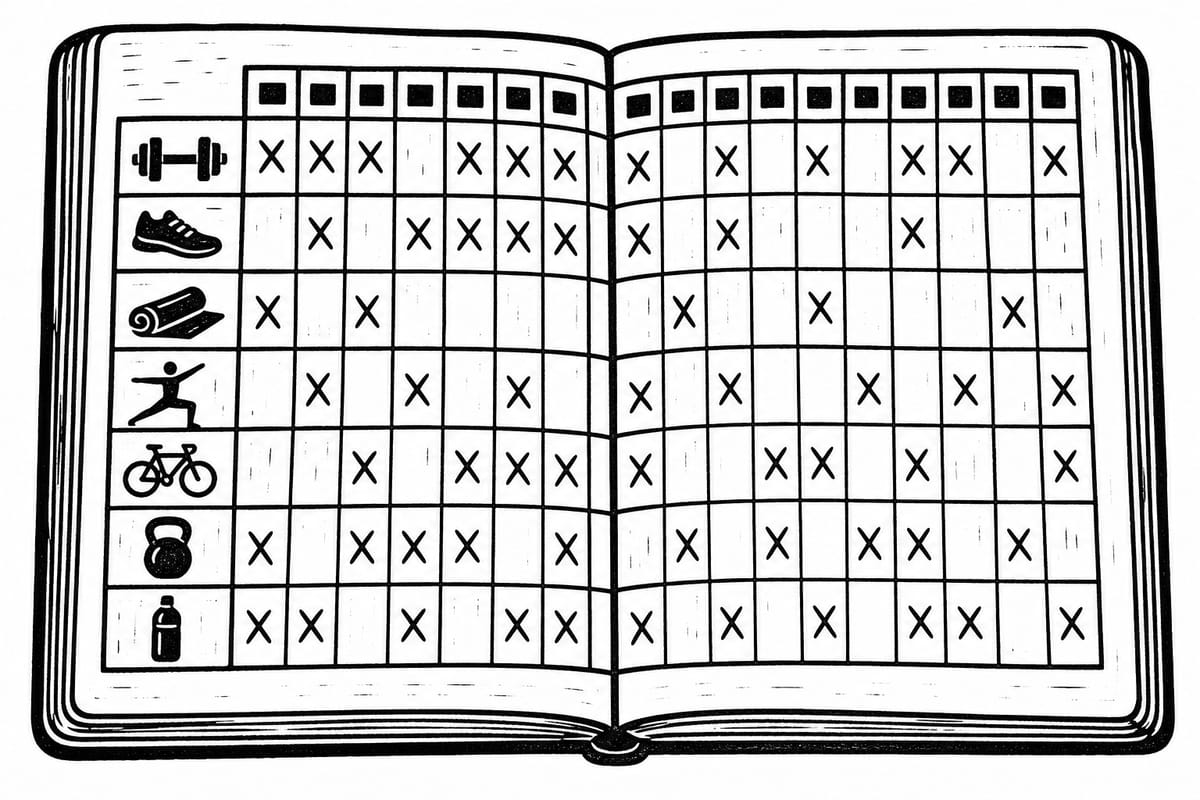
- [01:50] and [03:53] The grid: exercises down the left column, dates across the top, an X in each cell. [04:13] Fill in all the dates in advance so you can see the days you missed.
- [02:08] Five-minute breaks between blocks. Snack, walk around the block, do not burn out.
- [04:22] The late-night rule: even if it is late and you do not want to, do these exercises, spend the hour, and know you will make yourself do it. After a couple of late nights you will start doing it earlier.
- [05:36] Mark N/A for days that are genuinely unavailable, rather than leaving a gap.
- [05:12] He shows his own maximal schedule, warm-ups that "took like two hours" plus Bill Evans 30, Bach 30, composing 30, learning his own music 60, meditating 15, chanting 30, yoga and a workout, and says flatly "I obviously didn't keep to it." That is in the video on purpose.
How to make a practice schedule
- The structure is percentages, not minutes, so it scales to whatever time you have. [00:22]
- [35:53] With one hour a day, split the two-hour breakdown across two days rather than shrinking everything, "because you don't want to do like a minute of something." That is the design principle behind the A and B days below.
- [01:15] Scales, 10 minutes, metronome 40 to 50, one octave, then double the note values, then speed up, every key.
- [02:37] Beringer exercises, the ones Herbie Hancock introduced him to, 10 minutes in his own breakdown and 20 by the time he finishes describing them at [03:53]. Put a metronome on and, if you need it, have it count sixteenth notes so you know the sixteenths are accurate [03:46]. He uses a Boss unit with subdivision options rather than the keyboard's metronome.
- [06:01] The thumb agility exercise from Herbie Hancock, 5 minutes. Thumb holds a note two octaves from the working finger; the index moves a half step each way, then a whole step, then a minor third, then a major third, and outward. Repeat with fingers 3, 4 and 5.
- [07:58] Attached to it, the rule that governs the whole schedule: do it as slow as you need to make sure you are not going faster than you can go, because rushing builds "a really Rocky sense of time." Push yourself, but never past the ability to keep solid time.
- [30:45] The one-octave soloing exercise, and the reason it works, from a real student: it stops you playing arpeggios and random vocabulary all over the place and makes you listen to the melodies you are creating.

How NOT to practice!!
- [02:15] The caps, in his words: five hours maximum if you are really obsessive, two hours if you are moderately obsessive, one hour a day if you want to keep improving but have a lot of other things going on. You are the third case.
- [02:45] Why technical hours evaporate: they are muscle work that goes away as soon as you stop.
- [02:52] The line to write at the top of the schedule: "it's about learning how to do more with what you have than learning to have more."

How to make yourself practice (short)
- [00:18] The diagnosis: what stops you is an overactive mind, not laziness.
- [01:55] Five minutes is enough, and sitting works if chanting is not your thing. Back straight, cross-legged, eyes closed, attention on the breath at the diaphragm. [02:02]
Practicing SLOW!!!, The Most Important Thing for Intermediate Piano Players, Advanced Pianists Need This!!!
- Watch the first now. Watch the second now for the definition of a goal note only; A13 is the real lesson.
- Watch the third and then leave it alone. Greg gates it himself at [00:10]: "this is an advanced exercise so you have to know all of your basics of theory" and have some chops first, and "it's not for beginners." It enters your schedule after A8b.

The Most Important Thing for Intermediate Piano Players
- goal notes, previewed here because they are one of the four blocks in Greg's own core hour; the full lesson is A13

Advanced Pianists Need This!!!
- the call-and-response exercise that eventually replaces a technical block; gated until the harmony vocabulary exists
At the piano
Buy the notebook before you play anything. Rule a grid: exercise names down the left, thirty dates across the top, every date written in advance. Keep it on the piano, not in a phone.
Then take the five minutes before you sit. Greg's version is chanting meditation, which Herbie introduced him to; the sitting version is back straight, eyes closed, attention on the breath, five minutes. The claim is specific and testable: it centers you in the moment rather than the past or the future, which is what lets you know what to do right now. Log whether the gap between what you intended to practice and what you actually practiced narrows over two weeks.
The blocks below are already ordered by what breaks first. Warm-up protects the hands. Scales protect the fingering. Everything after that is where the music is.
The direction this schedule serves
A plan does not exist until a direction does. Greg's words at the top of the lesson were "to get there we have to pick a some sort of goal. We have to pick like some direction. So let's dig into that a little bit more." The direction got picked in the room, and the schedule above is built to serve it, so it is worth having in writing next to the grid.
The direction is composition first, and it is deliberately not jazz. Greg: "the path that I see for you is not learning jazz. Like I could show you comping and walking a bass line and melody and I can make you learn standards and all of that, and it'll take you a few years." His reasoning ran straight off your own numbers in the scenario exercise below. "The path of putting you on a full jazz like diet and learning the genre and comping and soloing and standards and all that would take you to one of your outcomes that's more of a five. So we probably don't want to do that." The outcomes you rated 8 were composing a lot, releasing it, having people who follow your compositions, and touring your own material. So the years go there.
What jazz competence actually costs, measured on a real student. Greg has one: "I have a student in London that I actually taught for a couple of years, he was my only student that I kept for a couple of years. Well, it was like four years that he actually took. And he got from like almost nothing to being able to really hold his own in a jazz trio. But he worked like crazy at it and that's all he wanted to do, for about four years it took him and he practiced like a couple hours a day." Four years, a couple of hours a day, single-minded. And then, in Greg's words, "you're at the starting point of where you can begin to build a jazz career," competing with "amazing people who've been doing that since they were eight years old." Read that against the 30 to 60 minutes you have.
Jazz vocabulary is not being thrown away, it is being sequenced later. From the end of the lesson: "incorporating some of it will be good, but it's just like that's not the starting point right now. All of this stuff will inform your ability to do some of the jazz vocabulary too." Scales, modes, extensions, guide tones and goal notes are the same material a jazz education starts with. You are learning them for composition first, which means the jazz door stays open and unlocked without any of these months being spent on standards.
The horizon is three to six months, then a reassessment. His words: "start out just getting all the theory down and then get basic compositional techniques down and work on just basic improvisation on the piano for a period of time. It could be for 3 months, could be 6 months, and get to a point where you can sit down and have a command of the instrument where you really know what the melody harmony and rhythm is that you're doing and how it works as a composition even when you're improvising. And then you can write music too." Put a date three months out at the top of the first grid page and a second date at six months. Those are review points, not deadlines. What gets reviewed is whether you can improvise in any key and know what you are doing while you do it.
Two rules that live outside the grid
Record every lesson and keep it. This was the first instruction of the day, before any music: "You got do you have a recorder or something or your phone or something? I want to make sure you keep this." Video or a voice note, your choice. Greg records a backup, and you still keep your own. He said the reason himself during the densest ten minutes of the lesson: "That's a lot of information, but that's why we're recording it." File each recording by date next to the grid, and re-listen to the current one once a week.
Message Greg between lessons. His words: "you can also message me questions." Two channels, and they do different jobs. Questions go as messages. Playing goes as audio, because he asked for that separately: "you can send me a voice note of you doing something." Put a standing line at the bottom of each week's grid page for the question you did not get answered that week, so it goes out rather than being carried.
Your weekly schedule
Two versions, an A day and a B day, alternating, because a 45-minute session cannot carry every block at a usable length. Greg's own solution for the one-hour student is exactly this: split the breakdown across two days rather than shrinking every item to a minute.
The 45-minute core, alternating A and B days, six days a week.
BOTH DAYS (20 min)
  0:00   Sit, five minutes, breath at the diaphragm            5
  0:05   Warm-up routine from A2, in order, no skipping       12
  0:17   Break                                                 3

DAY A (25 min)                        DAY B (25 min)
  0:20  Major scales, 40 BPM      10    0:20  Minor + blues scales, 40 BPM  10
  0:30  Break                      2    0:30  Break                          2
  0:32  Theory block               8    0:32  Structured listening           8
  0:40  Transcription              5    0:40  Sketching at the piano         5
The 30-minute floor, for days when 45 is not real. Never skip the sit or the warm-up; cut the second half.
  Sit                                    5
  Warm-up routine from A2               12
  Scales at 40, whichever day it is      8
  One block, chosen the night before     5
The 60-minute version, when you have it. Add fifteen minutes to the second half, split as ten on the day's main block and five more on transcription or sketching. Do not add a seventh block, and do not add a second hour.
Hard rules attached to the grid.
- Six days a week, one day off, marked N/A rather than left blank.
- Five-minute break every twenty minutes, out of the chair. This is the ISM guidance and it is also the only thing that keeps a programming day and a practice session from stacking into one continuous load on the same tendons.
- Metronome at 40 for all scale work until A5 says otherwise. Use a dedicated metronome or a phone app with subdivision settings, not the keyboard's click, which is what Greg does himself.
- Cap the session. One hour is the ceiling, not the target. If you want to keep going, stop.
- Any pain ends the session. Fatigue means rest, pain means stop and get help.
How the schedule changes across the program
The shape stays. The contents of the two variable blocks rotate as each lesson opens them up.
LESSONS        DAY A BLOCKS                    DAY B BLOCKS
A1-A4          major scales · theory ·         minor+blues scales · listening ·
               transcription (listening only)   sketching

A5-A8b         scales · triads and 7ths        scales · ear training ·
               around the circle · notation     progressions

A9-A11         scales and modes ·              modes · voicings ·
               chord-scale drills · notation    comping

A12-A16        one motive, developed ·         goal notes · rhythm ·
               transcription                    Bach

A17-A18        Sibelius engraving ·            sight-reading, ten minutes,
               notation of your own sketches    below level, never stopping

PART B (L0+)   the module's keyboard work ·    the module's listening protocol ·
               transcription                    composing toward the module piece
The warm-up and the scale block never leave. Treat Part A Module 1 as the first twenty-five minutes of every session for the rest of the program, rather than as a stage you finish and put behind you.
Exercises
1. Build the grid
Do. Notebook, pen, ruler. Blocks down the left, thirty dates across the top, all dates written in before you start. Tape the caps and the injury rules to the inside cover.
Done when: the physical grid exists at the piano with every date pre-written.
2. Run it for thirty days
Do. A and B days alternating, X or N/A in every cell, no blanks.
Done when: thirty consecutive days are marked, with no unmarked gaps.
3. The intention log
Do. One line per session: what you meant to practice, what you actually practiced.
Done when: two weeks of entries exist and you can say whether the gap narrowed.
4. The sizing audit
Do. After thirty days, count the misses. More than five means the schedule is too big, not that you are undisciplined. Cut it and start another thirty.
Done when: you have completed one thirty-day cycle you did not have to cut.
5. Time-of-day migration
Do. Log the clock time each session starts. Keep the late-night rule: if it is 11pm and you do not want to, do it anyway.
Done when: the median start time has moved earlier across thirty days.
6. Substitution, after two cycles
Do. Swap one block for something you designed yourself.
Done when: the replacement survives its own thirty-day cycle.
7. The 1-to-10 scenario audit, re-run at three months and at six
Do. This is Greg's own diagnostic from 9/6, and it is the tool that picked the direction. His framing: "I'm going to give a couple scenarios and like just get on a scale of 1 to 10 how like amazing, dream like this would be my ultimate are are these? Just give me a number one to ten." Six scenarios, each rated cold, no averaging and no explaining. Your answers on the day were these.
| Scenario | Your rating on 9/6 |
|---|---|
| Day job plus three or four nights a week playing jazz at restaurants around the city | 4 |
| Day job plus touring quarterly with an original metal group playing your own compositions | 5 or 6 |
| Barely any money, gigging six nights a week with great players, a lot of fun | 5 |
| Writing your own compositions, touring the country and the world playing them, paid decently | 7 or 8 |
| Touring with a pop band, 15,000 people a night, not your music, pays great | 8 |
| Day job plus composing a lot, releasing it, having fans of your compositions, an occasional tour of your own material | 8 |
The two 8s that are about your own music are what this curriculum is pointed at. The 4 and the 5s are the jazz-first path, which is why it is not the path. Write the six scenarios on one notebook page with the dates across the top, exactly like the practice grid, and rate them again at three months and at six. Done when: three dated columns of ratings exist, and you can say in one sentence whether anything moved and what you would change about the plan if it did.
Checkpoint
Module 1 ends here. Before A5:
- The physical grid, photographed, with thirty dates pre-written and at least thirty marked cells.
- Your written weekly schedule, in the format above, with your own minutes per block.
- The intention log, two weeks minimum.
- Say the caps out loud: one hour is the ceiling, five-minute break every twenty minutes, fatigue means rest and pain means stop.
- Everything from A1 through A3 still passing: all 12 majors, 36 minors and 12 blues scales at 40, hands together, two octaves clean before four, no hesitation.
- The direction written in one sentence in your own words, with the three-month and six-month review dates on the first grid page.
- Every lesson so far recorded, kept, and filed by date, and the most recent one re-listened to inside the last week.
- At least one question sent to Greg between lessons, and at least one voice note of you playing something.
Read
- Source course, Lesson 1 preface. The exercises are the course; the prose explains and the exercises teach. Your schedule is the mechanism by which that is true.
- ISM, 'How to become a healthy instrumentalist.' Twenty-minute breaks, warm-up, and the flat statement that "no pain, no gain" is false. Link
- Furuya et al. 2006, on prevalence and causal factors of playing-related disorders in 203 pianists. Read the risk factors and check them against your grid. DOI
- Sakai 2006, the slow-down protocol. Reread from A3. The clinical treatment for focal dystonia and your daily scale method are the same method, which tells you how seriously to take the tempo cap. DOI