The idea
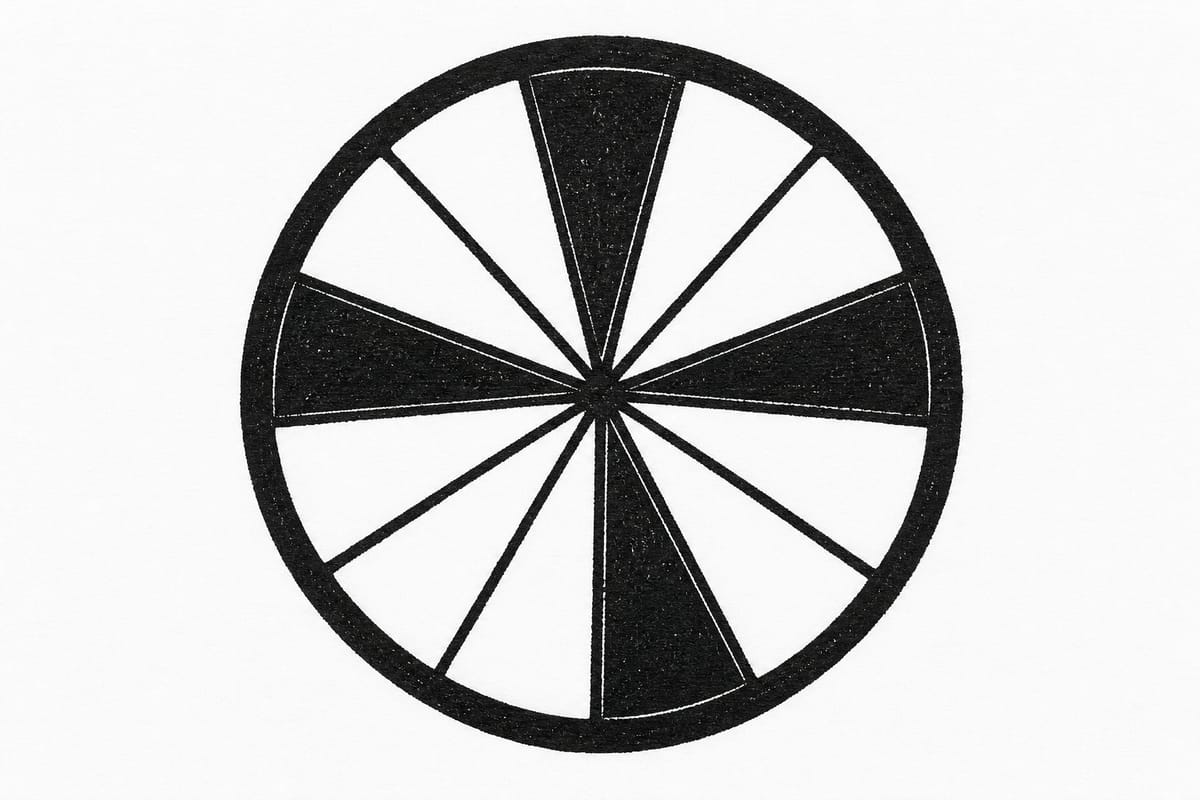
A symmetric collection is one that maps onto itself under transposition. The whole-tone scale returns to itself after two semitones. The octatonic returns after three. Messiaen's third mode returns after four.
That single property produces everything else about them. If a collection is the same after transposition, then no note in it is privileged, so there is no leading tone, no tonic, and no cadence. The source course puts it exactly: the whole-tone scale contains no perfect fifth and therefore no dominant function, "there is no leading tone, no pull toward resolution" (Source course, Lesson 17).
Which means a symmetric scale cannot do what a diatonic scale does. It is not a worse diatonic scale. It is a different tool, and the two things it is genuinely good at are colour and generation. Debussy used them for colour. Holdsworth and Thordendal use them to generate line. You will do both.
Watch
Diminished Lick Over a Modal Progression (https://www.youtube.com/watch?v=zaqmg2RmpuI)
- At [02:38], the structure named: "it's a basic diminished lick, the structure of it is planing in diminished thirds." A shape moved by a fixed interval, which is what a symmetric collection makes possible.
- At [02:49], the harmony inside the line: "it's really the four to the one, like the minor four with the natural six." A symmetric scale has no function, but a subset of it can carry one. That is how you get motion out of a static collection. At [03:20] the same notes are reused vertically as a comping voicing for V. Colors and Superimpositions on the Piano (https://www.youtube.com/watch?v=u6iHPlj7GM0)
- At [24:37], the Petrushka chord: a C major triad plus an F sharp major triad. Greg's account of Stravinsky is loose, since he says opera and Petrushka is a ballet, so take the chord and not the history.
- At [25:52], the mechanism, and this is the good part: those two triads are three stacked tritones, which is the diminished scale, so the chord "has virtually every possibility of resolution built into the chord. Pick any one of those tritones and you can resolve it." Symmetry is why there are four exits and why none of them is the exit.
- At [18:43], the voicing fix. Thin the left hand to 1-5-9 so the upper structure has room. You will need this the moment you start stacking symmetric material.
Diminished Lick Over a Modal Progression
- a symmetric collection used as a line, and the harmony hiding inside it named out loud
Colors and Superimpositions on the Piano
- the Petrushka chord taken apart as three stacked tritones, with all four resolutions available
Listen
Debussy, "Voiles." Pass one: notice that nothing arrives. Pass two: find the section that leaves the whole-tone collection and hear how much a pentatonic sounds like an event by comparison. Pass five: try to hum a bass line. You cannot, and that is the point. The source course's line for this repertoire is the one to carry: "His chords exist in the present tense. They do not promise; they are."
Stravinsky, Petrushka, the chord. Pass one: hear it as one sonority. Pass five: hear it as two triads a tritone apart. Then go to a piano and find the four resolutions Greg demonstrates.
Meshuggah, "Rational Gaze," 0:00 to 0:29. Pieslak: guitars, bass and pedal bass drum run four bars of 25/16 then a bar of 28/16, while the cymbals hold a steady quarter-note pulse with snare where beat 3 of a 4/4 would fall. Pass one: the cymbals only. Pass five: the guitars only. What matters here is his secondary finding, that the pitch content is deliberately static: one tonal center framed by Locrian, with chromatic motion around the minor third above the tonic. The pitch material exists to stay out of the way of the rhythm.
Death, "Flesh and the Power It Holds." Sánchez Vinueza's string-quartet study finds harmonization predominantly in perfect fifths, octaves and unisons, minor keys alternating with Phrygian and Locrian, and the diminished scale used to construct motives, ostinati and melodies. Pass one: hear the fifths as the harmony rather than as an absence of it. Pass five: find one motive whose shape repeats at the minor third.
Holdsworth. Listen for the absence of picking. What is documented is the technique and the scale, not a track. See the caution below.
The comparison
The exact parallel. Messiaen catalogued a fixed set of symmetric collections, gave each a colour, and used them as vertical blocks. In current terminology his modes of limited transposition are sets with transpositional symmetry: mode 1 is the whole-tone collection, mode 2 is the octatonic, and mode 3 is a nine-note collection, 1, 2, ♭3, 3, ♭5, 5, ♭6, ♭7, 7, which repeats every major third. His treatise, nineteen chapters published in 1944, also sets out added values (metric displacement and asymmetric grouping) and non-retrogradable rhythms (palindromes), which is why he returns in Module 2's rhythmic work as well.
Allan Holdsworth's "symmetrical scale" is that third mode. Guitar World states it plainly: in his 1992 instructional video Holdsworth calls it the symmetrical scale, and more specifically it is Messiaen mode 3. The nine notes are identical.
Where it breaks, first break, and it is a sourcing break. The Messiaen identification is made by analysts, not by Holdsworth. In his own published interviews he describes symmetry in his own terms and never names Messiaen. To Mark Gilbert in 1992: "The whole step-half step scale is interesting too, because although it has a kind of horrible sound most of the time, it's an unbelievable vehicle if you start jumping things around on it." To Steve Adelson: "I just see a permutation of intervals. I also like to see the symmetries." No quotation of Holdsworth citing Messiaen was found. Attribute the identification to the analysts and the practice to Holdsworth, and do not fuse them.
Note also what Holdsworth's own sentence tells you about method. The scale run in order sounds bad. The scale with things jumped around is a vehicle. Symmetry is a supply of intervals, not a melody.
Where it breaks, second break. Messiaen chose his modes for their invariance properties, theorized them explicitly, assigned each a fixed colour, and treated them as objects to be coloured in. Set theory would call a mode of limited transposition a set class with a non-trivial transpositional stabilizer, and that is a neutral, uninverted description. Messiaen's is not neutral. Holdsworth's is neither: he arrived at his through the geometry of a fretboard, and Chuck Schuldiner arrived at the diminished scale through guitar-idiomatic symmetrical fingerings. Ocaklı's thesis finds Schuldiner working with octatonic, Phrygian dominant and Messiaen's modes across sixteen Death pieces, with a marked deepening from Human in 1991 onward, and describes his harmony as multi-layered and polymodal rather than tertian. There is no evidence Schuldiner theorized any of it. The resemblance is convergent, not derived. Three players and one composer found the same collections because the collections are findable, not because anyone read anyone.
Where it breaks, third break, and this is the compositional one. Stravinsky exploits the octatonic's invariant subsets to build harmonic areas. Holdsworth and Thordendal use the same collection as a linear pattern generator, so it organizes surface figuration rather than structure. Fredrik Thordendal's lead style descends from Holdsworth's legato, applied over Meshuggah's rhythmic substrate: symmetrical diminished scales, half-whole and whole-half, with added chromatic passing tones, grouped in sevens and fives per string against a 4/4 substrate, which produces phase relationships against the beat that mirror what the rhythm section is doing with meter. That last part is documented from interviews and published transcriptions only. No academic study of Thordendal's lead playing exists. Say so when you teach it.
The lesson you take from the break is this. If you use a symmetric collection to make lines, you get pattern and no destination. If you want a destination you have to supply it from outside the collection, from rhythm, from register, from a subset that does carry function, or from the moment you leave the collection entirely. Greg's diminished lick does the third of those: the minor iv with a natural 6, sitting inside the diminished material, resolving to i.
At the piano
The four collections, every transposition each has. Whole-tone: two. Octatonic: three. Messiaen mode 3: four. Augmented (1, ♯2, 3, 5, ♯5, 7): four. That is the whole inventory, and the number of transpositions is the definition, so learn the number with the scale.
Fingering. The whole-tone scale is 1-2-3-1-2-3-4 in the right hand ascending from C, and it stays the same shape everywhere because the scale does. The octatonic in either form takes a repeating four-note fingering that recycles every minor third. Mode 3 is nine notes and the pattern recycles every major third: play it as three identical three-note cells, because that is what it is.
Play the symmetry, not the scale. Take any three-note cell and transpose it by the collection's period. For the octatonic that is a minor third, for mode 3 a major third. This is Greg's planing in the diminished lick video, generalized.
Build the Petrushka chord and resolve it four ways. C major in the left, F sharp major in the right. Find the three tritones. Resolve each one outward and inward, and name the destination chord each time. Greg demonstrates resolving outward from an F sharp root into B major. Do the other three yourself.
The Holdsworth voicing habit, adapted. He plays wide intervals, not scale steps. Take mode 3 on C and play it as a line where no adjacent notes are adjacent in the scale, skipping at least two scale degrees on every move, four notes in one direction then reverse. Legato is not available at a piano, so let the fingers overlap slightly instead of pedalling.
Exercises
1. The inventory
Do. Play all two whole-tone collections, all three octatonic collections in both rotations, all four transpositions of mode 3, and all four augmented scales. Two octaves, hands separately, then together, at 60 bpm.
Done when: you can name the number of distinct transpositions of each collection and produce any one of them by name in under three seconds.
2. Cell transposition by period
Do. Write one three-note cell. Transpose it by the octatonic period (minor third) through a full cycle. Then by the mode 3 period (major third). Then by the whole-tone period (whole step).
Done when: you can play all three cycles at 80 bpm, and you can say, without playing, how many transpositions each cycle contains before it repeats.
3. The lick, rebuilt
Do. Transcribe Greg's diminished lick from the video into Sibelius. Then find the minor iv with natural 6 inside it and mark those pitches. Then rewrite the lick over a different tonic.
Done when: the transcription is accurate, the subset is marked, and you can play the rewritten version in three keys.
4. Petrushka, four exits
Do. Play the chord, then play each of its four tritone-based resolutions, naming the destination out loud each time.
Done when: all four are available with no hunting, and you can explain why the chord has four exits in terms of its symmetry.
5. Non-adjacent line building
Do. Using mode 3 on C, write a sixteen-note line in which no two consecutive notes are adjacent in the scale. Then write a second version in which they all are.
Done when: you can play both and articulate what Holdsworth meant by "it has a kind of horrible sound most of the time" and "an unbelievable vehicle if you start jumping things around on it."
6. Symmetry against a fixed pulse
Do. Set a metronome to a quarter-note pulse in 4/4. Play an octatonic line grouped in sevens, then in fives, without altering the pulse. Count the bars until the grouping realigns with the downbeat.
Done when: you can state both realignment numbers correctly and play thirty seconds of each without drifting. This is Thordendal's device, and it is arithmetic before it is technique.
Compose
Write a ninety-second instrumental piece built entirely from symmetric collections, with exactly one diatonic bar in it.
Constraints. Use at least two different symmetric collections, and change between them at a moment the listener can hear. All melodic material derives from one three-note cell transposed by its collection's period. Nothing cadences until the diatonic bar, which is the only cadence in the piece and must arrive at least three quarters of the way through.
Then write a second version, same length, with no diatonic bar at all, and make the ending convincing by rhythm and register alone. Play both for a listener and ask which one ended.
Piano first. If you arrange it, put the cell work on a single instrument and let the rest hold the collection as harmony.
Checkpoint
- Play every transposition of all four symmetric collections and state the count for each.
- Explain, in one sentence, why a symmetric collection cannot produce a leading tone.
- Play the diminished lick, name the functional subset inside it, and transpose it.
- Play the Petrushka chord and all four resolutions.
- State what Guitar World claims about Holdsworth and mode 3, state what Holdsworth himself said, and state why those are two different claims.
- Play an octatonic line in sevens against a 4/4 pulse and give the realignment number.
- Hand over both versions of the composition.
Read
- Source course, Lesson 17 (/library/garnett-course.pdf). The whole-tone and pentatonic sections, and the planing discussion. Its account of Debussy's two paths out of tonality is the frame this lesson sits in.
- Broad, "Technique de mon langage musical," Routledge Encyclopedia of Modernism (https://www.rem.routledge.com/articles/technique-de-mon-langage-musical). Read this rather than hunting for the treatise. Messiaen's original stays in copyright in France until 2039 and the English translation until 2051, so no substantial quotation is legally online and anything you find that claims to be one is unreliable.
- Griffiths, Guitar World, 13 May 2024 (https://www.guitarworld.com/lessons/allan-holdsworth-legato-string-skipping-shred). Two pages, and it gives the scale in guitar terms. Instructional journalism, not scholarship, and the source of the Messiaen identification.
- Gilbert, Jazz Journal, May 1992 (https://jazzjournal.co.uk/2022/05/31/jj-05-92-allan-holdsworth-the-reluctant-guitarist-in-conversation-with-mark-gilbert/). Read for Holdsworth in his own words about symmetry, so that you can keep his account and the analysts' account separate.
- Pieslak, "Re-casting Metal" (DOI 10.1525/mts.2007.29.2.219). The "Rational Gaze" section for the rhythm, the closing pitch discussion for why the harmony is deliberately inert.
- Ocaklı (2025) (https://tezara.org/theses/977960). The abstract is in Turkish and retrievable. Read it for the claim that Schuldiner used octatonic, Phrygian dominant and Messiaen's modes, and note that it is a master's thesis, not a peer-reviewed article.