The idea
Babbitt, Wolpe and Stravinsky all accepted the same two premises. The chromatic aggregate is the harmonic universe, and tonal hierarchy is not coming back. From there they went three different directions, and the source course frames the difference as an answer to one question: what is twelve-tone composition for (Lesson 22)?
Babbitt is deductive. He derives the system's consequences with the rigor of a mathematician, which produces combinatoriality, hexachordal complementation and the all-partition array. The structure determines pitch content exhaustively, and register, dynamics, articulation, duration, timbre and tempo remain free. "The pre-compositional structure is a skeleton; the music itself is the living body."
Wolpe is empirical and gestural. He starts from the physical sensation of sound, the tension of a minor second, the openness of a fifth. He has precompositional charts too, but their purpose is to prepare for spontaneous invention. Where Babbitt would describe a relationship as an invariant trichord under retrograde inversion at T6, Wolpe would describe how it feels.
Stravinsky is adaptive. He bends the system to a compositional personality that was already complete. The technique changed his harmonic content. It did not change his process.
Jazz supplies a fourth answer that the other three do not contain, and it is the one closest to your hands.
Watch
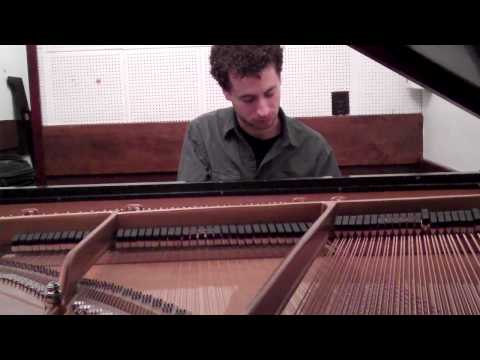
Weekly Piano Improv #46 - for Schoenberg lovers (3:10)
- No transcript exists, so this is a listening assignment rather than a lecture. You watched it in L27. Watch it again now.
- Ask one question of it. Which of the three paths is Greg on in this improvisation? There is a defensible answer for at least two of them.
- Note whether any collection recurs, and whether recurrence or contrast is doing more of the work.
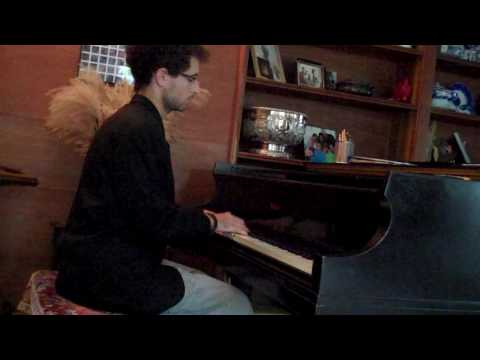
Improv on Everything In It's Right Place (2:57)
- No transcript exists for this one either. Do not take any content claim about it from a summary, including this one.
- The Radiohead tune gives him a static harmonic bed and nothing else. Track how he generates motion when the harmony supplies none. That is the exact problem your own writing has.
- To verify: the tune's chord cycle and meter should be confirmed by transcription rather than assumed before this lesson is taught.
Listen
The six-listen protocol on Arie da Capo. The source course prescribes this in Lesson 25. Do it over two weeks. Do not binge.
- Pure sound. No score, no counting. Write down three things you noticed immediately afterward.
- The soloists. Five arias, one per instrument: clarinet, cello, flute, violin, piano. Hear when each assumes the solo role and when it yields.
- Texture. Inside each aria there is a palindromic plan that contracts and expands, quintet to quartet to trio to quartet to quintet. Find the trio.
- Intervals and register. Minor ninths, major sevenths, tritones. A minor ninth low in the cello and bass clarinet is heavy and dark; the same interval in flute and violin is bright and piercing. That is Wolpe's argument about register appearing inside Babbitt's piece.
- and 6. The whole. Fourteen minutes as one experience. Does it have a trajectory?
After the fifth listen, and not before, read Ciro Scotto's "Preparing a Performance of Babbitt's Arie da Capo," Perspectives of New Music 26, no. 2 (1988).
One listen against a source you already know. Play "Everything In Its Right Place" and "Jigsaw Falling Into Place" back to back, then play Radio Rewrite straight through without stopping. Write down every moment you think you recognise, with a timestamp, then check how many were harmonic rather than melodic. Reich's claim that rock would not cross your mind is testable, and you are the test.
Sing and tap. Sing the three key centers of "Giant Steps," B, G and E♭, as a cycle dividing the octave into equal major thirds. Tap the tempo while you do it and notice how little time the improviser has to move between them.
The comparison
The parallel. Coltrane's chromatic key cycling completes the aggregate at the level of key centers rather than individual pitches. All twelve chromatic tones appear as chord tones through rapid modulation. The source course notes that the three key centers dividing the octave into equal major thirds is a group-theoretic property, the cyclic group of order 3 acting on the twelve-element pitch-class set, the same structure underlying some of Babbitt's combinatorial constructions.
George Russell's Lydian Chromatic Concept (1953) supplies the other half. Russell organizes all twelve tones by their gravitational relationship to a tonal center. Where Schoenberg used twelve tones to escape tonality, Russell uses them to build a new kind of tonal gravity. Every chord has a parent scale, and the improviser gets a continuum of gravitational distance rather than a binary inside and outside.
Where it breaks. The source course is careful and you should be too: "Coltrane almost certainly did not think of it in these terms, but the structural parallel is real." A convergent structure is not an influence. Nothing in the record has Coltrane deriving "Giant Steps" from group theory, and claiming otherwise would be the fan lore this curriculum excludes. State the parallel as a parallel.
The fourth path, and what makes it different in kind. Babbitt, Wolpe and Stravinsky all abandoned hierarchy among the twelve tones. Russell keeps hierarchy and rebuilds it on a different foundation. That is why the fourth answer complements the other three rather than joining them.
A working composer's synthesis. The spine assigns this lesson a fifth figure, Jonny Greenwood, on the strength of his concert music. That music is now documented well enough to teach, with one honest caveat stated below.
Popcorn Superhet Receiver (2005) is scored for 18 violins, 6 violas, 6 cellos and 4 double basses, was commissioned by BBC Radio 3, and was premiered on 23 April 2005 at Jerwood Hall, LSO St Luke's, by the BBC Concert Orchestra under Robert Ziegler. The study score is published by Faber Music, ISBN 0-571-52204-1. Greenwood names his own model in the score's liner notes: the commission was "a chance to try out a long-held ambition to write something using large, Penderecki-style microtonal clusters." He also states the method, and the method is the reason this piece sits in a lesson about the chromatic universe. "I understood that two octaves of quarter-tones would produce white noise, and wanted to start from there, treating it like a big block to carve up and distort." Every other path in this lesson builds a total chromatic out of individual pitches. Greenwood starts with saturation already achieved and removes.
Neven Prostran's thesis maps Part 1 from the Faber score. Bars 1 to 29 hold sustained notes that turn into contiguous falling notes. From bar 30 the microtones enter as a noise wall. Bars 60 to 93 drive the significant convergence, where the wall collapses and every player arrives on one unison F sharp at bar 93. Bars 118 to 142 set opposite pairs of strings in a tug of war, each filling the other's negative space with opposed dynamics, microtonal pitches and rhythmic placement. Bars 181 to 206 stagger a microtonal ascent between individual players to manufacture a Shepard tone. Two later sections are worth knowing about for a different reason: in Part 2b the string orchestra strums with guitar plectrums, and Greenwood notated those muted strums using standard hi-hat notation transposed down a sixth. Greenwood's own gloss on how that texture arrived is that at the first workshop the players tried to reproduce an electronic drum machine and "it didn't work at all." The failure produced the material.
Two corrections you should carry, because they run against the usual story. The convergence on F sharp is the opening of There Will Be Blood, and Prostran traces that gesture back past bar 86 of Popcorn to the outro of Radiohead's "Climbing Up the Walls" (OK Computer, 1997), where the same gesture starts on C. The technique predates the concert piece, so "rock guitarist discovers the avant-garde" runs backwards. And the 2012 Nonesuch album pairs Popcorn Superhet Receiver directly with Penderecki's Threnody and Polymorphia, played by AUKSO under Penderecki and Marek Mos, which is the pairing the composer himself sanctioned.
Where this evidence is thin. There is no peer-reviewed article or monograph chapter on Greenwood's concert works. The literature is one MA thesis and music criticism. Prostran also misdates Threnody as 1994 in one sentence, and it is 1960. Treat the structural map as a careful reading of the score by one student, not as settled analysis, and check any bar number against the Faber score before you repeat it.
What is documented on the other side is the traffic running back toward rock, and the borrowing there is written down by the composer who did it.
Steve Reich wrote Radio Rewrite after hearing Greenwood play Reich's own Electric Counterpoint at the Sacrum Profanum festival in Kraków. Reich dates that appearance to 2011 in most tellings and to 2010 in one, so leave the year open. The piece takes two Radiohead songs as raw material, "Everything In Its Right Place" from Kid A and "Jigsaw Falling Into Place" from In Rainbows. Reich's own account of the shape: "the piece is in five movements, the movements go fast, slow, fast, slow, fast. And the fast movements are all drawn from 'Jigsaw Falling Into Place'… basically I'm looking at their harmonies… In the second and fourth movements I'm referring to 'Everything In Its Right Place' and it's just like the original: slower, more mysterious." The scoring is consistent across three interviews: flute, clarinet, string quartet, two vibraphones, two pianos and one electric bass, with the bass appearing only in movements 1, 3 and 5. Greenwood is on the 2014 album as the performer of Electric Counterpoint, not as a composer on it.
Two things there are directly usable by you. First, what Reich borrows is harmony and bass lines rather than tunes: "What if I took these songs… and used some of the harmonies, some of the bass lines, some of the melodic material, but going my own way with it." Second, he insists the result does not sound like its source: "if you didn't know the original material, rock & roll wouldn't cross your mind." That is what a synthesis is, and it is the standard to hold your own three-section piece to.
One caution on detail. Reich gives the "everything" figure as "5-1-5" to NME and as "That 1-5-1, tonic, dominant, tonic" to Gothamist. He is describing one phrase two ways in two interviews. Quote either. Do not weld them into a single claim.
The classical end of the lineage is documented in this curriculum's sources, and Greenwood's own declaration of Penderecki as a model connects him to it directly. What still may not be stated as fact is any Ligeti or Messiaen model for a specific Greenwood score. Greenwood has cited Messiaen since his teens and Alex Ross hears Messiaen's piano writing in "Eat Him by His Own Light," but that is criticism, not the composer naming a model for a given piece.
Messiaen. Technique de mon langage musical (Leduc, 1944) sets out melodic shaping rooted in plainchant and folksong, harmony including the modes of limited transposition, and rhythm. In current terminology the modes of limited transposition are sets with transpositional symmetry, added values are metric displacement, and non-retrogradable rhythms are palindromic. A mode of limited transposition is a set class with a non-trivial transpositional stabilizer, which is why mode 2 is the octatonic and mode 1 the whole-tone in Forte's catalogue. Where the pairing with Forte breaks: Messiaen assigns each mode a fixed color and treats it as a fixed object to be colored in, while Forte's set classes are colorless equivalence classes closed under both transposition and inversion.
Ligeti. Richard Steinitz documents Ligeti's own limiting statement that only two of his works are deliberately based on contemporary mathematics: the first étude "Désordre," an iterated structure consciously based on the Koch snowflake, and the fourth movement of the Piano Concerto. In "Désordre" the right hand plays only white notes and the left only black, producing what Steinitz calls a combinatorial tonality. The deformation mechanism is exact. Bars 1 to 3 are notated in eight quavers accented 3+5, 3+5, 5+3, and from bar 4 Ligeti deletes one quaver from the right hand to make a 7/8 bar, repeating that deletion every fourth bar. Stephen Taylor documents the "tempo fugue" of Étude no. 6, where a 2:3 hemiola stretches into 3:5, 5:7 and even 3:4:5:7.
Use these as the verified end of the lineage. The Penderecki link to Greenwood is his own claim and you can teach it. Note where the analogy stops: Penderecki's clusters in Threnody are a notated apparatus of extended techniques deployed as elegy, while Greenwood's begin as a timbral raw material derived from radio static. His own framing, build white noise and then carve, is closer to subtractive synthesis and studio practice than to the Polish sonorist project.
At the piano
Choose one six-note collection and keep it for this entire lesson. Then treat it three ways in three sittings.
Babbitt treatment. Fix an ordering, and let it determine the pitch sequence of a melodic line strictly. Write eight to sixteen bars. Every choice about register, rhythm, dynamic and articulation is yours, and make each deliberately, because they are the only choices left.
Wolpe treatment. Discard the ordering. Deploy the same six pitches freely across registers, rhythms and dynamics. Interrupt yourself. Cut off a developing idea and replace it.
Stravinsky treatment. Rotate and transpose the collection into a small array as in L30. Read the columns for chords and the rows for melodies. Build eight bars from the grid, and fix each pitch in a register.
Then play all three back to back. Same six notes, three pieces of music that do not sound related.
Finally the fourth treatment, which is yours as a pianist. Put the six notes over a bass note they do not belong to, the way Greg does at [05:58] in "Playing outside the changes," and name a goal note for each phrase. That is Russell's gravity applied to your own collection. One held bass note under all four treatments is enough for your left hand this week.
Exercises
1. The three treatments
Do. One six-note collection, three passages of eight to sixteen bars each, Babbitt then Wolpe then Stravinsky, exactly as the source course assigns in Lesson 22. Play all three on your instrument and record them.
Done when: All three exist as recordings, and a listener told only that they share pitch material cannot tell you which is which without being told the methods.
2. Three adjectives, four times
Do. Listen to Semi-Simple Variations, Form IV: Broken Sequences, one movement of Movements, and "Giant Steps." For each, write three adjectives for the sound rather than the technique.
Done when: You have four sets of three plus one sentence on what is surprisingly similar across them.
3. The Arie da Capo protocol
Do. Five listens over two weeks, spaced. One paragraph after each, specific rather than general. The source course's model of specificity: "At about the four-minute mark, I heard the cello playing a sustained low note while the clarinet played rapid figures above it, and the piano contributed isolated high notes that sounded almost like bells." Then read Scotto.
Done when: Five dated paragraphs exist, and after reading Scotto you can name one thing in the score you had already heard without knowing what it was.
4. Russell's gravity on your own collection
Do. Put your six-note collection over four different bass notes in turn, one bar each, and rank them by how far outside they sound. Then write a line through all four with a named goal note per bar.
Done when: The four are ranked in writing, you can defend the ranking, and the line lands on its named goal note every time.
5. Diagnose your own default
Do. Take three riffs from your own catalogue, one of them from the 2016 EP. For each, decide whether the pitch material was generated deductively, gesturally, or adaptively.
Done when: You have an honest paragraph on which of the three paths is your default, and one sentence on which of the other two would help most.
6. Messiaen mode 2 against your collection
Do. Write out Messiaen's mode 2, the octatonic, and find its transposition levels. Compare it to your collection and note the shared pitches.
Done when: You can state why the octatonic has only three distinct transpositions, and you have written one phrase that moves between your collection and the octatonic on a shared pitch.
Compose
Write a five-minute instrumental in three sections from one six-note collection, each section using one of the three methods, in whatever order you choose. Constraints: the collection never changes, the sections must be audibly different in character, and the seams are hard cuts rather than transitions. What must be audible is that the three sections belong to the same piece despite their differences.
Arrange it for the ensemble you want to hear it played by, and notate it fully in Sibelius with parts. This is the largest deliverable in Module 6 and it is the piece you should be prepared to show someone.
Then write two paragraphs. First, which method produced the material you liked best, and why. Second, which one you would never have tried without being told to.
Checkpoint
- Three passages from one collection, recorded, one per method.
- Four sets of adjectives, plus the sentence on what is similar.
- Five dated paragraphs on Arie da Capo and one observation confirmed by Scotto after the fact.
- Four bass notes ranked by gravitational distance, with a defensible ranking.
- Your written diagnosis of your own default path.
- The five-minute three-section piece, fully notated with parts, plus the two paragraphs.
- You can state, without notes, what the three paths share and where the fourth one diverges from all three.
Read
- Source course, Lesson 22, complete. The three paths, the three shared commitments, Russell's tonal gravity, Coltrane's key cycling, and the group-theoretic reading of "Giant Steps" with its caveat intact. /library/garnett-course.pdf
- Source course, Lesson 25, for the six-listen protocol and for portmantonality, Babbitt's deliberate arrangement of serial structures to produce tonal allusions that appear "like a face glimpsed in a crowd."
- Russell, The Lydian Chromatic Concept of Tonal Organization, 4th ed. (Concept Publishing, 2001). You met this in L18. Return to it now that you have three non-hierarchical systems to compare it against.
- Scotto, "Preparing a Performance of Babbitt's Arie da Capo," Perspectives of New Music 26, no. 2 (1988). Read it after the fifth listen. The sequencing is the assignment.
- Messiaen, Technique de mon langage musical (Leduc, 1944; English trans. Satterfield, 1956). The original is in copyright until 2039 in France and 2051 for the English translation, so no substantial quotation is available online. Get the book.
- Steinitz, "The Dynamics of Disorder," The Musical Times 137/1839 (May 1996): 7–14, http://www.jstor.org/stable/1003934, for "Désordre" and the Koch snowflake claim in Ligeti's own limiting words.
- Taylor, "Chopin, Pygmies, and Tempo Fugue," MTO 3/3 (1997), https://www.mtosmt.org/issues/mto.97.3.3/mto.97.3.3.taylor.html, for the tempo fugue and Ligeti's own account of combining Schumann's and Chopin's hemiola with African additive pulsation.
- Prostran, "Jonny Greenwood Scores the Western" (MA thesis, Dalhousie University, 2017), https://dalspace.library.dal.ca/handle/10222/73268. Chapter 3 is the only bar-numbered map of Popcorn Superhet Receiver anyone has published. Read it for the structural table and the liner-note quotations, and hold the analysis loosely, since it is one student's reading and it misdates Threnody as 1994 in one sentence.
- Reich on Radio Rewrite, four interviews, which are the whole basis of what this lesson says about the piece: the Boosey and Hawkes podcast page, https://www.boosey.com/podcast/Steve-Reich-on-Radio-Rewrite/100173; The Quietus, 5 July 2012, https://thequietus.com/interviews/steve-reich-interview-2/; Gothamist, 15 November 2013, https://gothamist.com/arts-entertainment/an-interview-with-steve-reich-who-rewrote-radiohead; and NME, 23 October 2014, https://www.nme.com/blogs/nme-blogs/steve-reich-interview-on-radiohead-aphex-twin-and-the-rite-of-spring-762662. Composer's words rather than analysis, which is why they are quoted rather than paraphrased.