The idea
You have been composing with notes. Starting now you compose with actions.
The source course puts the demand plainly: to work this way you have to "abandon the notion that music consists of melodies accompanied by harmonies, organized into phrases that build toward cadences," and replace it with "a conception of music as bodies moving in space" (Source course, Lesson 23). Wolpe listed the parameters himself, and the list is a sculptor's, not a theorist's: weight, tension, looseness, hardness, roundness, softness, sweetness. The course insists these "are not metaphors applied casually to sound. They are compositional parameters, as concrete and manipulable as pitch and rhythm."
The reason this lesson sits where it does is that you already have the physical vocabulary. A palm mute is a hardness. A thumped string is a weight. A held pedal is a looseness. What you have never done is treat those as the material and let the notes follow.
Watch
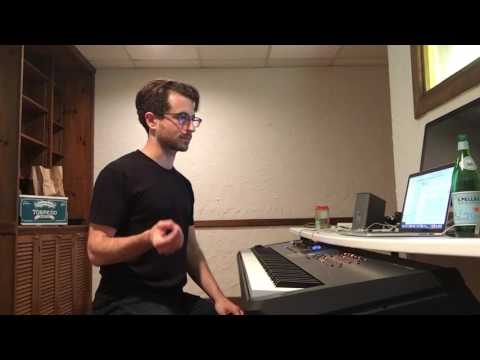
How to avoid tendinitis playing piano
- The posture calibration: stand, reach the crown of your head toward the ceiling until the body is straight, sit down from there [01:10]–[01:24]. Do it before every session this month.
- Shoulders neutral, and the drill that finds neutral. "Think about the muscles in your shoulders and think about not using them" [02:04]–[02:21].
- The touch itself, which Herbie Hancock gave him: "rather than using the whole weight of your body, you're actually just doing contrary motion between your fingers, very very gently" [03:41]–[03:49], demonstrated at [04:30].
- The rule and the self-check: "never press" [06:24]–[07:04]. Greg watched you play with tension in the fingers and the wrist. This is the fix.
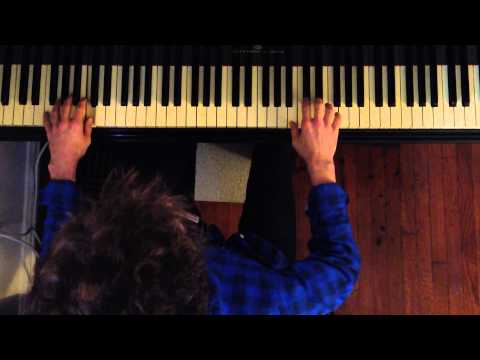
Learn to play fast
- Same mechanic, different words: "it's almost just like wiggling your fingers… it's like a flutter" [01:33]–[02:07].
- The framing caveat comes first for a reason: "speed means nothing without musicality" [00:22]–[00:45]. Hold onto that until Module 8.
- The pentatonic sequence at 45 bpm in eighth notes [04:52]–[05:29]. Use it as a gesture study, not a lick. Play the same sequence heavy, then light, then hard, then round, changing nothing but the touch.
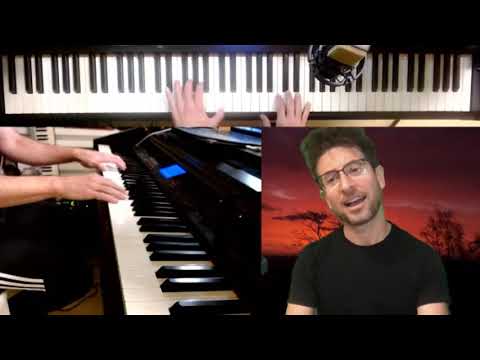
This One Exercise will Transform Your Playing
- The flashlight image at [25:39]–[26:14]: "if you have a tiny flashlight and you go into a big black box, it's not going to shine anywhere. So you make the box smaller." Wolpe's registral space is that box. This lesson shrinks it on purpose.
- Range restriction as a physical constraint, one to the five, then one to the three [07:12], [10:34]. Notice what your hand does differently when it cannot travel.
Listen
Wolpe, Piece in Two Parts for Six Players (1962). Flute, trumpet, piano, three percussionists. The source course describes the opening as a dense chord with all six instruments pressed into a narrow registral band, which then explodes outward: flute up, trumpet down to a growl, piano scattered across five octaves inside a beat, a sharp isolated percussion crack. Pass one, follow nothing. Pass two, listen only for whether the music is gathering or scattering. Part I is dominated by gathering, Part II by scattering, and both contain the other. Pass five, mark by stopwatch the three places where the mode flips and write one sentence on what flipped it.
Ellington, "Ko-Ko" (1940). The source course's reading is the one to test: the baritone and trombone riff is "pure mass, thick, dark, heavy, low," and the plunger trumpet that follows "exists in a completely different spatial zone: nasal, bright, cutting, mid-register." Those are two bodies in two regions, and the arrangement is the distance between them.
Gil Evans and Miles Davis, Miles Ahead (1957). French horns as warmth and depth, flutes and clarinets as transparent layers above, tuba and bass clarinet on the bottom, and the trumpet moving through the field. Listen for the field rather than the tune.
Rush, "La Villa Strangiato" (1978), 5:49–6:10. Bowman documents the "Monsters!" section as a quotation of Raymond Scott's "Powerhouse," with Lifeson and Lee palm-muting the first three notes specifically to match Scott's staccato attack (Bowman 2003, Ex. 3.20). That is a gesture decision, made to reproduce a physical quality, and it is documented rather than inferred. Play the two recordings back to back.
Animals as Leaders, "Tempting Time" (2009). Sallings transcribed the whole song. His pitch findings: a B pedal running through most of it, an opening riff oscillating between a C major triad and a B major triad, and later riffs adding D-sharp and G pedals. Ignore the notes on this pass and count how many distinct right-hand attack types you can hear.
The comparison
The exact parallel. Wolpe's gestural parameters and a modern riff writer's articulation choices are the same category of decision. Wolpe wants a sound with a stated hardness; a djent guitarist wants a palm-mute of a stated tightness. Both are composing the attack rather than the pitch, and in both cases the notated pitches would survive the change while the music would not.
Two documented cases carry the point. Bowman's palm-mute observation on "La Villa Strangiato" is a composer choosing an articulation to reproduce a specific historical staccato. And Tosin Abasi's two signature techniques, thumping (a Victor Wooten double-stroke thumb move adapted to guitar) and selective picking (the fretting hand generating some attacks by hammer-on while the picking hand attacks only chosen notes), produce two rhythmic streams from one pair of hands. Be honest about the evidence there. Abasi's techniques are documented in interviews and instructional material only. No peer-reviewed study of them was located, and one circulating study of The Madness of Many could not be attributed to any author or institution, so it is not cited here.
Where it breaks, first break. Wolpe's gestures are notated for other players to execute, and the score is the transmission. Rock guitar technique is transmitted through recordings, video and gear replication. DePue's conclusion in his 2022 dissertation is exactly this: an accomplished rock guitarist's style is a personal integration of technique, sensibility and equipment, which means "style" includes the signal chain in a way no classical parallel captures. A Wolpe gesture can be handed to a stranger. A Meshuggah guitar tone cannot.
Where it breaks, second break. For Wolpe, physical difficulty is a byproduct. For the metal repertoire it is an aesthetic end. Hannan's argument in "Difficulty as heaviness" is that rhythmic difficulty enhances perceived heaviness through "enactments of sonic metaphors for size, weight, density, power, transgression and seriousness," and that the practice is simultaneously transgressive and deeply conformist to metal's central value. Wolpe never claims difficulty produces weight. He claims the sound has weight and the player has to find it.
Where the classical bridge is thin. Cone's Musical Form and Musical Performance is the standard reference for treating the performer's realisation as part of the form, and both research dossiers name it as the bridge for this idea. Its edition details and page numbers were not verified for this curriculum, so no page-level claim is made here or in class.
At the piano
Single-pitch study. Choose one pitch. Play it heavy, light, hard, soft, round, sharp, tense, loose. Change nothing except attack, dynamic, duration and release. This is the source course's own exercise from Lesson 23 and it is the whole module in ninety seconds.
Gathering and scattering, one player. Gathering: start with one middle-register note and add pitches inward until you have a compact five-note band, crescendo through the accumulation. Scattering: start from that band and let it fly apart, one attack at a time, into isolated events across five octaves. Two minutes of each.
The Herbie touch under load. Run the F pentatonic sequence from Learn to play fast at 45 bpm in eighth notes with the flutter touch only. Then run it again with deliberate arm weight, the way you used to. Record both, so you hear the difference as well as feel it.
Symmetry and stasis. Play a diminished seventh chord arpeggiated up four octaves, then an augmented triad the same way. Both are equal-interval structures and both float. Now insert one note from outside the pattern. The line snaps into focus. The source course names this as the bebop alteration of the diminished scale and identifies it as the same move Wolpe theorised, from proportion to disproportion.
Riff physicality on the keyboard. A palm mute has no piano equivalent, so build one. Take a two-bar low-register riff. Version A, all notes fully released with pedal. Version B, all notes cut short with the hand, no pedal, played from the fingers only. Version C, alternating, one note ringing and the next choked. Same pitches. Three pieces.
Exercises
1. Gesture inventory of your own riffs
Do. Pull four riffs from your own catalogue, including at least two from Cloud Speak. For each, write down the physical action that produces it on its original instrument, using Wolpe's words: weight, tension, hardness, roundness, softness. Then write what changes if you invert that quality.
Done when: you have four entries, each naming a physical action rather than a pitch set, and one stated inversion per entry that you have actually played.
2. One pitch, eight bodies
Do. Record eight versions of a single pitch, each with a different physical quality, labelled. Play them to someone without the labels and ask them to sort the eight into pairs.
Done when: a listener sorts at least six of the eight into the pairs you intended.
3. Gathering and scattering, two minutes
Do. Improvise two minutes in which the first minute only gathers and the second only scatters, on a click at 60. Then two minutes where the two modes alternate every fifteen seconds. Then two minutes where they overlap, left hand gathering while the right hand scatters.
Done when: you can play the overlapping version for two minutes without either hand adopting the other's mode.
4. The articulation triptych
Do. Write one two-bar riff for piano, low register, and produce the three versions above: fully sustained, fully choked, alternating. Record all three at the same tempo and the same dynamic.
Done when: you can rank the three by perceived weight and name the single articulation change that moved each ranking.
5. Palm mute, transcribed
Do. Listen to Raymond Scott's "Powerhouse" and to "Monsters!" at 5:49–6:10. Notate the three palm-muted notes Bowman identifies and write two sentences on what the mute imitates.
Done when: you can play both versions on the piano, one choked and one open, and say which is the quotation.
6. Symmetry to asymmetry, and the narrow box
Do. Write sixteen bars whose first eight are built entirely from equal-interval structures (diminished sevenths, augmented triads, whole-tone runs) and whose second eight break the symmetry with exactly one added pitch class per bar. Then improvise three minutes on three gestural types and three minutes on five.
Done when: a listener points to the same bar you do as the moment the music starts moving instead of floating, and you can say in one sentence why the three-type improvisation beat the five-type one.
Compose
Write ninety seconds for solo piano called Field.
Constraints. Four gestural types, named at the top of the score in Wolpe's vocabulary, at least one of which is defined by articulation rather than by pitch or rhythm. The piece opens in a gathering mode and ends in a scattering mode, with exactly one reversal in the middle. Every pitch structure in the first half is symmetrical, every one in the second half is not. No melody anywhere. If you can hum it, rewrite it.
Then record it twice, once with the flutter touch and once with arm weight, and write a paragraph on what changed. That paragraph is part of the deliverable.
Checkpoint
- Play a five-finger pattern with contrary-motion touch, no arm push, no tension in the wrist, for two minutes.
- Demonstrate one pitch in eight distinct physical qualities and name each.
- Play the overlapping gathering-and-scattering improvisation for two minutes.
- Play the articulation triptych and rank the three versions by weight.
- Hand over Field with a score, two recordings and the comparison paragraph.
- Say in two sentences what Wolpe's gestural parameters share with a palm mute, and the one thing they cannot share.
- Say which claims in this lesson are interview-based and which are documented analysis.
Read
- Source course, Lesson 23 (/library/garnett-course.pdf). Wolpe's parameters, mobile polyphony, the Bauhaus and Dada inheritance, symmetry against asymmetry, gathering against scattering, and the Ellington and Gil Evans readings. Do the single-pitch exercise before you read the second half.
- Bowman, "Permanent Change" (UCLA, 2003), https://durrellbowman.com/wp-content/uploads/2013/02/dbowman_dissertation.pdf. Table 3.6 gives the twelve sections of "La Villa Strangiato" with timings; Ex. 3.20 is the palm-muted Raymond Scott quotation. This is the free, notated source. Use it rather than the trade book.
- Hannan, "Difficulty as heaviness," Metal Music Studies 4/3 (2018), https://doi.org/10.1386/mms.4.3.433_1. For why a band would do this rather than how.
- DePue, Rock Guitar (UC Riverside, 2022), https://escholarship.org/uc/item/6qh4d3f0. Chapter 6 on Guthrie Govan. Historiography rather than measure-level theory, so read it for how a player's voice forms.
- Sallings (UNT, 2021), https://digital.library.unt.edu/ark:/67531/metadc1808378/. The transcriptions at pp. 132–393 are the most useful asset in the djent literature for a composition student.
- Cone, Musical Form and Musical Performance. For the argument that the performance is part of the form. Do not quote page numbers from this curriculum; they were not verified.