The idea
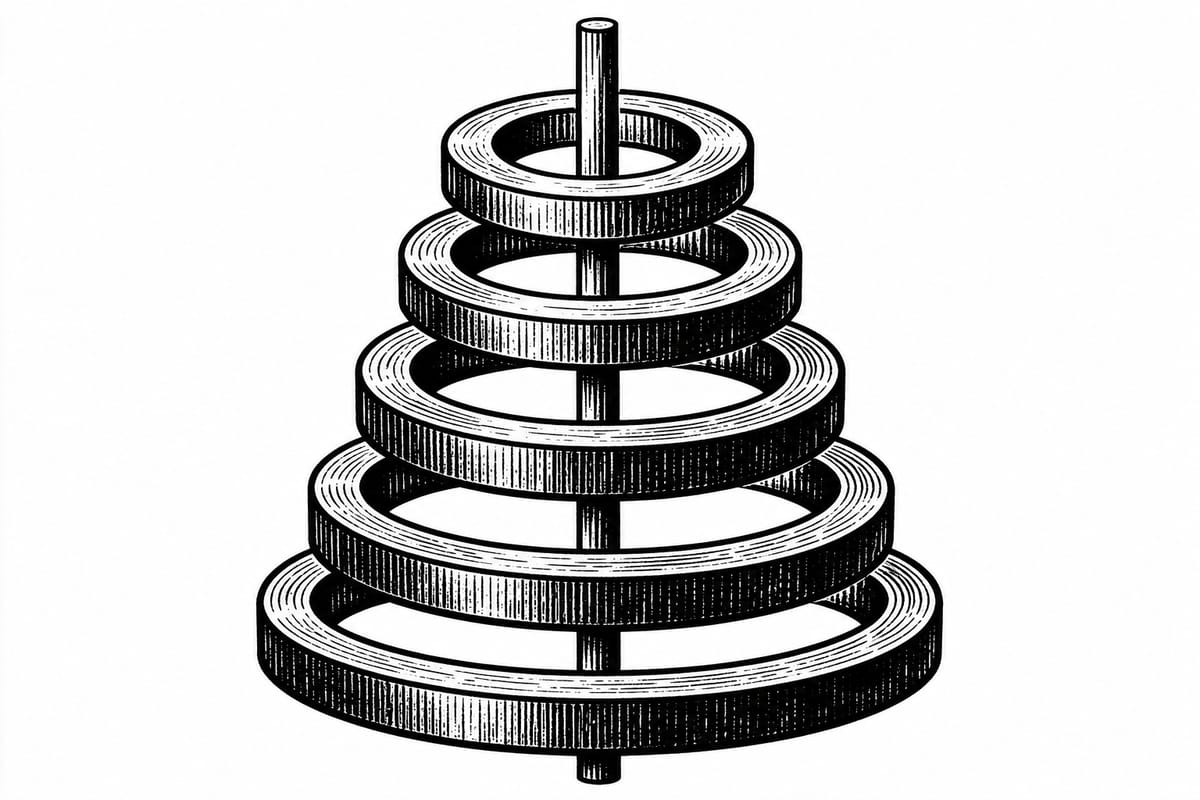
Greg gave you the whole stack in one sentence: "1-3-5 and then there's 1-3-5-7 and there's 1-3-5-7-9 and then there's in major 1-3-5-7 sharp 11 and then 1-3-5-7 sharp 11 13. That's all the upper extensions." Then he told you where to stand: "I would say just start with like 1-3-5-7-9 and then you can add the sharp 11 and the 13 if you really like want to get into it."
Thirteen is the ceiling, and the reason is arithmetic. Stack one more third above the 13 and you land on the root again. A 13th chord already contains every degree of the scale, so there is nowhere further to go.
The part worth slowing down for is the one Greg said most people get wrong. A ♯11 and a ♯4 are the same key on the piano, and so are a 13 and a 6, but "they have different functions and the ear tends to hear it as sharp 11 and 13 in a harmony context." A 6 is a chord tone inside the octave. A 13 floats above a root that is somewhere below it. Same pitch, different job, different voicing.
Watch
How to build a 7th chord (multiple ways) (Greg Spero, Weekly Piano)
- Two routes to the same chord: stack diatonic thirds inside a scale, or stack specific major and minor thirds by interval [00:12]. Learn both. The first is fast in a key, the second works anywhere.
- The identity of a seventh chord is the order of its thirds [07:38]. Major 7 is major, minor, major. Dominant 7 is major, minor, minor. Minor 7 is minor, major, minor.
- Half diminished is a minor 7 with a flat 5, which puts you in Locrian: minor, minor, major [08:44], [09:45].
- Fully diminished double-flats the 7, giving three stacked minor thirds [10:01]. "It's the most unstable of all seven chords" [10:14], and at [10:23] he names it as the chord used in compositional contexts to switch keys. Hold that. A8 uses it.
How to play 7th chords on piano
- Spacing decides everything. The 7 crushed against the 1 is harsh; the same 7 placed an octave away inside the 3 and 5 is the dreamy sound. "It's all about context" [01:18], [01:31].
- Where the word dominant comes from, and why G7's natural F is what makes it dominant in C [01:55], [02:44].
- The three working ii-V-I voicings [05:12]. On the ii he puts the 7 on the bottom with the 1, 3 and 5 above it. On the V, at [05:47], the 7 on the bottom then the 3, the 5 and the 9. On the I, at [06:00], the 3, the major 7, the 9 and the 5, or trimmed at [06:08] to 1, 3, major 7 and 5.
What is a 9th chord?
- Minor 9 is made by lowering the 3 and the 7; the 9 stays natural [01:00]. "It's kind of a haunting sound, isn't it."
- The mechanism you already met in A5, now with a second layer: G7 to C works because B and F resolve inward. Add the ♭9 and you get a second tritone, A♭ against D, which also resolves, ♭6 down to 5 and 2 up to 3 [03:38].
- The ♯9 with a ♯5 as the next step out [04:40].
What is a 13th chord?
- Why 13 is the largest chord there is [00:12], [00:32].
- Major 13 takes the ♯11, because at [01:22] the natural 4 is "not a resolved tone" against a major 3 while the 3 is. At [01:39] he adds that you will usually write a dominant 13 rather than a major 13 anyway.
- Minor 13 keeps the natural 11, and the reason is intervallic: against a ♭3 the natural 11 forms a major ninth, not the harsh minor ninth it forms against a major 3 [03:03].
- The comping voicing at [05:20]: left hand 3-9-♭7, right hand the 13 in octaves with the root in the middle.
What is a 7th chord?
- the two-minute version, and the rule that a dominant leads a fifth below
Ear training: recognizing 7th chords
- drill one, triads against sevenths
Ear training: recognizing 9th chords
- drill two, with a second section of spread voicings
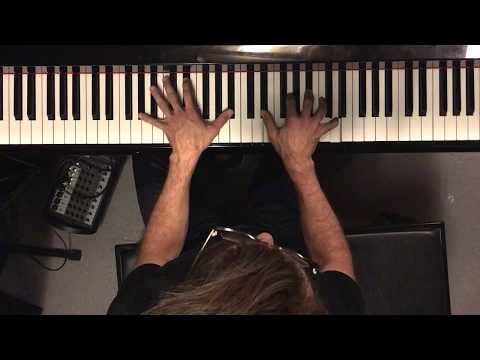
Exercise for recognizing chords (13th 9th 7th triads)
- the capstone drill, roughly forty items covering everything in this lesson
At the piano
The full quality list Greg drilled, in his order, which is the order to practice it: major triad, minor triad, major 7, dominant 7, minor 7, major 9, dominant 9, minor 9, dominant ♭9, major ♯11, major ♯11 13, minor 11, minor 13. "That's pretty much all of them because then you start over if you keep going up in thirds."
| Quality | Spelling from the root |
|---|---|
| major 7 | 1 3 5 7 |
| dominant 7 | 1 3 5 ♭7 |
| minor 7 | 1 ♭3 5 ♭7 |
| half diminished | 1 ♭3 ♭5 ♭7 |
| fully diminished | 1 ♭3 ♭5 ♭♭7 |
| major 9 | 1 3 5 7 9 |
| dominant 9 | 1 3 5 ♭7 9 |
| minor 9 | 1 ♭3 5 ♭7 9 |
| dominant ♭9 | 1 3 5 ♭7 ♭9 |
| major ♯11 | 1 3 5 7 ♯11 |
| major 13 | 1 3 5 7 ♯11 13 |
| minor 11 | 1 ♭3 5 ♭7 9 11 |
| minor 13 | 1 ♭3 5 ♭7 9 11 13 |
| dominant 13 | 1 3 5 ♭7 9 13, the 11 omitted; in practice you drop the 5 as well |
Hands. Greg was specific about the division of labor: "I want you to have your baseline because your left hand, so you can do baseline. But I want you to know that this is a 13, you know, this is a nine." Left hand holds the root and moves. Right hand holds the color and you say out loud what it is. Naming while playing is the whole exercise.
Do not voice these as stacks. Six notes in a row from the root is a textbook illustration, not a sound. Drop the 5, drop the root once your left hand has it, and keep the tightest interval away from the bottom. The 3 and the 7 carry the quality, which is why every shorthand voicing above keeps them.
Exercises
1. Third-order construction
Do. From ten random roots including black keys, build each of the five seventh qualities by stacking thirds in the correct order (M-m-M, M-m-m, m-M-m, m-m-M, m-m-m), saying the pattern aloud before you play.
Done when: All five qualities are produced from any root without re-spelling, and you never confuse half diminished with fully diminished.
2. One root, every quality
Do. On C, play the full thirteen-quality list in Greg's order, then the same list on F, B♭, and E♭. Left hand plays the root, right hand plays the color, and you say the quality out loud each time.
Done when: The full list runs clean on four roots with no hunting, spoken as you play.
3. The ♯11 versus ♯4 test
Do. Play a C major triad with an F♯ crushed inside it, then Cmaj7 with the F♯ up an octave above the 7. Same pitch class, two very different chords. Write one sentence on what changed. Repeat on three other roots.
Done when: You can explain, unprompted, why the ♯11 is voiced high and what the natural 11 would do to a major chord.
4. The two tritones
Do. Play G9 to C, then G7♭9 to C. In the second, find both tritones and name the four moving voices and their destinations. Do it in three keys.
Done when: All four resolving voices are named before you play them, in three keys.
5. Voicings on a ii-V-I
Do. Play Dm7, G7, Cmaj7 with the voicings from the video: C-D-F-A, then F-B-D-A, then E-B-D-G. Left hand walks the roots. Then move it around the circle of fifths, one key at a time.
Done when: All twelve keys are fluent with the top voice never leaping more than a third between chords.
6. The three ear drills, in order
Do. Screen turned away. Run drill one to 100 percent twice, then drill two, then the capstone. Greg's instruction on the last one is "keep going through the video until you can get it all perfectly."
Done when: Every item on the capstone drill is named before Greg names it, on two consecutive runs.
7. Improvise over one landscape
Do. Hold Cmaj7 as a landscape and improvise over it, in Greg's assignment: "this is major 7 landscape, most simple possible landscape." Then change the scale over the same held chord without changing the chord. Record a voice note and send it to him.
Done when: You can play two minutes over one static chord that has shape rather than wandering, and a listener can hear where the scale changed.
Checkpoint
- Any of the thirteen qualities played from any root, left hand on the bass, quality spoken aloud.
- The five seventh qualities built by third-order from black-key roots without recalculating.
- The ♯11-versus-♯4 distinction explained in your own words with an example at the keyboard.
- The capstone chord ear drill passed twice.
- One voice note of improvisation over a single held major-7 landscape, sent to Greg.
Read
- Source course, Lesson 2, on the minor seventh as the dominant chord's "quality of unresolved tension" and the major seventh as "brightness with an edge," a "near-miss quality" a half step short of the octave. It explains why Cmaj7 is a consonance in jazz and a bite in classical usage.
- Source course, Lesson 11, on the V7 tritone as "the moment of greatest instability within the tonal system." Read it directly before A8, because the circle of fifths is that instability repeated twelve times.