The idea
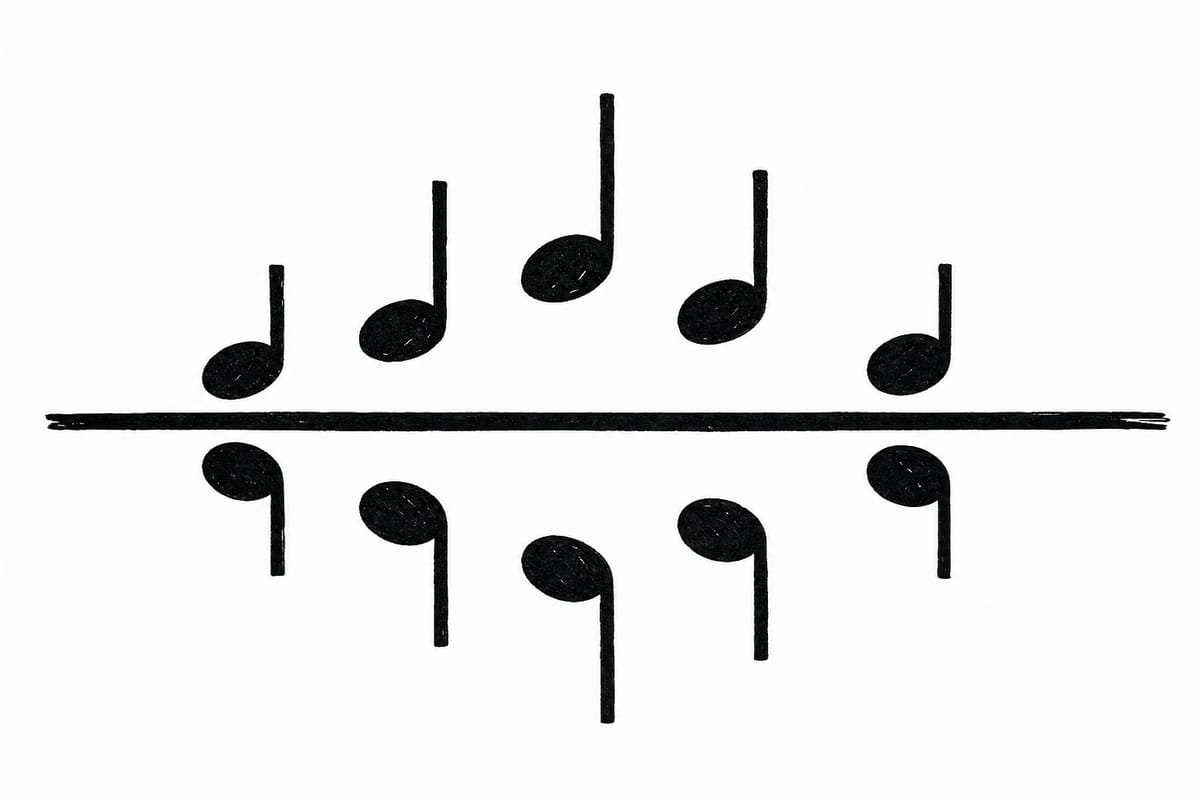
Pick an axis. Reflect every note of a progression across it. Play the result. That is the entire operation, and it takes about ten minutes to learn.
Everything interesting about it is downstream of one fact: the axis sits between the tonic and the dominant. In C that is the midpoint between E flat and E. Reflect a G7 across it and you get F minor 6. Reflect the whole cycle A7 to D7 to G7 to C and you get E flat minor 6 to B flat minor 6 to F minor 6 to C. Collier's own description of what has happened: "it kind of converts everything perfect to plagal."
So the mirror is not a random scramble. It exchanges the two ways Western music ends. That is why the technique is worth two weeks and why almost everything written about it online is wrong about where it came from.
Watch
Reverse Harmony (https://www.youtube.com/watch?v=JfzN9e9OcKc). This is the primary asset for the lesson. Watch it twice.
- At [00:53], the axis: "in between an E and an E flat." Fix that pitch before anything else, because every mistake downstream comes from a misplaced axis.
- At [02:21], the mirrored dominant arrives as "your minor four with a major 6." That is the plagal conversion, heard rather than argued.
- Between [05:31] and [07:26], the tritone substitution reflected. Watch what happens to a chord that is already symmetrical.
- At [10:21] and again at [11:35], Greg catches his own arithmetic error and redoes it on camera. Do not skip this. Counting semitones across an axis is error-prone for everyone, and seeing the correction is more useful than seeing a clean take. Voiceleading exercise (https://www.youtube.com/watch?v=rg-EP4rRTEs). You did this in L20. Return to [02:46] and [05:20] with the axis in hand, and confirm for yourself that the tension points survive the flip.

Reverse Harmony
- the whole operation demonstrated at a piano, including the moment the arithmetic goes wrong and gets redone
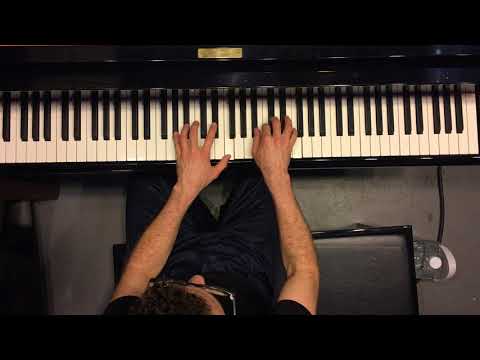
Voiceleading exercise
- the same chain played straight and mirrored, with the tension points surviving the flip
Listen
Collier, "In the Bleak Midwinter," final chorus. Pass one: the choir as one sound. Pass three: the bass. Pass five: find one chord you cannot name. Then note the honest caveat, which is that even Wikipedia's article on the topic observes that Collier has not explicitly applied the exact methods of negative harmony in his music. He talks about it in interviews. What is in the recordings is much harder to attribute, and you should hold the connection loosely.
Bach, Art of Fugue, Contrapunctus XII, both forms. The mirror fugue is the same music inverted, written three hundred years earlier. Pass one: form one alone. Pass two: form two alone. Pass five: both, one after the other, listening for what stayed and what flipped.
Evans, "Blue in Green." Listen for the plagal motion in a piece that got there by ear. The point of including it is to keep you from hearing every minor iv as evidence of a mirror.
The comparison
The exact parallel. Levy's A Theory of Harmony, edited by Siegmund Levarie and published by SUNY Press in August 1985 after Levy's death, argues that major and minor are mirror images generated from a single point by ascending and descending series. His term for this is polarity. Lewin's transformational theory, forty years of it, formalizes inversion as an operator on pitch-class sets that can be applied to anything. Collier's practice takes a progression, reflects it, and plays what comes out. All three are doing the same arithmetic.
Where it breaks, first break, and it is a naming break. "Negative harmony" does not appear in Levy's text. The term was coined by Steve Coleman in the late 1970s or early 1980s. The transmission chain is Levy to Coleman to Barak Schmool to Collier, and Collier learned it from Schmool. Every article that says "Jacob Collier's negative harmony comes from Ernst Levy" has skipped two people and one coinage. Say the chain correctly, because it is the single most repeated error in this subject.
Where it breaks, second break, and it is a mechanical one you will feel at the keyboard. The axis is the midpoint between tonic and dominant. The widely repeated formulation, that the axis sits between the third and fifth scale degrees, gets the right answer in C by coincidence and misleads you about why. Derive it from the tonic and the dominant every time and it will be right in every key.
Where it breaks, third break, and this is the theoretical one. Levy claims acoustic reality for the mirror. His dualism rests on an undertone series, a physical descending counterpart to the overtone series. There is no undertone series. Haller's thesis devotes a section to it under the heading "The Fallacy of Harmonic Dualism," and this is the standard modern position. Lewin makes no such claim: for him inversion is an operator, useful because it is well defined, indifferent to whether nature endorses it. The technique survives the collapse of Levy's justification. You can use the mirror and reject the physics, and that is the honest position to teach from.
Where it breaks, fourth break. Bach's mirror fugue inverts the music and preserves its function. A cadence stays a cadence. Negative harmony inverts the music and converts function, turning authentic into plagal. Same operation, opposite consequence, because Bach inverts around a diatonic axis inside the key and negative harmony inverts around an axis chosen precisely to swap the poles.
A correction to the received story. There is a widespread claim that Collier misunderstands Levy. No peer-reviewed article argues this. What the literature actually contains is more modest and more useful: Ahn's observation that "negative harmony is a loose term," and Haller's demolition of the dualist physics rather than of Collier. Treat the "Collier is wrong" genre as unsourced.
The deeper warning comes from Buchler, writing about transformational analysis generally: the method "contains only tools, not guidelines for their application," and "the more ways that it is possible to draw equivalent relations, the less significant those relations become." Applied here, it means this. If you can mirror any progression around any axis, and you always can, then the fact that two progressions are mirror-related tells a listener nothing by itself. What makes a mirrored progression good is what makes any progression good, which is the voice-leading, the register and the rhythm. The mirror is a generator, not a justification.
What actually transfers, in three items. First, the plagal conversion is a real compositional device: reflect a dominant, get a minor iv with a major sixth, and you have a substitute cadence you can hear. Second, the mirror is a fast idea generator when you are stuck, because it produces progressions you would not have chosen. Third, symmetrical chords are their own reflections, which is why the tritone substitution behaves strangely in the video and why L19's symmetric collections are the fixed points of this operation. Everything else is bookkeeping.
At the piano
Find the axis in all twelve keys. In C it is between E flat and E. Derive it by taking the tonic and the dominant and finding the midpoint. Say it out loud in each key before you play anything.
Reflect single notes. Play C, then its reflection. Play D, then its reflection. Do all twelve chromatic notes in C's mirror until you stop counting.
Reflect triads. C major becomes an F minor triad in reflection. G major becomes a C minor triad. Do all the diatonic triads of C, and notice that the major and minor qualities exchange.
Reflect the cycle. A7, D7, G7, C becomes E flat minor 6, B flat minor 6, F minor 6, C. Play the original, then the mirror, then alternate bar by bar.
Voice the results properly. The reflection gives you pitch classes, not a voicing. This is L20's pitch-versus-pitch-class distinction again. Once you have the mirrored chords, re-voice them for smooth motion, because the raw output of the mirror usually leaps.
Check the fixed points. Play a diminished seventh and reflect it. Play a whole-tone-derived chord and reflect it. Find out for yourself which chords come back as themselves.
Exercises
1. Axis derivation
Do. Write out the axis for all twelve keys, deriving each from the tonic and the dominant.
Done when: you can state the axis for any key in under three seconds and you never use the third-and-fifth shortcut.
2. Note reflection drill
Do. In C, play each chromatic note and its reflection, ascending, then descending, at 60 bpm.
Done when: two full passes with no counting and no errors.
3. Triad reflection
Do. Reflect all seven diatonic triads of C and play both versions of each.
Done when: you can do it in three keys and state the rule about major and minor exchanging.
4. The cycle
Do. Play A7 to D7 to G7 to C, then the mirror, then re-voice the mirror so no voice moves more than a whole tone.
Done when: the re-voiced version is playable at 70 bpm and you can name every chord in it.
5. The error check
Do. Reflect an eight-chord progression of your own on paper. Then check every chord at the keyboard. Count the ones you got wrong.
Done when: you have found and fixed every error. Greg made one on camera at [10:21], so expect some, and treat the count as data rather than a grade.
6. Fixed points
Do. Find every chord type you can that maps onto itself under the mirror.
Done when: you have at least two and can explain the connection to L19's symmetric collections.
Compose
Write a two-minute piece in three sections.
Section one is a plain diatonic progression of eight to sixteen bars with a clear authentic cadence. Write it well enough to stand alone.
Section two is section one, mirrored around the tonic-dominant axis, re-voiced so that no voice leaps more than a whole tone. The melody is mirrored too. The cadence will have become plagal, and you leave it that way.
Section three is your composition, using material from both, in which the two cadence types alternate and the last one is your choice.
Then write one paragraph, in your own words, on whether section two is any good, and if it is, whether it is good because of the mirror or in spite of it. That paragraph is the actual assignment. Buchler's warning is the standard to hold it to.
Checkpoint
- State the axis in any key on request and derive it correctly.
- Reflect any triad or seventh chord at the keyboard without counting on your fingers.
- Play the A7 to C cycle and its mirror, re-voiced.
- State the transmission chain from Levy to Collier, naming all four people and who coined the term.
- State what is wrong with Levy's justification and why the technique survives it.
- State Buchler's objection in your own words.
- Hand over the three-section piece and the paragraph.
Read
- Levy, A Theory of Harmony (https://sunypress.edu/Books/A/A-Theory-of-Harmony). Read the chapters on polarity. It is a short book and a strange one. Read it to see that the term everyone attributes to him is not in it.
- Collier with June Lee, Part 1 (https://www.youtube.com/watch?v=DnBr070vcNE). Watch the negative harmony explanation and write down the chord mappings he gives. This is the primary source for what Collier actually says, as opposed to what is said about him.
- Buchler, "Reconsidering Klumpenhouwer Networks" (https://mtosmt.org/issues/mto.07.13.2/mto.07.13.2.buchler.html). Free and online. It is about a different topic and its argument about tools without guidelines is the one that matters here. Read the introduction and the conclusion.
- Debora Haller, "Negative Harmony: The Shadow of Harmonic Polarity on Contemporary Composition Techniques" (MA thesis, Belmont University, 2020), https://www.academia.edu/92589329/, section 1.5, "The Fallacy of Harmonic Dualism." Read that section for the undertone-series problem, and chapter 1 for the dualist genealogy she traces from Zarlino through Hauptmann, von Oettingen and Riemann to Levy. This is a master's thesis, not a peer-reviewed article. Weight it accordingly.
- Wikipedia, "Negative harmony" (https://en.wikipedia.org/wiki/Negative_harmony). Read it as an artifact. Note where it is careful, including its own caveat about Collier's music, and note where the internet consensus it summarizes is unsourced.