The idea
A long piece needs something to be about, planted early and kept small.
The source course's example is one note. In the Eroica the cellos state a theme outlining the E-flat triad, and in bar 7 the melody reaches a C-sharp, foreign to E-flat major. It resolves down to D immediately, and it generates 691 bars of musical consequences (Source course, Lesson 14).
That is the technique. A small contradiction, stated once, that the rest of the piece exists to metabolise. Rosen's argument, which the source course follows, is that Beethoven asked how much pressure the Classical style could bear rather than breaking it, and the answer was far more than anyone expected.
Your problem is the opposite of Beethoven's. Your sections are consistent and do not move. Here is the reason a piece has to move. You put something in it that cannot be left alone.
Watch
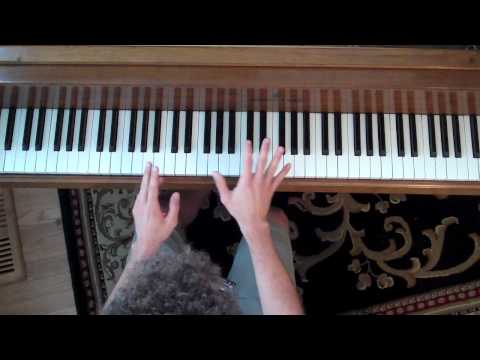
Learning Wayne Shorter Solo Technique - Goal Notes
- [00:50] Greg derives the two goal notes, G and C, from the melody's rhythm alone, by which notes are held and where phrases land. G is primary, C is secondary. Everything after this is those two notes.
- [04:44] the centrepiece. In one phrase Shorter accents D and B-flat, neither a goal note, each converging two half steps inward onto C and G. Greg: "it might just sound like a cool bluesy phrase, but it's really much more deep than that."
- [05:44] the third chorus lays on the secondary goal note almost continuously, in octaves, with the primary as a grace note, then releases upward.

Become more Musical in your Piano Solos
- [00:38] "it's a lot easier to be musical if you force yourself into a limitation like one octave." Beethoven's limitation is four notes.
- [02:25] the metronome clicking only on beat one. You hold the subdivisions yourself, the small version of holding a long form together.
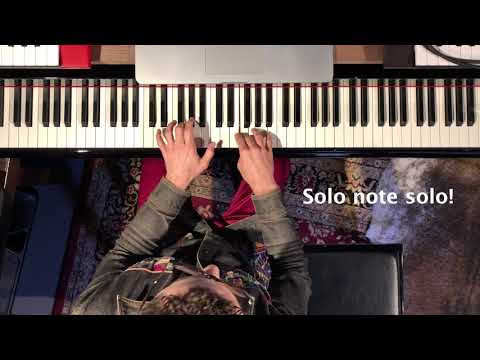
12 Steps to Musicality overview
- [07:47] the one-note expansion. "How do you use two notes to do a solo, how do you use one note to do a solo?" The Fifth Symphony problem as a practice exercise.
Listen
Beethoven, Eroica, first movement. Pass one: the two opening chords and the cello theme. Play it until you expect the C-sharp before it arrives. Pass two: the whole exposition, timed. The source course gives exposition 152 bars, development 245, movement total 691. Pass five: find the new E minor theme in the development, then the horn entry over the dominant pedal that made Ferdinand Ries think the player had come in early.
Beethoven, Symphony No. 5, first movement. Pass one: three short notes and a long one, then the same a step lower. Pass two: the second theme in the relative major and what the accompaniment plays underneath. Same rhythm. Pass five: count the development, 123 bars in the source course. Then hear the coda do the work of a second development.
Then the bridge from the third movement into the finale, a dominant pedal prolonged over fifty bars of hushed, pulsing repetition. It is the most instructive passage in Classical music about what suspense is made of, and it is almost nothing.
Beethoven, Appassionata, first thirty seconds. A theme in bare octaves descends through the F minor triad, then restates a half step higher in G-flat major. That semitone becomes the structural dissonance of the whole sonata. Play both statements before listening again.
Coltrane, A Love Supreme, first movement, last two minutes. The four-note bass motif matching the title's syllables is chanted, and the source course describes it sung on every pitch of the chromatic scale.
Sleepy Eyes of Death, "Mean Time 'Till Failure." Osborn's piece built from one two-chord motive, F major to A minor, developed only by amplitude, timbre and texture. The build levels off at 1:07 and a structural decrescendo runs from 2:12 to the end.
Animal Collective, "Banshee Beat," first four and a half minutes. Osborn's mirror case, a structural crescendo. Two chords, a groove in three-plus-three-plus-two sixteenths. The second chord takes over two minutes to arrive, the groove is not formed until 2:59, the howling vocal motive first appears at 4:27. Osborn reads it as a non-recapitulatory version of Spicer's cumulative form.
Anomalous, "Ohmnivalent," final module. Hannan's song travelling from structural density to structural clarity. The local pattern a-b-a-c-a-b-a-d parses at the larger level as ab-ac-ab-ad. Listen for where you stop working to follow it.
Between the Buried and Me, Parallax II, two consecutive tracks. Listen for material returning, and whether it returns longer than it was.
The comparison
The exact parallel. Beethoven's end-weighting and the modern terminal climax both move a piece's centre of gravity toward the end. In Haydn and Mozart the development is the dominant upbeat to a tonic downbeat, and Beethoven made it the centre of gravity of the movement (Source course, Lesson 14). Osborn's terminally climactic form, from his 2013 Music Theory Spectrum article and his 2010 dissertation, names the modern version, where the peak arrives in a new final section rather than in a returning chorus. In both cases the formal goal is a new terminal section rather than a recapitulation, which inverts the Classical norm.
Hannan's death metal terminal climax, from his 2022 article, lists what one is made of. A break in texture, vocals ceasing, a moderate or slow tempo often after a tempo change, spacious let-ring triadic or modal chords, layered guitars and solos, gradual fade, repetitive structures. He relates it to Osborn's terminal climax and distinguishes it from it. That list is why so many long metal songs end quiet and wide.
Where it breaks, first break, and this is the one that matters. Beethoven's ending pays a debt. The C-sharp in bar 7 was a contradiction and the movement's end is where it stops being one. The rock and metal terminal climax is usually achieved through textural and dynamic accumulation on new material, with no tonal debt paid. Getting louder is not resolving.
So if you write a big ending, name what it resolves. If the honest answer is nothing, you have written an accumulation, a legitimate form, and you should build it the way Osborn's Type I pieces are built, as a crescendo with no theme, rather than pretending it is a Beethoven coda.
Where it breaks, second break. Beethoven's unity is thematic and his scale is enabled by it. When every event relates to a central idea, the listener's memory has a thread through remote modulations, so unity of material permits a larger canvas. Between the Buried and Me get their scale differently. Hannan's conference paper on Parallax II argues that recognising returns of previously presented material, from short guitar gestures up to whole sections and across the album, is how you hear the form, and that material there returns expanded. He names an ABABB additive formal process and a looser case he calls expanding repetition. That is a Romantic cyclic principle rather than a Beethovenian developmental one, the material coming back longer rather than transformed. It is a conference paper, not a peer-reviewed article, and say so if you cite it.
Opeth, honestly. Opeth's most teachable feature is the alternation of death metal and folk or progressive rock sections inside one song, and no measure-level scholarly analysis of "Blackwater Park" or "Ghost of Perdition" could be located. The one scholarly datum that exists is a single moment, "The Drapery Falls" at 0:08, analysed by Boddington Jordan and Herbst inside a twenty-track progressive-metal corpus whose finding is that the subgenre has no consistent harmonic practice. Any structural claim about the long songs is to verify. The usable frame is topic theory after Ratner and Agawu, where the acoustic sections work as style-topics carrying imported associations, as a sudden alla turca does in Mozart. That breaks on scale. In Mozart the imported topic is subordinated to tonal syntax and lasts a few bars. In Opeth it occupies whole minutes and brings its own harmonic language, closer to a suite of movements fused into one track.
At the piano
Plant a contradiction. In C major, play a four-bar phrase that is diatonic except for one note. Put an A-flat in bar 3, on a strong beat, resolving down by step. Play it fifty times until it sounds inevitable. Then write eight bars whose only job is to explain where it came from, by tonicising A-flat major or using it as the third of F minor.
Fragment to two notes. Reduce the four-bar phrase to its first two notes. Play only those, in six registers, six rhythms and three harmonisations.
The long pedal. Left hand, a low G struck once every two bars, pianissimo. Right hand, one fragment of your theme, unchanging, for thirty-two bars. Then arrive in C. Most students give up at bar twelve, which is why most students cannot write suspense.
The two endings. Write two endings for the same sixteen-bar passage. Ending A is a Beethoven coda, resolving the A-flat, returning the theme intact, loud because it has earned volume. Ending B is a terminal climax, new material, thicker texture, slower, let-ring chords, no return. Play both to one listener and ask which felt finished.
Exercises
1. Two notes, four choruses
Do. Over a blues, choose a primary and secondary goal note. Improvise four choruses in which every phrase arrives at, departs from, or outlines one of the two. Chorus three lays on the secondary note almost continuously, as Shorter's does.
Done when: you play four consecutive choruses with no third goal note appearing, and a listener can name your two.
2. Enclosure at a distance
Do. Take the enclosure device from the Shorter video. Choose a goal note, then two notes two half steps away on either side, and write four phrases that accent the outer pair and never state the goal.
Done when: a listener names the goal note you never played.
3. The one-note solo
Do. Greg's exercise from the twelve steps video. Solo over a blues on one pitch, then two.
Done when: the one-note chorus holds attention for twelve bars on rhythm, space and dynamics alone.
4. The planted contradiction
Do. Write a four-bar theme in a major key with exactly one foreign note. Then three eight-bar passages, each taking that note as a starting point and going somewhere different with it.
Done when: you can play all three and say what the foreign note turned out to be in each.
5. The fifty-bar pedal, scaled down
Do. Build thirty-two bars over an unchanging dominant pedal on one rhythmic fragment, with only dynamics and register changing. Then land on the tonic.
Done when: you play it through without adding material out of boredom, and the arrival lands as a release.
6. Debt audit
Do. Take three long pieces you love, at least one instrumental rock or metal. For each, write two sentences saying what the ending resolves and how you know. If the answer is nothing, say so.
Done when: at least one of the three has "nothing, and it works anyway" as the honest answer, and you can say why it works.
Compose
Write six to eight minutes for piano, or piano and one other instrument, built on a single planted contradiction.
Requirements. State the contradiction in the first twenty seconds, as one note or interval foreign to the prevailing key, and do not explain it yet. Build at least three sections from material derived from the theme containing it, and let the middle section be the longest and least stable. Somewhere in it, use the same fragment in augmentation underneath and at speed on top.
Before the return, write at least thirty seconds over a single held or repeated bass note, with no new material.
Then choose your ending and label it on the score. A Beethoven ending is marked at the bar where the contradiction resolves. A terminal climax is marked "no debt paid" where the new terminal material begins, and must use at least four features from Hannan's list. You may not write both. Choose, and defend it in two sentences.
Checkpoint
Play four blues choruses on two goal notes, with a lay-on-it chorus, and have a listener name them.
Play a phrase whose goal note is enclosed at a distance and never stated, and have a listener name it.
Play the thirty-two-bar pedal passage without adding material.
Hand over the composition with either the resolution bar or the "no debt paid" marking written in.
Say what Beethoven's end-weighting and the terminal climax share, and where the comparison stops.
Say what is and is not known about Opeth's long forms, and what frame you would use instead.
Read
- Source course, Lesson 14 (/library/garnett-course.pdf). Structural dissonance, motivic integration as the enabler of scale, the coda as a second development, and the late style. Memorise the sentence lining up Haydn planting surprises, Mozart concealing asymmetries, and Beethoven introducing contradictions whose resolution requires an immense argument.
- Brad Osborn, "Understanding Through-Composition" (Music Theory Online 17/3, 2011), https://mtosmt.org/issues/mto.11.17.3/mto.11.17.3.osborn.html. Read the whole thing this time. The four types and the idea of independent verses and choruses carry into L25 and L26.
- Calder Hannan, "Structural Density and Structural Clarity" (Music Theory Online 28/1, 2022), https://mtosmt.org/issues/mto.22.28.1/mto.22.28.1.hannan.html. The death metal terminal climax section and the "Ohmnivalent" analysis, with the track playing.
- Brad Osborn, "Subverting the Verse–Chorus Paradigm" (Music Theory Spectrum 35/1, 2013, 23–47), https://doi.org/10.1525/mts.2013.35.1.23. The publisher paywalls it, but Osborn deposited an open copy at https://kuscholarworks.ku.edu/handle/1808/19147, so there is no reason not to read it. Cite the concept to the article, not to the summary above.
- Score of the Eroica, first movement, first page. Find bar 7 and look at the note. The whole lesson in one glance.