The idea
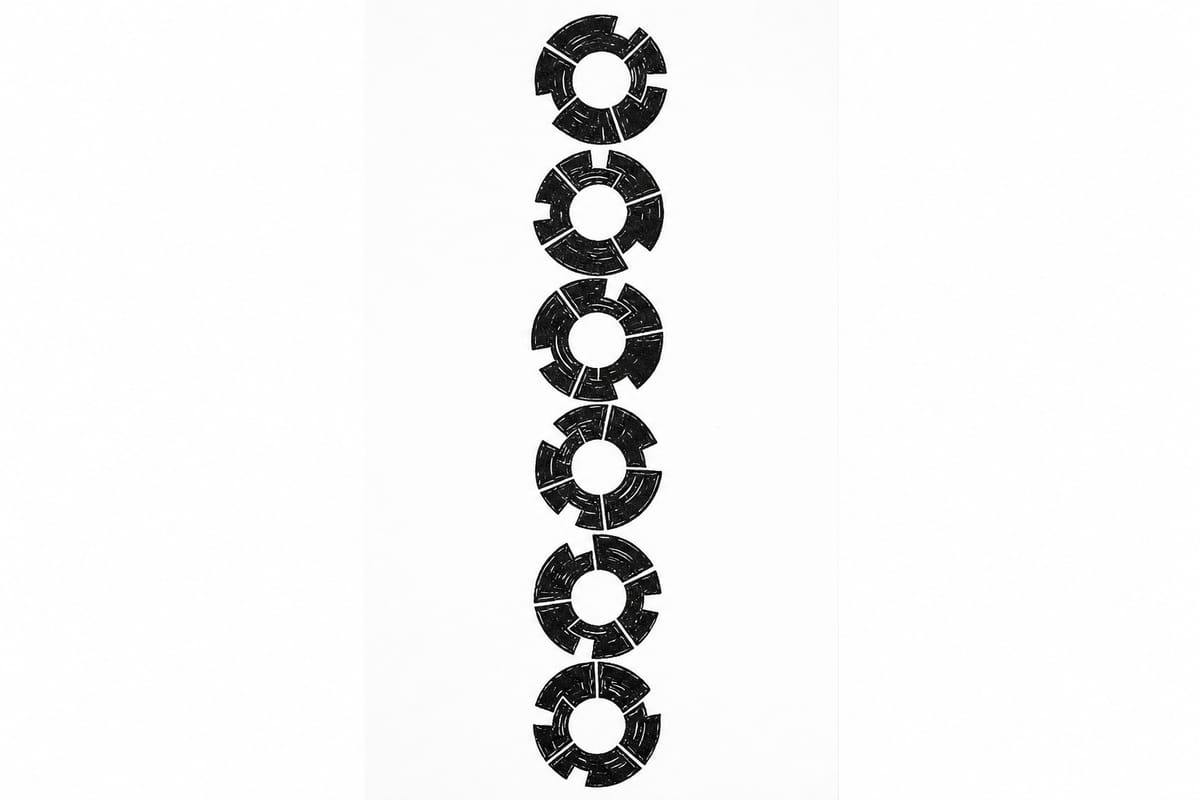
Take a repeating figure. Do not change a single duration in it. Change only which duration you call the first one.
Nothing about the sound has changed and everything about the meaning has. Olivia Lucas calls the result a rotated riff: a looping riff whose internal durational pattern is arranged so that it sounds as if it begins in the middle, in media res. The listener re-orients, guesses wrong about where the segment boundary should fall, and is denied the correction.
Stravinsky does the identical operation in the pitch domain and calls it a rotational array. Source course Lesson 21 gives you the five steps. Same move, different axis: take an ordered set, move the first element to the end, do it again, and read the results.
Rotation is the cheapest structural operation there is. It costs you no new material.
Watch
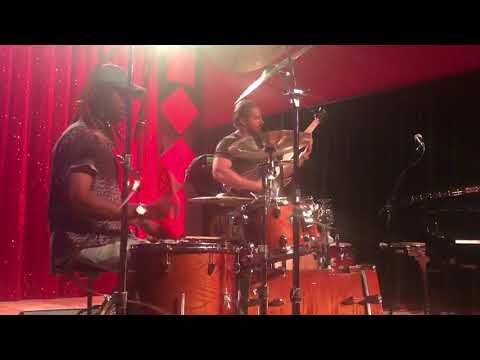
Polyrhythmic 17/16 groove
- Performance only, no talking, so the work is entirely yours.
- Count in sixteenths from the first attack you hear and mark where you think the cycle restarts. Then count again starting from a different attack.
- The groove is 17 sixteenths, one sixteenth longer than a bar of 4/4, which is why it feels like something familiar that keeps sliding.
- Listen for where the left hand's cycle re-aligns with the downbeat you perceive, which is not necessarily the downbeat Greg is playing from.
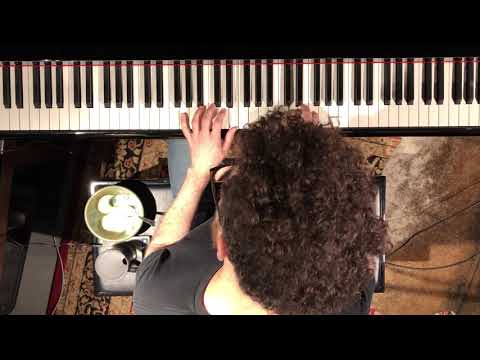
Play Polyrhythms on Piano
- [00:25] to [00:40] is the mechanism: "you play in triplets sometimes, and sometimes you take those triplets and you turn their equal length into sixteenth notes for a longer bar, so it ends up being a four overlaid over the three." The note value stays. The grouping moves.
- [00:57] "it's all about phrasing, it's really just a phrasing difference." That sentence is this lesson.
- [01:07] he deletes the downbeat click. Practicing without a stated beat one is exactly the condition a rotated riff creates.
- [02:14] his standing warning that he rushes. Rotation exercises punish rushing more than anything else in the module.

Good Time and Feel: The Time Stack
- [05:05] play scales with every note on the sixteenth immediately before or after the beat. If you cannot deliberately place a figure one sixteenth off, you cannot rotate one.
Listen
"Lethargica," "Pineal Gland Optics," and "Pravus," all from obZen (2008). These are Lucas's three named in media res examples, and "Pravus" carries two separate rotated riffs, so the song repeatedly denies you a stable orientation point.
Pass 1. Riff entry only, ten seconds. Tap where you think beat one is. Commit.
Pass 2. Same ten seconds. Try to hear a different attack as beat one. If you can hold either reading, the rotation is doing its job.
Pass 5. Now play the whole segment and find where it ends. Lucas's structural claim is that Meshuggah builds songs in segments of eight, sixteen, or thirty-two bars of 4/4, and that the looping riff is simply cut off wherever it happens to be when the segment ends. Note where the truncation lands relative to the riff's own pattern. That truncation, not a cadence, is the form.
What to sing and tap. Sing the riff cycle on one pitch, starting from your pass-1 guess. Then sing it starting from your pass-2 guess. Tap steady quarters through both.
Stravinsky, Movements (1958–59). Source course Lesson 26 calls this the first work to employ hexachordal rotation fully and systematically, and describes the audible result exactly: "The ear perceives not a melody being developed but a harmonic field being explored from different angles." Listen for that. You are not tracking a theme. You are hearing one collection from six positions.
The comparison
The parallel with Cone. Edward T. Cone, in Musical Form and Musical Performance, distinguishes beginning, middle, and end as functions rather than positions, and separates the "temporal beginning" from the "rhythmic beginning." Lucas's rotated riff is precisely a passage whose temporal beginning and rhythmic beginning are misaligned on purpose. That is Cone's distinction operating as a compositional device rather than as an analytical category.
Where Cone breaks. In Cone's repertoire, tonal syntax and phrase rhythm make the "true" beginning recoverable. You may be fooled, and then the harmony tells you. In Meshuggah there is no syntactic evidence for a correct orientation at all, so the ambiguity is permanent rather than retrospectively resolved. You never find out.
The parallel with Haydn. Source course Lesson 12 is built on surprise, and the surprise there is frequently a matter of where a phrase starts and how long you were expecting it to be. Haydn's game and Meshuggah's game are the same game: set an expectation about the location of a boundary, then put the boundary elsewhere.
Where Haydn breaks. Haydn's displacement is measured against a norm the listener shares and can name, and the joke lands because the correction arrives. The metal version withholds the correction, so the effect is disorientation rather than wit.
The parallel with Stravinsky's rotational arrays. Source course Lesson 21 gives the procedure. State a hexachord in order. Move the first pitch to the end and repeat for all six rotations. Then, and this is the step that makes it Stravinsky rather than plain rotation, transpose each rotation so it begins on the original first pitch. Arrange the six results as a 6x6 grid where every row starts on the same note but runs a different succession of intervals. Read across for melody. Read down the columns for the "Stravinsky verticals," harmonies unavailable through transposition, inversion, or retrograde, and typically whole-tone or octatonic in flavor. The course's line is worth memorizing: "The array is not a score. It is a PALETTE."
Where Stravinsky breaks, and this is the important one. Calder Hannan's conference paper on Between the Buried and Me's Parallax II generalizes McCandless's ABAC process into rotation through cycles with static and variable parts, and names a narrower case, the ABABB additive formal process, plus expanding repetition: material on that album, when it returns, tends to be expanded. That is a rotation of thematic material whose variable element is length and orchestration. It is closer to Romantic cyclic form than to a serial array. Stravinsky's rotations are pitch-class operations on an ordered series that generate genuinely new hexachordal content the listener has never heard. The metal version returns things you recognize. One generates; the other recalls.
One more break, on the axis. Meshuggah rotates durations, Stravinsky rotates pitches. Nothing forces those to behave alike, and mostly they do not: rotating a durational cycle changes where the accents land against a fixed grid, while rotating a pitch series changes the intervals you hear from a fixed starting note. The shared thing is the operation, not the result.
At the piano
Part one, rhythm. Choose a seven-sixteenth cycle with an internal grouping of 3+2+2. Play it as a single low note, left hand, against a metronome at 83 marking quarters.
Now play the same seven durations as 2+2+3, then 2+3+2. Same notes, same total, three different riffs. Record all three. Listen back and identify which one most strongly implies its own downbeat and which one most convincingly starts in the middle.
Extend to eleven. 3+3+3+2, then 3+3+2+3, then 3+2+3+3, then 2+3+3+3. Four rotations. Play each for eight bars of 4/4 and note where the cycle truncates when you stop.
Part two, pitch. Take the hexachord the source course uses in its own exercise: C, D♭, F, G♭, A, B♭. Write out the six rotations. Transpose each so it begins on C. Arrange them in a 6x6 grid. Play the six rows as melodies, hands separate, slow. Play the six columns as chords, both hands. Say out loud which columns sound familiar and which do not.
Part three, the two together. Play a row of the array as a melody in the right hand, in a seven-sixteenth rhythmic cycle, over a left-hand quarter-note grid. You are now rotating on both axes at once. This is the technical center of the lesson.
Exercises
1. Orientation test
Do. Play the riff entry of "Lethargica" for a friend or into a recorder, ten seconds. Ask them to clap beat one. Do the same with "Pineal Gland Optics" and both riffs in "Pravus."
Done when: You can predict, before they clap, which attack most listeners will choose, and you can name the alternative reading.
2. Four rotations, one cycle
Do. Write an 11-sixteenth cycle. Produce all four rotations of its internal grouping. Play each for eight bars at 83 against a quarter-note click.
Done when: You can play any of the four on request without counting up from the original, and you can state where each one truncates at the end of bar 8.
3. The rotational array
Do. Follow the five steps from source course Lesson 21 on a hexachord of your own choosing. Rotate. Transpose each rotation to begin on your first pitch. Build the 6x6 grid. Play all six rows and all six columns.
Done when: The grid is written out correctly by hand, every row begins on the same pitch, and you can play any column as a chord from the page.
4. Truncation as form
Do. Take one riff and one segment length. Loop the riff and stop the recording at exactly bar 8, then again at bar 16, then again at bar 32. Three takes.
Done when: You can hear that the three takes end on three different points inside the riff, and you can say which of the three endings is most usable and why.
5. Cone's two beginnings
Do. Write a four-bar piano figure whose temporal beginning and rhythmic beginning are aligned. Then rewrite it so they are not, changing nothing but the rotation.
Done when: Played back to back, a listener identifies a different downbeat in each version.
6. Expanding repetition
Do. State a 16-beat riff. Return it later at 20 beats by lengthening only its tail, then again at 24 beats by the same method. Do not change the head.
Done when: The head is literally identical in all three statements and each return is audibly longer.
Compose
Write a 48-bar instrumental piece in three 16-bar segments for piano, or for guitars, bass and drums.
- Segment one states a riff whose cycle is rotated so it begins in media res. It is truncated at bar 16.
- Segment two states a second riff derived by rotating segment one's durational cycle, no new durations allowed.
- Segment three returns segment one's head unchanged and expands its tail, so the return is longer than the original.
The one technique that must be audible: a listener should be unable to agree with you about where segment one's riff begins, and should immediately recognize the return in segment three.
Checkpoint
- Play any of four rotations of an 11-sixteenth cycle on request.
- Produce a correct 6x6 rotational array from a hexachord, by hand, in under ten minutes.
- Play three columns of that array as chords and describe their harmonic character.
- State Cone's distinction between temporal and rhythmic beginning in one sentence, and say why the metal case never resolves it.
- Hand in the 48-bar piece with the head identical across all three statements.
Read
- Lucas 2018, in full and free online. This is the primary text of the lesson. Read the sections on rotated riffs and on the hypermetric segment that truncates them, and note that her in media res examples are "Lethargica," "Pineal Gland Optics," and "Pravus," not "Bleed."
- Cone, Musical Form and Musical Performance, the chapters on beginning, middle and end as functions. Short and old and still the clearest statement of the distinction you are exploiting.
- Osborn 2011, https://mtosmt.org/issues/mto.11.17.3/mto.11.17.3.osborn.html, on "independent verses," which is the concept Lucas cites to explain why Meshuggah's segments do not behave like verses. Read it to stop looking for verse-chorus form where there is none.
- Hannan, Progect 2021 conference paper abstract, for rotation through cycles with static and variable parts, the ABABB additive formal process, and expanding repetition. Label it as a conference paper, not a peer-reviewed article, when you cite it. A related masters thesis exists but its record was not confirmed, so do not cite the thesis.
- Straus, Stravinsky's Late Music, for the documented places where Stravinsky departs from strict serial procedure. The course's own gloss is the lesson: when the array suggests one pitch and the ear hears another, the ear wins.
- Source course, Lesson 21, the five steps, plus Lesson 26 on Movements for what rotation sounds like, and Lesson 12 on Haydn for the surprise that does resolve.