The idea
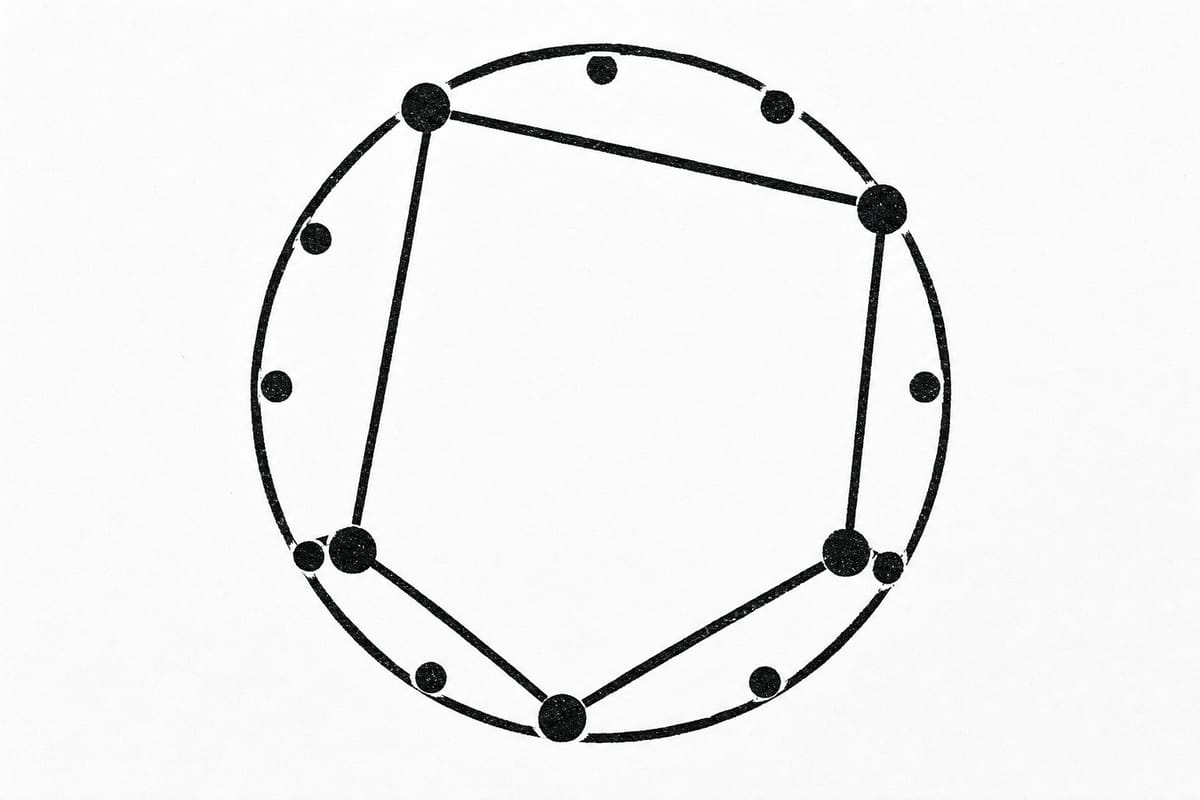
Ask a mathematician to put five attacks in twelve pulses as evenly as possible and there is one right answer. Ask about five pitches in twelve semitones and you get the same answer, written differently.
That is the whole lesson. Maximal evenness is a property of a set, and a set does not care whether you read it as time or as pitch. The diatonic scale is seven notes distributed as evenly as twelve semitones allow. Almost every groove that feels natural across the world's music is some number of attacks distributed as evenly as its cycle allows.
Brad Osborn's article "Kid Algebra" brought this apparatus into rock analysis in 2014, working on Radiohead. His method vocabulary is Euclidean rhythms E(k,n), maximal evenness, the Goldilocks principle, and the Spears–Stockhausen Continuum. He took the idea from the pitch side, where Clough and Douthett formalised maximally even sets in 1991, and applied it to time. This lesson teaches the mathematics you can verify at the keyboard and points you at Osborn for the songs.
Watch
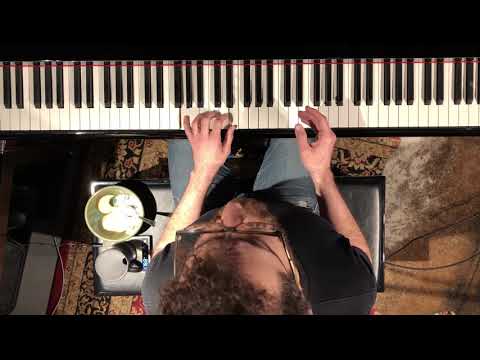
Polyrhythmic Exercise
- [00:29] metronome at 90, click on every beat, Chick Corea bassline in the left hand.
- [01:52] to [02:11] the three-to-four conversion. Three attacks across a span, then four across the same span, is E(3,12) against E(4,12) in the simplest possible form.
- [02:38] the mechanism: the triplets become sixteenths in a slightly longer bar. Same span, different k.
- [02:56] "try to speak in phrases so that question-answer form." An even attack pattern is still a rhythm, not a ruler.
Polyrhythmic 17/16 groove
- Performance only. Seventeen is prime, so no k divides it evenly and every distribution is a compromise.
- Count the attacks in one cycle. Ask whether the pattern you hear is the evenest possible arrangement of that many attacks across seventeen, or a deliberately lopsided one.
Improv on Everything In It's Right Place
- No transcript exists for this video, so nothing about its verbal content can be reported here.
- The harmony supplies almost no motion, so track how Greg generates development purely from placement and motivic return.
- To verify: commonly repeated descriptions of the tune's cycle length and its chord planing were not confirmed against a source for this course. Count the cycle yourself from the Radiohead recording before you write any of it down as fact.
Listen
Clapping Music (1972). Saltini analyzes the basic pattern as the beat-class set {0,1,2,4,5,7,9,10} in mod-12 space, with interval-class vector ⟨456562⟩. Eight attacks in twelve pulses.
Pass 1. Clap along with the fixed part until it is automatic.
Pass 2. Write the pattern as a row of twelve boxes with eight filled. Look at the gaps. They are not identical, and they are as close to identical as eight in twelve permits.
Pass 5. Follow only the second performer as the pattern shifts. Every shift is a transposition of the beat-class set. Notice that the ear hears direction, which the mathematics does not encode.
Piano Phase. Twelve notes on five pitches. Ask the evenness question of the pitch collection as well as the rhythm.
"Everything In Its Right Place," Kid A (2000). Count the cycle. Write down how many pulses it has and where the attacks fall. Do this before reading anything about the song. Then compare your count to whatever you read.
"Codex" and "Morning Bell," the two Osborn analyses worth hearing back to back. "Codex" is E(5,16): sixteen semiquaver time points, five piano onsets, gaps {3,3,3,3,4}, which is the only closest-to-even way to put five into sixteen. "Morning Bell" is E(4,10), gaps {2,2,3,3}, and it is the more instructive of the two, because Radiohead order those gaps as 3, 3, 2, 2. That crams the two long gaps together, so the groove is Euclidean without being maximally even. The maximally even orderings would be 2, 3, 2, 3 or 3, 2, 3, 2. Osborn's separation of "Euclidean" from "maximally even" is his own contribution, and this is the song that shows why it was needed. When k divides neither n nor n plus or minus one, more than one long-short arrangement exists and the ordering you choose is audible.
"Bleed," for contrast. The riff cycle from L6 is emphatically not maximally even. Its attacks clump. Side by side, the difference between "distributed" and "grouped" is audible in ten seconds.
The comparison
The parallel, stated as an identity rather than an analogy. Osborn's method rests on treating a rhythmic cycle as a set of positions in a modular space and asking how evenly its members are spread. That is the same question set theory asks about pitch-class sets. Saltini makes the identity explicit for Reich: attack points behave as pitch classes, phase offsets as transpositions, and interval-class vectors can be computed. Allen Forte's apparatus, a core text of the source course, moves into the time domain without modification.
The source course already contains the pitch half of this lesson, and you should notice it. Lesson 19 classifies the six all-combinatorial hexachords, and they happen to lay out an evenness spectrum:
- Type A, {0,1,2,3,4,5}, the chromatic hexachord. Six consecutive semitones. Maximally clumped.
- Type C, {0,2,4,5,7,9}, the diatonic hexachord, a six-note subset of the major scale. Nearly even, with one unavoidable irregularity.
- Type F, {0,2,4,6,8,10}, the whole-tone hexachord. Perfectly even, and maximally combinatorial: it maps onto its complement at every odd transposition level, T1 through T11. The source course's prose says "even" here and its own exercise says "odd"; the exercise is right, and L28 corrects it at length. Check it yourself. T1 gives {1,3,5,7,9,11}, which is the complement, while T2 gives the collection back.
Read those three as rhythms in a twelve-pulse bar and you get a clump, a groove, and a metronome. That is the entire evenness continuum in three collections you already know.
Where the analogy between rhythm and pitch breaks, and it breaks in one specific place. Saltini's own caveat is the sharp version: Forte's sets are unordered and atemporal, whereas a beat-class set's transposition is heard as a directional temporal event. Set theory treats T₁ and T₁₁ as analytically equivalent. In Reich they are not remotely equivalent, because the direction of drift is the entire drama. Time has an arrow and pitch space does not.
A second break, on perception. Maximal evenness predicts which collections are available, not which are good. A perfectly even distribution of attacks is a metronome, and nobody grooves to a metronome. Osborn's Goldilocks principle and his Spears–Stockhausen Continuum are his framing terms for that fact, and both are his own. His own range statement runs from "almost completely banal rotations of E(5,16) in 'Codex,' to the jarring E(3,7) opening groove of '2+2=5,' to the non-isochronous yet smooth E(4,10) recurring grooves in both 'Morning Bell' and '15 Step.'" Read the article for the full formulation of each term, because the paraphrase here is deliberately short.
A third break, on causation. That a groove can be described as E(k,n) does not mean anyone computed it. The description is a description. Osborn's claim is analytical, and the honest framing is that Euclidean generation produces many of the patterns musicians arrived at by ear, which is a finding about the space of good rhythms rather than a finding about anybody's method.
The Babbitt bridge, which is the tightest one available. Source course Lesson 19: pitch class 0 corresponds to time point 0, and an interval of 4 semitones becomes an attack separation of 4 time units. Babbitt's move and Osborn's move are the same move made from opposite directions. Babbitt starts with a row and derives a rhythm. Osborn starts with a rhythm and applies pitch-set tools to it. The course's own distinction still governs both: Babbitt serialized attack points, not durations, precisely because attack-point organization "preserves the possibility of rhythmic grouping, accent, and meter."
Where Babbitt breaks against Osborn. Babbitt's grid is ordered and generative, with an aggregate to complete. A Euclidean rhythm is unordered, has no aggregate, and completes nothing. It is a shape, not a process.
At the piano
Generate E(k,n) by hand. The rule is simple and worth doing on paper before you touch a key. To place k attacks in n pulses as evenly as possible, distribute them so that the gaps between consecutive attacks take only two adjacent integer values, and interleave those two gap sizes as evenly as the counts allow.
Work these out and write each as a row of filled and empty boxes:
- E(3,8). Three attacks in eight pulses. Gaps of 3, 3, 2.
- E(5,8). Five in eight. Gaps of 2, 1, 2, 2, 1.
- E(5,12). Five in twelve. Gaps of 3, 2, 3, 2, 2.
- E(7,12). Seven in twelve. This one is the diatonic scale written as a rhythm. Check it against the white keys.
- E(7,16), E(9,16), E(5,17). These are where it stops being obvious.
Play them. Left hand, one low note per attack, at 63 bpm with the click on every pulse. Then move the click to the first pulse of each cycle.
The pitch reading. Take E(7,12), map pulse 0 to C, and play the seven pitches it names. You will get a major scale, rotated to whatever mode your starting point implies. Do the same with E(5,12) and you will get a pentatonic. This is not a coincidence and it should feel like one the first time.
Clumped against even, deliberately. Play E(5,16) for eight cycles, then play five attacks bunched into the first six pulses of sixteen for eight cycles. Same k, same n, opposite distribution. Record both. Name what each one is good for.
Two evennesses at once. Left hand plays E(5,16) as a bass ostinato. Right hand plays a melody drawn only from the pitch classes of E(7,12), which is to say one diatonic collection. The rhythm is one evenness reading and the pitch is another.
Beat-class transposition. Play the Clapping Music set {0,1,2,4,5,7,9,10} in the left hand as a fixed pattern. Play the same set in the right hand starting one pulse later. Then two. Then three. This is T₁, T₂, T₃ in beat-class space, and you will hear immediately why direction matters.
Exercises
1. Generate by hand
Do. Write E(3,8), E(5,8), E(5,12), E(7,12), E(7,16), E(9,16) and E(5,17) as box rows on paper. State the two gap sizes for each.
Done when: Every row has the correct number of attacks, uses only two adjacent gap sizes, and you produced them without looking anything up.
2. Play the ladder
Do. Play each of the seven patterns for eight cycles at 63 bpm, click on every pulse, then again with the click on cycle-start only.
Done when: With the click on cycle-start only, you land the downbeat on all eight cycles for at least five of the seven patterns.
3. The scale is a rhythm
Do. Map E(7,12) onto pitch from C. Play the resulting collection. Then map E(5,12) and play that.
Done when: You can state, without hesitating, which familiar scale each one produces and why the same procedure produced both.
4. Even against clumped
Do. Record two 60-second takes over the same one-chord vamp: one using E(5,16) as the bass ostinato, one using five clumped attacks in sixteen.
Done when: A listener can describe the difference in character in their own words, and you can name which one you would use to open a piece and which to end one.
5. Beat-class transposition
Do. Play the Clapping Music set against itself at T₁ through T₄, four bars each.
Done when: You can say for each offset whether the composite pattern is denser or sparser than the original, and you can hear that T₁ and T₁₁ are not the same experience.
6. Count Radiohead yourself
Do. Count the cycle of "Everything In Its Right Place" from the recording, write down the pulse count and the attack positions, and only then read what has been written about the song.
Done when: You have your own count on paper with a date on it, and you can state where your count agrees and disagrees with what you read.
Compose
Write a 90-second piece in which the rhythm and the pitch collection are two readings of one number.
- Choose a pair (k, n). Write it at the top of the score.
- The primary ostinato is E(k,n) in the time domain.
- The pitch collection for the entire piece is the same E(k,n) read as pitch classes from a chosen zero.
- One passage must deliberately break the evenness, by clumping the attacks, and it must be the piece's emotional turn.
The one technique that must be audible: a listener told the rule should be able to point at the moment the piece stops obeying it.
Checkpoint
- Generate any E(k,n) on paper, correctly, in under a minute.
- Play seven Euclidean patterns from memory with the click on cycle-start only.
- Explain why E(7,12) produces the diatonic collection.
- State Saltini's caveat about direction in one sentence.
- Name the three all-combinatorial hexachords that sit at the clumped, near-even, and perfectly even ends of the spectrum, with their integer contents.
- Hand in the 90-second piece with its (k, n) pair stated on the score.
Read
- Osborn 2014, "Kid Algebra," Perspectives of New Music 52, no. 1: 81–105, https://doi.org/10.1353/pnm.2014.0002, with an open PDF at KU ScholarWorks. The method source for this entire lesson, and the place where the Goldilocks principle and the Spears–Stockhausen Continuum are actually defined. It is not in Music Theory Online, and a good deal of secondary writing gets that wrong.
- Osborn 2016, Everything in its Right Place: Analyzing Radiohead, chapter 3, for the five rhythmic techniques: odd-cardinality meter ("2+2=5", "15 Step"), changing meter ("Sail to the Moon"), Euclidean and maximally even rhythms, grouping dissonance ("Weird Fishes", "Lotus Flower"), and polytempo ("The Gloaming", "Bloom"). Osborn insists on "odd-cardinality" and "non-isochronous" rather than "odd" or "asymmetrical," and the reason is worth knowing: an odd number of pulses is if anything more symmetrical, because its midpoint falls on a beat.
- Osborn 2011, Music Theory Online 17, no. 3, https://mtosmt.org/issues/mto.11.17.3/mto.11.17.3.osborn.html, on "independent verses" and through-composition in post-millennial rock. Read it for the formal vocabulary that Module 6 will use.
- Clough and Douthett, "Maximally Even Sets," Journal of Music Theory 35, nos. 1/2 (1991): 93-173, https://www.jstor.org/stable/843811. The pitch-side original. Osborn's own mathematical lineage runs through it, and reading the two together is the fastest way to see what changes when you move the idea into time.
- Saltini, Intégral 7, free PDF. Read it for beat-class sets in mod-12 space, for the Clapping Music and Phase Patterns analyses, and above all for the caveat about direction that keeps the rhythm-pitch identity honest.
- Forte, The Structure of Atonal Music (1973), the chapters on set class and the interval-class vector. You need the pitch-side apparatus to see what Saltini is borrowing.
- Source course, Lesson 19, for the six all-combinatorial hexachords and the time-point system, and Lesson 18 for combinatoriality. Note the internal inconsistency in that lesson's hexachord labels and use the classification list, where A = {0,1,2,3,4,5} and E = {0,1,4,5,8,9}.